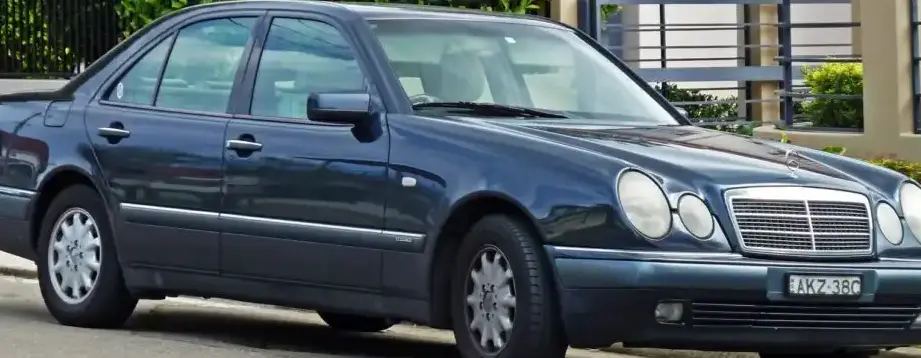
The Mercedes-Benz E 250 D, produced between June 1995 and July 1999, was a diesel-powered variant of the W210 E-Class, representing a significant offering in the mid-size luxury segment. Positioned as a fuel-efficient and durable option within the broader E-Class range, the E 250 D catered to buyers prioritizing practicality and long-term reliability over outright performance. It was a key model in European markets, where diesel engines held a strong preference, and saw limited import into the United States due to stricter emissions regulations. This variant utilized a naturally aspirated five-cylinder diesel engine paired with either a manual or automatic transmission, offering a balance between economy and usability.
Technical Specifications
| Brand | Mercedes-Benz |
| Model | E-Class |
| Generation | E-Class (W210) |
| Type (Engine) | E 250 D (113 Hp) |
| Start of production | June, 1995 |
| End of production | July, 1999 |
| Powertrain Architecture | Internal Combustion engine |
| Body type | Sedan |
| Seats | 5 |
| Doors | 4 |
| Fuel consumption (urban) | 9.2 l/100 km (25.6 US mpg) |
| Fuel consumption (extra urban) | 5.1 l/100 km (46.1 US mpg) |
| Fuel Type | Diesel |
| Acceleration 0 – 100 km/h | 15.3 sec |
| Acceleration 0 – 62 mph | 15.3 sec |
| Acceleration 0 – 60 mph | 14.5 sec |
| Maximum speed | 193 km/h (119.92 mph) |
| Weight-to-power ratio | 13.4 kg/Hp |
| Weight-to-torque ratio | 8.9 kg/Nm |
| Power | 113 Hp @ 5000 rpm |
| Torque | 170 Nm @ 2800-4600 rpm (125.39 lb.-ft.) |
| Engine layout | Front, Longitudinal |
| Engine Model/Code | OM 605 D 25 / 605.912 |
| Engine displacement | 2497 cm3 (152.38 cu. in.) |
| Number of cylinders | 5 |
| Engine configuration | Inline |
| Cylinder Bore | 87 mm (3.43 in.) |
| Piston Stroke | 84 mm (3.31 in.) |
| Compression ratio | 22:1 |
| Number of valves per cylinder | 4 |
| Fuel injection system | Multi-port manifold injection |
| Engine aspiration | Naturally aspirated |
| Valvetrain | DOHC |
| Engine oil capacity | 6.5 l (6.87 US qt | 5.72 UK qt) |
| Coolant capacity | 8.5 l (8.98 US qt | 7.48 UK qt) |
| Kerb Weight | 1510 kg (3328.98 lbs.) |
| Max. weight | 2010 kg (4431.29 lbs.) |
| Max load | 500 kg (1102.31 lbs.) |
| Fuel tank capacity | 65 l (17.17 US gal | 14.3 UK gal) |
| Length | 4795 mm (188.78 in.) |
| Width | 1799 mm (70.83 in.) |
| Height | 1436 mm (56.54 in.) |
| Wheelbase | 2833 mm (111.54 in.) |
| Front track | 1542 mm (60.71 in.) |
| Rear track | 1536 mm (60.47 in.) |
| Drivetrain Architecture | Rear wheel drive |
| Number of gears | 5 |
| Gearbox type | Automatic |
| Front suspension | Double wishbone |
| Rear suspension | Independent multi-link spring suspension with stabilizer |
| Front brakes | Ventilated discs |
| Rear brakes | Disc |
| Assisting systems | ABS (Anti-lock braking system) |
| Steering type | Steering rack and pinion |
| Power steering | Hydraulic |
| Tires size | 195/65 R15 |
| Wheel rims size | 6.5J x 15 |
Powertrain & Engine Architecture
The heart of the E 250 D is the OM 605 D 25 engine, a 2.5-liter inline five-cylinder diesel. This engine, a mainstay of Mercedes-Benz’s diesel offerings during the 1990s, is known for its robust construction and longevity. The ‘D 25’ designation indicates its displacement. The OM 605 featured a cast iron block and aluminum cylinder head, a common configuration for durability. Fuel is delivered via a multi-port manifold injection system, a relatively simple system compared to later common-rail diesels, but effective for its time. The engine utilizes a double overhead camshaft (DOHC) valvetrain, operating four valves per cylinder, contributing to improved breathing and efficiency. The 5-speed automatic transmission, typically the 722.3 unit, was designed to provide smooth shifts and enhance the car’s usability in everyday driving. This transmission was known for its reliability, but could sometimes feel sluggish compared to more modern automatics.
Driving Characteristics
The E 250 D with the automatic transmission offered a comfortable, albeit unhurried, driving experience. With 113 horsepower and 170 Nm (125 lb-ft) of torque, acceleration was modest, taking around 15.3 seconds to reach 60 mph. The automatic transmission’s gear ratios were optimized for fuel economy rather than performance. While the engine provided adequate power for cruising on highways and navigating city streets, overtaking maneuvers required careful planning. Compared to the more powerful E 320 or the sportier E 280, the E 250 D prioritized fuel efficiency and relaxed driving. The automatic transmission, while convenient, did diminish the engine’s responsiveness compared to the available manual gearbox.
Equipment & Trim Levels
The E 250 D typically came with a respectable level of standard equipment for a mid-size luxury car of its era. This included power windows, central locking, air conditioning, and an AM/FM radio. Interior upholstery was generally cloth, although leather was available as an option. Trim levels varied depending on the market, but common options included a sunroof, upgraded audio systems, and wood trim. Safety features such as ABS (Anti-lock Braking System) were standard. The E 250 D was often seen as a more affordable entry point into the E-Class range, offering a good balance of features and value.
Chassis & Braking
The W210 E-Class chassis featured a double wishbone front suspension and an independent multi-link rear suspension, providing a comfortable ride and good handling characteristics. The E 250 D, being a diesel variant, often had slightly heavier-duty suspension components to cope with the engine’s weight. Braking was handled by ventilated discs at the front and solid discs at the rear, equipped with ABS. The steering was a hydraulic power-assisted rack and pinion system, offering precise control. The tires were typically 195/65 R15, providing a good compromise between comfort and grip.
Market Reception & Comparison
The E 250 D was well-received in European markets as a practical and economical choice. Critics praised its fuel efficiency and durability, but noted its lack of outright performance. Compared to the gasoline-powered E 280 or E 320, the E 250 D offered significantly better fuel economy, but at the expense of acceleration and refinement. The E 250 D also competed with other diesel-powered sedans from BMW and Audi, often offering a similar blend of practicality and economy. Its limited availability in the US meant it wasn’t a significant player in the American market.
Legacy
The OM 605 engine, found in the E 250 D, is renowned for its longevity and reliability. Many examples have surpassed 200,000 miles with proper maintenance. The W210 E-Class, in general, has gained a reputation as a durable and well-built car. Today, the E 250 D represents an affordable entry point into Mercedes-Benz ownership. While not a performance icon, it remains a popular choice for those seeking a reliable and economical classic car. Parts availability is generally good, and the relatively simple mechanical design makes it a viable option for DIY mechanics. The E 250 D stands as a testament to Mercedes-Benz’s commitment to building durable and long-lasting vehicles.