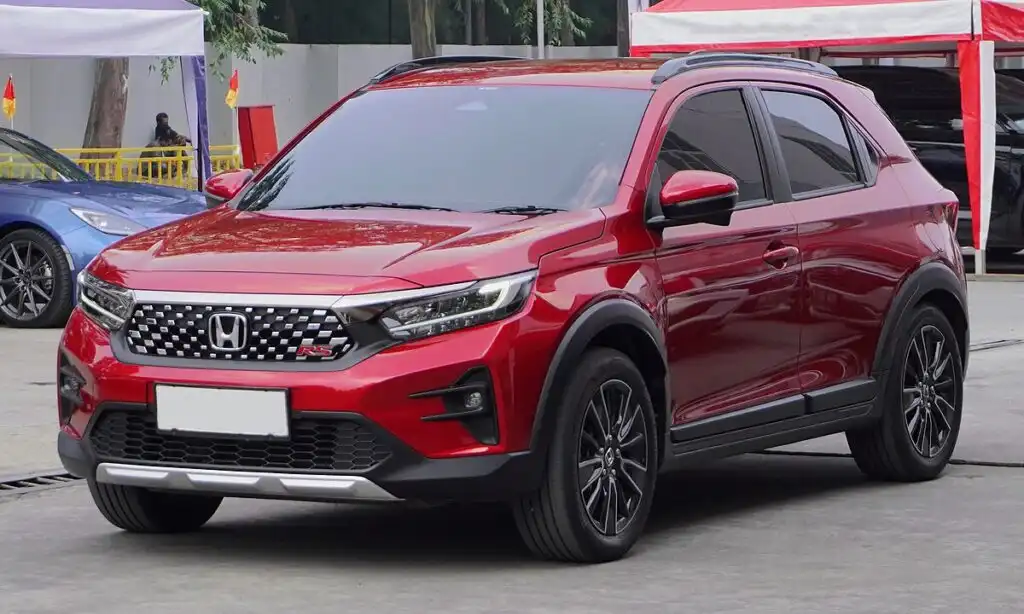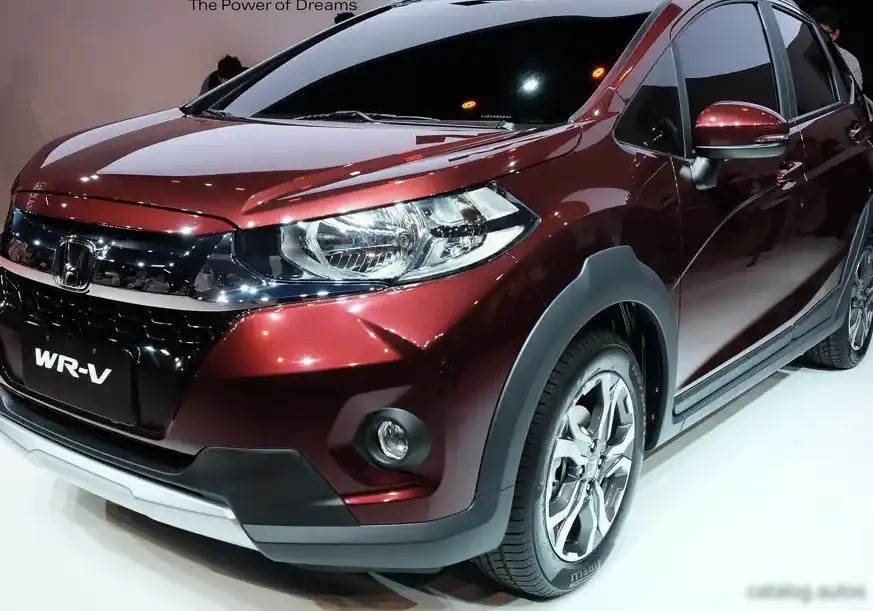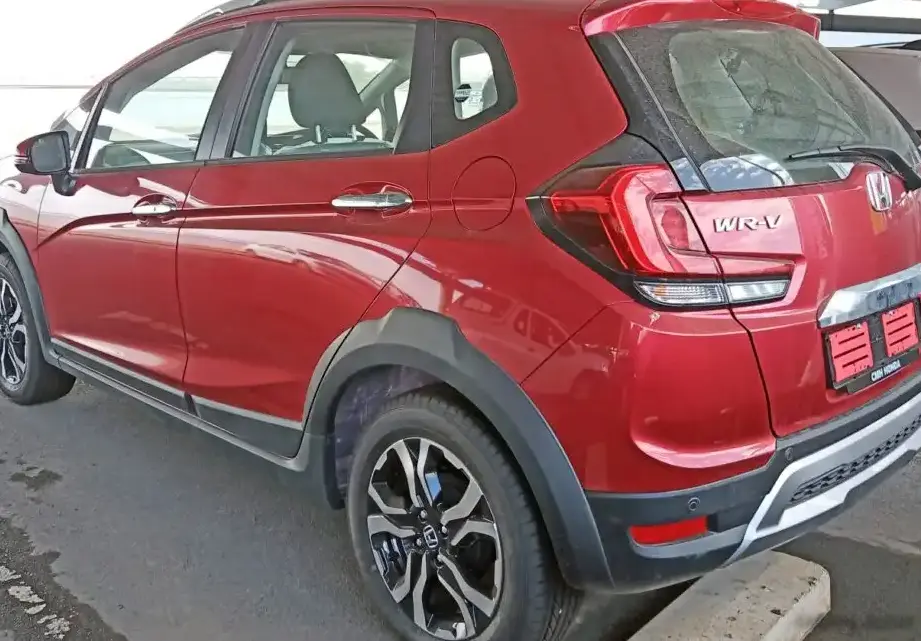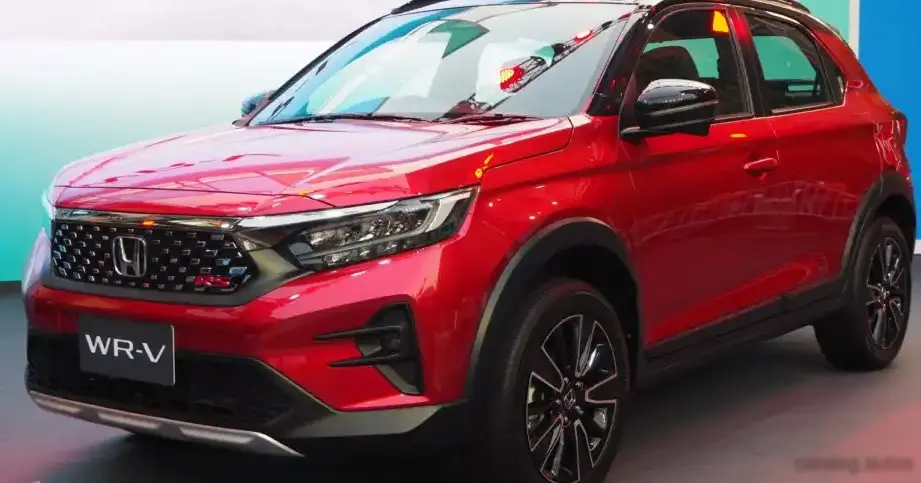
The Honda WR-V II (DG4) 1.5 i-VTEC with Continuously Variable Transmission (CVT) represents Honda’s entry into the subcompact SUV market, primarily targeted towards emerging economies like Brazil and India. Introduced in November 2022, this variant builds upon the foundation of the first-generation WR-V, offering a blend of practicality, fuel efficiency, and Honda’s reputation for reliability. The DG4 generation represents a significant redesign over its predecessor, sharing platform components with the Honda City and utilizing a more sophisticated engine and transmission pairing. This specific 1.5L i-VTEC CVT trim serves as the mainstream offering within the WR-V II lineup, positioned between more basic trims and potentially higher-spec versions with additional features.
Technical Specifications
| Brand | Honda |
| Model | WR-V |
| Generation | WR-V II (DG4) |
| Type (Engine) | 1.5 i-VTEC (121 Hp) CVT |
| Start of production | November, 2022 |
| Powertrain Architecture | Internal Combustion engine |
| Body type | SUV |
| Seats | 5 |
| Doors | 5 |
| Fuel Type | Petrol (Gasoline) |
| Emission standard | Euro 4 |
| Power | 121 Hp @ 6600 rpm |
| Power per litre | 80.8 Hp/l |
| Torque | 145 Nm @ 4300 rpm |
| Torque (lb-ft) | 106.95 lb.-ft. @ 4300 rpm |
| Engine layout | Front, Transverse |
| Engine Model/Code | 15ZF |
| Engine displacement | 1498 cm3 |
| Engine displacement (cu. in.) | 91.41 cu. in. |
| Number of cylinders | 4 |
| Engine configuration | Inline |
| Cylinder Bore | 73 mm |
| Cylinder Bore (in.) | 2.87 in. |
| Piston Stroke | 89.5 mm |
| Piston Stroke (in.) | 3.52 in. |
| Compression ratio | 10.6:1 |
| Number of valves per cylinder | 4 |
| Fuel injection system | Multi-port manifold injection |
| Engine aspiration | Naturally aspirated engine |
| Valvetrain | DOHC, i-VTEC |
| Engine systems | Start & Stop System |
| Length | 4060 mm |
| Length (in.) | 159.84 in. |
| Width | 1780 mm |
| Width (in.) | 70.08 in. |
| Height | 1608 mm |
| Height (in.) | 63.31 in. |
| Wheelbase | 2485 mm |
| Wheelbase (in.) | 97.83 in. |
| Front track | 1540 mm |
| Front track (in.) | 60.63 in. |
| Rear (Back) track | 1540 mm |
| Rear (Back) track (in.) | 60.63 in. |
| Drivetrain Architecture | The Internal combustion engine (ICE) drives the front wheels of the vehicle. |
| Drive wheel | Front wheel drive |
| Number of gears and type of gearbox | automatic transmission CVT |
| Front suspension | Independent type McPherson |
| Rear suspension | Torsion |
| Front brakes | Ventilated discs |
| Rear brakes | Drum |
| Assisting systems | ABS (Anti-lock braking system) |
| Steering type | Steering rack and pinion |
| Tires size | 215/60 R16; 215/55 R17 |
| Wheel rims size | 7J x 16; 7J x 17 |
Powertrain & Engine Architecture
The heart of the WR-V II 1.5 i-VTEC CVT is the 1.5-liter, four-cylinder, naturally aspirated gasoline engine, designated as the 15ZF. This engine utilizes Honda’s Intelligent Variable Valve Timing and Lift Electronic Control (i-VTEC) system, which optimizes valve timing and lift for improved performance and fuel efficiency across the engine’s operating range. The engine employs a multi-point fuel injection system, delivering fuel directly to the intake ports. The engine’s 10.6:1 compression ratio contributes to its efficiency. Paired with this engine is a Continuously Variable Transmission (CVT). Unlike traditional automatic transmissions with fixed gear ratios, a CVT provides a seamless and theoretically infinite number of gear ratios, optimizing engine speed for efficiency or power as needed. This CVT is tuned for smooth operation and fuel economy, prioritizing comfort over outright acceleration.
Driving Characteristics
The 121 horsepower and 145 Nm (107 lb-ft) of torque produced by the 1.5L i-VTEC engine, when coupled with the CVT, results in adequate, but not exhilarating, performance. Acceleration is linear and predictable, with the CVT effectively minimizing any noticeable shift shock. Compared to a manual transmission version (if offered in certain markets), the CVT prioritizes fuel efficiency and ease of driving over sporty responsiveness. The CVT’s programming tends to hold engine RPMs relatively low during cruising, contributing to quiet operation and good fuel economy. However, under hard acceleration, the CVT may cause the engine to “drone” as it maintains a high RPM to deliver power. The front-wheel-drive configuration provides predictable handling, but lacks the all-weather capability of an all-wheel-drive system.
Equipment & Trim Levels
The WR-V II 1.5 i-VTEC CVT typically comes standard with features such as air conditioning, power windows, power door locks, and a basic audio system with Bluetooth connectivity. Higher trim levels may add features like a touchscreen infotainment system with Apple CarPlay and Android Auto integration, a rearview camera, alloy wheels, and automatic climate control. Interior upholstery is generally cloth, with higher trims potentially offering leatherette or full leather options. Safety features typically include dual front airbags, ABS, and electronic stability control. The specific equipment levels can vary significantly depending on the target market and optional packages.
Chassis & Braking
The WR-V II utilizes a front independent McPherson strut suspension and a rear torsion beam suspension. This setup provides a comfortable ride quality, suitable for varied road conditions. The front brakes are ventilated discs, providing adequate stopping power, while the rear brakes are drums, a cost-saving measure common in this segment. The steering system is a rack and pinion setup, offering responsive and precise steering feel. Tire sizes typically range from 215/60 R16 to 215/55 R17, depending on the trim level.
Market Reception & Comparison
The WR-V II 1.5 i-VTEC CVT has been generally well-received in its target markets, praised for its practicality, fuel efficiency, and Honda’s reputation for reliability. Critics have noted that the engine and CVT combination, while adequate, isn’t particularly exciting. Compared to other subcompact SUVs in the same segment, such as the Hyundai Venue or Kia Sonet, the WR-V offers a competitive level of features and value. Fuel economy is a key selling point, with the CVT helping to maximize efficiency. Reliability is expected to be strong, based on Honda’s track record.
Legacy
The 15ZF engine and CVT pairing in the WR-V II is relatively new, so long-term reliability data is still emerging. However, Honda’s i-VTEC engines have a generally strong reputation for durability, and the CVT, while potentially requiring more diligent fluid maintenance than a traditional automatic, is designed for longevity. In the used car market, the WR-V II 1.5 i-VTEC CVT is expected to hold its value reasonably well, particularly if it has been well-maintained. Its combination of practicality, fuel efficiency, and Honda’s brand image should make it a desirable option for budget-conscious buyers seeking a reliable and efficient subcompact SUV.