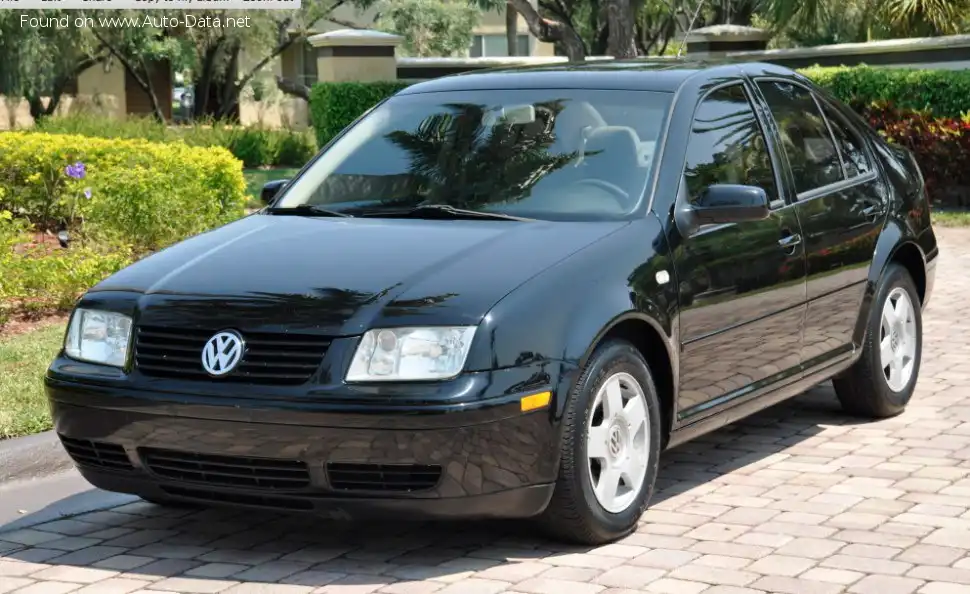
The Volkswagen Jetta IV 2.0 (115 hp) Automatic, produced between 1998 and 2005, represents a significant iteration of Volkswagen’s popular compact sedan. Part of the fourth generation Jetta (codenamed 1HX0/A3), this variant occupied a middle-ground position in the lineup, offering a balance between affordability, comfort, and reasonable performance. It was primarily marketed towards buyers seeking a practical and reliable family car with the convenience of an automatic transmission. The Jetta IV was a crucial model for Volkswagen in the North American market, solidifying its reputation for build quality and European engineering.
Technical Specifications
| Brand | Volkswagen |
| Model | Jetta |
| Generation | Jetta IV |
| Type (Engine) | 2.0 (115 Hp) Automatic |
| Start of production | 1998 |
| End of production | 2005 |
| Powertrain Architecture | Internal Combustion engine |
| Body type | Sedan |
| Seats | 5 |
| Doors | 4 |
| Fuel consumption (urban) | 13 l/100 km (18.1 US mpg, 21.7 UK mpg, 7.7 km/l) |
| Fuel consumption (extra urban) | 6.9 l/100 km (34.1 US mpg, 40.9 UK mpg, 14.5 km/l) |
| Fuel Type | Petrol (Gasoline) |
| Acceleration 0 – 100 km/h | 12.4 sec |
| Acceleration 0 – 62 mph | 12.4 sec |
| Acceleration 0 – 60 mph | 11.8 sec |
| Maximum speed | 192 km/h (119.3 mph) |
| Weight-to-power ratio | 10.8 kg/Hp, 93 Hp/tonne |
| Weight-to-torque ratio | 7.3 kg/Nm, 137.4 Nm/tonne |
| Power | 115 Hp @ 5200 rpm |
| Power per litre | 58 Hp/l |
| Torque | 170 Nm @ 2400 rpm (125.39 lb.-ft. @ 2400 rpm) |
| Engine layout | Front, Transverse |
| Engine Model/Code | AVH, BBW, BEV |
| Engine displacement | 1984 cm3 (121.07 cu. in.) |
| Number of cylinders | 4 |
| Engine configuration | Inline |
| Cylinder Bore | 82.5 mm (3.25 in.) |
| Piston Stroke | 92.8 mm (3.65 in.) |
| Compression ratio | 10:1 |
| Number of valves per cylinder | 2 |
| Fuel injection system | Multi-port manifold injection |
| Engine aspiration | Naturally aspirated engine |
| Valvetrain | OHC |
| Engine oil capacity | 4.2 l (4.44 US qt | 3.7 UK qt) |
| Coolant | 5 l (5.28 US qt | 4.4 UK qt) |
| Kerb Weight | 1237 kg (2727.12 lbs.) |
| Max. weight | 1770 kg (3902.18 lbs.) |
| Max load | 533 kg (1175.06 lbs.) |
| Trunk (boot) space – minimum | 455 l (16.07 cu. ft.) |
| Trunk (boot) space – maximum | 785 l (27.72 cu. ft.) |
| Fuel tank capacity | 55 l (14.53 US gal | 12.1 UK gal) |
| Length | 4376 mm (172.28 in.) |
| Width | 1735 mm (68.31 in.) |
| Height | 1446 mm (56.93 in.) |
| Wheelbase | 2513 mm (98.94 in.) |
| Front track | 1513 mm (59.57 in.) |
| Rear (Back) track | 1494 mm (58.82 in.) |
| Drivetrain Architecture | The Internal combustion engine (ICE) drives the front wheels of the vehicle. |
| Drive wheel | Front wheel drive |
| Number of gears and type of gearbox | 4 gears, automatic transmission |
| Front suspension | Coil spring |
| Rear suspension | Coil spring |
| Front brakes | Ventilated discs |
| Rear brakes | Disc |
| Assisting systems | ABS (Anti-lock braking system) |
| Steering type | Steering rack and pinion |
| Power steering | Hydraulic Steering |
| Tires size | 195/65 R15 |
| Wheel rims size | 6J x 15 |
INTRODUCTION
The Volkswagen Jetta IV 2.0 Automatic, produced from 1998 to 2005, was a mainstay of the Jetta lineup during a period of significant growth for Volkswagen in the United States. Built on the A4 (1HX0) platform shared with the Golf, Bora, and Audi A3, the Jetta IV represented a move towards more refined styling and improved interior quality compared to its predecessor. The 2.0-liter engine with an automatic transmission was positioned as a practical, comfortable, and accessible option, appealing to a broad range of buyers who prioritized ease of use over outright performance. It served as a stepping stone for customers who might later consider the more powerful VR6 or the fuel-efficient TDI models.
Powertrain & Engine Architecture
The heart of the Jetta IV 2.0 Automatic is the 1.8 to 2.0-liter inline-four cylinder engine, specifically the AVH, BBW, or BEV engine codes depending on the production year and market. These engines utilize a multi-port fuel injection system, delivering fuel directly into the intake ports. The engine features a single overhead camshaft (OHC) design operating two valves per cylinder. This configuration prioritized simplicity and reliability over more complex valvetrain setups. The 2.0-liter engine produced 115 horsepower at 5200 rpm and 170 Nm (125 lb-ft) of torque at 2400 rpm. Paired with a four-speed automatic transmission, the powertrain was designed for smooth and predictable operation. The automatic transmission itself was a conventional hydraulic control unit, offering a relatively simple and robust design. While not known for its sportiness, it provided comfortable shifting for everyday driving.
Driving Characteristics
The Jetta IV 2.0 Automatic offered a comfortable, if not particularly exhilarating, driving experience. Acceleration from 0-60 mph took around 11.8 seconds, and top speed was limited to 119.3 mph. The four-speed automatic transmission, while smooth, lacked the responsiveness of a manual gearbox. Gear ratios were optimized for fuel economy and cruising comfort rather than aggressive acceleration. Compared to the five-speed manual version of the 2.0-liter engine, the automatic resulted in a noticeable decrease in performance and fuel efficiency. The VR6 models offered significantly more power and a sportier driving experience, while the TDI diesel variants provided superior fuel economy. However, the 2.0 Automatic excelled in providing a relaxed and easy-to-drive experience, particularly in urban environments.
Equipment & Trim Levels
The Jetta IV 2.0 Automatic typically came standard with features such as air conditioning, power windows and locks, and an AM/FM radio with a cassette player. Higher trim levels, such as the GLX, added features like alloy wheels, a sunroof, upgraded upholstery, and a CD player. Interior upholstery was typically cloth, with leather options available on higher trims. The dashboard layout was functional and straightforward, with easy-to-read gauges and logically placed controls. Optional extras included a premium sound system, heated front seats, and side airbags.
Chassis & Braking
The Jetta IV utilized a MacPherson strut front suspension and a coil spring rear suspension. This setup provided a comfortable ride quality, although it wasn’t particularly sporty. Front brakes were ventilated discs, while rear brakes were solid discs. Anti-lock Braking System (ABS) was standard equipment, enhancing safety. The chassis was designed to provide a balance between ride comfort and handling stability. Stabilizer bars were included to reduce body roll during cornering. The suspension tuning was geared towards everyday driving conditions rather than aggressive performance.
Market Reception & Comparison
The Jetta IV 2.0 Automatic was generally well-received by automotive critics as a practical and reliable family sedan. However, it was often criticized for its relatively lackluster performance compared to its competitors and even to other Jetta variants. Fuel economy was considered average for its class. Compared to the VR6, the 2.0 Automatic offered significantly lower running costs but lacked the same level of driving enjoyment. The TDI models were praised for their exceptional fuel economy, but some buyers were hesitant due to concerns about diesel engine maintenance. The 2.0 Automatic found its niche among buyers who prioritized affordability, comfort, and ease of use.
Legacy
The Jetta IV 2.0 Automatic has proven to be a relatively reliable vehicle, with many examples still on the road today. The 2.0-liter engine and four-speed automatic transmission are known for their durability, although regular maintenance is essential. Common issues include oil leaks, cooling system problems, and wear and tear on suspension components. In the used car market, the Jetta IV 2.0 Automatic remains an affordable and practical option for buyers seeking a dependable compact sedan. Its simplicity and relatively low maintenance costs make it an attractive choice for those on a budget. While it may not offer the performance or features of more modern vehicles, the Jetta IV 2.0 Automatic continues to hold a place as a solid and reliable member of the Volkswagen family.