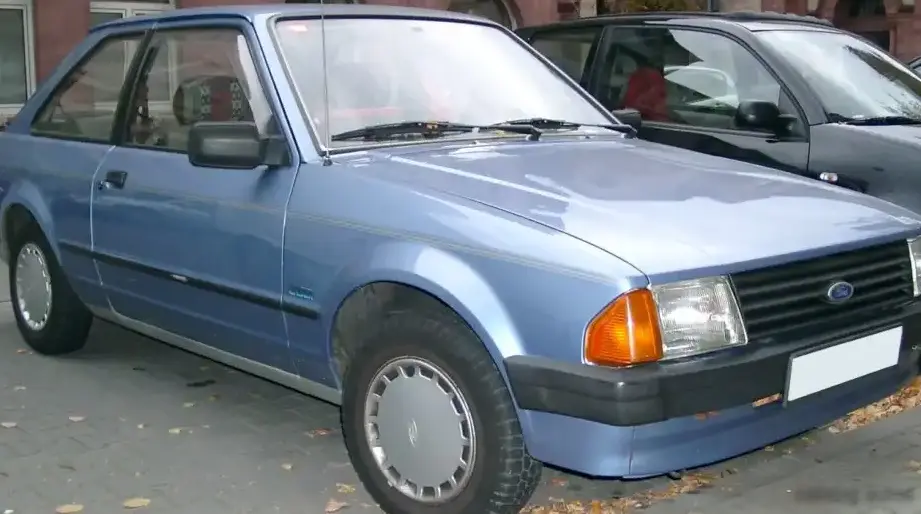
The Ford Escort III, produced between 1980 and 1986, represented a significant evolution of Ford of Europe’s popular compact car. Within the Escort III range (chassis codes GAA, AWA, ABFT, and AVA), the 1.1-liter variant, producing 58 horsepower, served as the entry-level model, particularly in the United Kingdom and other European markets. This version was designed to offer affordable transportation during a period of economic uncertainty and rising fuel costs. It played a crucial role in maintaining the Escort’s position as a best-selling vehicle in its segment, appealing to budget-conscious buyers and first-time car owners. Production of this specific engine configuration spanned from 1980 to 1983, before being superseded by later revisions within the Escort III lineup.
Technical Specifications
| Brand | Ford |
| Model | Escort |
| Generation | Escort III (GAA, AWA, ABFT, AVA) |
| Type (Engine) | 1.1 (58 Hp) |
| Start of Production | 1980 |
| End of Production | 1983 |
| Powertrain Architecture | Internal Combustion Engine |
| Body Type | Hatchback |
| Fuel Type | Petrol (Gasoline) |
| Power | 58 Hp |
| Engine Aspiration | Naturally Aspirated |
| Engine Displacement | 1.1 Liters |
| Cylinders | 4 |
| Valves per Cylinder | 2 |
| Transmission | 4-Speed Manual (primarily), 3-Speed Automatic (optional) |
| Drive Type | Front-Wheel Drive |
| Weight (approx.) | 1,740 – 1,870 lbs (depending on trim) |
Powertrain & Engine Architecture
The heart of the Escort III 1.1 was the Ford 1.1-liter inline-four cylinder engine, internally designated as the code ‘HS’. This engine was a relatively simple design, reflecting the need for affordability and ease of maintenance. It featured a cast iron block and an aluminum cylinder head, with a single overhead camshaft operating two valves per cylinder. Fuel delivery was managed by a single downdraft carburetor, typically a Ford 32/36 DGV unit. This carburetor, while reliable, wasn’t known for its precision, contributing to slightly compromised fuel economy and emissions compared to later fuel-injected engines. The engine’s modest 58 horsepower output was achieved at 6,000 rpm, with peak torque of around 62 lb-ft at 3,000 rpm. While a four-speed manual transmission was the most common pairing, a three-speed automatic transmission was offered as an optional extra, though it was less frequently chosen due to its impact on performance and fuel consumption. The automatic transmission, a Ford-sourced unit, was designed for smooth operation but added significant weight and reduced overall efficiency.
Driving Characteristics
The Escort III 1.1, particularly in its base specification, offered a utilitarian driving experience. Acceleration was modest, taking approximately 16-18 seconds to reach 60 mph. The 1.1-liter engine felt strained at higher speeds, and highway cruising required frequent downshifts. The four-speed manual transmission allowed drivers to extract the most from the engine, but the gear ratios were widely spaced. The optional automatic transmission further dulled performance, making the car feel sluggish in most situations. Handling was typical of front-wheel-drive cars of the era – safe and predictable, but not particularly engaging. The suspension, consisting of MacPherson struts at the front and a twist-beam rear axle, provided a comfortable ride on most road surfaces, but body roll was noticeable during cornering. The steering, while light, lacked feedback.
Equipment & Trim Levels
The Escort III 1.1 was typically offered in basic trim levels, focusing on essential features. Standard equipment included cloth upholstery, a basic instrument cluster with speedometer and fuel gauge, and manually operated windows and door locks. The interior was functional but spartan, with hard-wearing plastics used throughout. Optional extras included a radio, heated rear window, and upgraded upholstery. Higher trim levels, such as the ‘L’ and ‘GL’, added features like a more comprehensive instrument panel, improved interior trim, and additional exterior brightwork. However, the 1.1-liter engine was rarely paired with the top-of-the-line ‘GL’ trim, as buyers opting for more luxurious features generally chose the larger 1.3 or 1.6-liter engines.
Chassis & Braking
The Escort III utilized a monocoque chassis construction, providing a good balance of strength and weight. The front suspension featured MacPherson struts with anti-roll bar, while the rear suspension employed a twist-beam axle. Braking was typically accomplished with disc brakes at the front and drum brakes at the rear. The braking system was adequate for the car’s performance, but lacked the stopping power of more modern vehicles. The steering was a rack-and-pinion system, providing reasonably precise control. The 1.1-liter models generally featured smaller tires and narrower wheels compared to higher-spec Escorts, further contributing to the car’s modest handling characteristics.
Market Reception & Comparison
The Escort III 1.1 was generally well-received as an affordable and reliable mode of transportation. Critics acknowledged its practicality and low running costs, but often criticized its lack of performance and refinement. Compared to the 1.3-liter and 1.6-liter Escort variants, the 1.1 offered significantly less power and a less engaging driving experience. However, it was more fuel-efficient and cheaper to insure, making it an attractive option for budget-conscious buyers. The 1.1 also differed significantly from the diesel-powered Escorts, which prioritized fuel economy over performance. The 1.1’s main competitors included the Vauxhall Astra 1.0, Austin Metro, and Fiat Uno, all of which offered similar levels of affordability and practicality.
Legacy
The Ford Escort III 1.1, while not the most powerful or sophisticated version of the Escort, remains a fondly remembered car for many. Its simplicity and reliability have made it a popular choice among classic car enthusiasts and those seeking a low-cost, easy-to-maintain vehicle. The 1.1-liter HS engine, while not known for its longevity in high-performance applications, proved to be reasonably durable in its original specification. Today, well-maintained examples of the Escort III 1.1 are becoming increasingly collectible, particularly those in original condition. The car represents a significant chapter in Ford’s history, and a reminder of a time when affordability and practicality were paramount considerations in car design. Finding parts can be challenging, but a dedicated network of classic Ford parts suppliers continues to support owners of these vehicles.