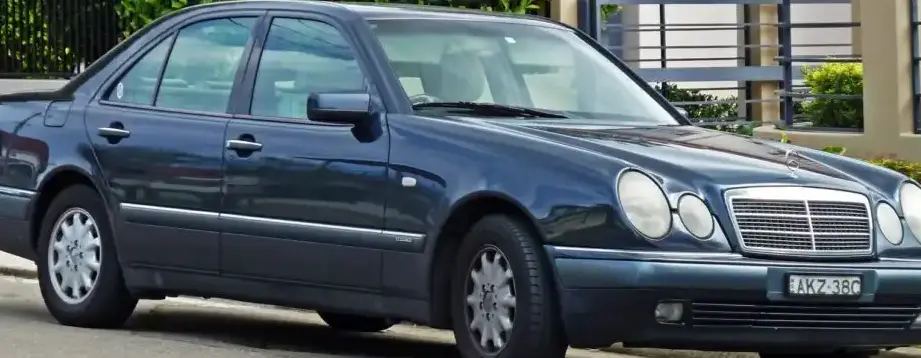
The Mercedes-Benz E 290 Turbodiesel, produced between January 1995 and June 1999, was a significant variant within the W210 E-Class range. Positioned as a premium, fuel-efficient option, it catered to drivers prioritizing long-distance comfort and economy over outright performance. This model represented a continuation of Mercedes-Benz’s long-standing reputation for robust diesel engines, and it played a key role in establishing the W210 as a technologically advanced and refined mid-size executive car. The E 290 Turbodiesel was primarily marketed in Europe, where diesel fuel was more readily available and economically advantageous, though limited numbers were imported to North America.
Technical Specifications
| Brand | Mercedes-Benz |
| Model | E-class |
| Generation | E-class (W210) |
| Type (Engine) | E 290 Turbodiesel (129 Hp) |
| Start of production | January, 1995 |
| End of production | June, 1999 |
| Powertrain Architecture | Internal Combustion engine |
| Body type | Sedan |
| Seats | 5 |
| Doors | 4 |
| Fuel consumption (urban) | 7.3 l/100 km (32.2 US mpg) |
| Fuel consumption (extra urban) | 4.8 l/100 km (49 US mpg) |
| Fuel Type | Diesel |
| Acceleration 0 – 100 km/h | 11.5 sec |
| Acceleration 0 – 62 mph | 11.5 sec |
| Acceleration 0 – 60 mph | 10.9 sec |
| Maximum speed | 195 km/h (121.17 mph) |
| Weight-to-power ratio | 11.9 kg/Hp |
| Weight-to-torque ratio | 5.1 kg/Nm |
| Power | 129 Hp @ 4000 rpm |
| Power per litre | 44.9 Hp/l |
| Torque | 300 Nm @ 1800 rpm (221.27 lb.-ft. @ 1800 rpm) |
| Engine layout | Front, Longitudinal |
| Engine Model/Code | OM 602 DE 29 LA / 602.982 |
| Engine displacement | 2874 cm3 (175.38 cu. in.) |
| Number of cylinders | 5 |
| Engine configuration | Inline |
| Cylinder Bore | 89 mm (3.5 in.) |
| Piston Stroke | 92.4 mm (3.64 in.) |
| Compression ratio | 22:1 |
| Number of valves per cylinder | 2 |
| Fuel injection system | Precombustion chamber injection |
| Engine aspiration | Turbocharger, Intercooler |
| Valvetrain | SOHC |
| Engine oil capacity | 7 l (7.4 US qt | 6.16 UK qt) |
| Coolant | 9.5 l (10.04 US qt | 8.36 UK qt) |
| Kerb Weight | 1540 kg (3395.12 lbs.) |
| Max. weight | 2040 kg (4497.43 lbs.) |
| Max load | 500 kg (1102.31 lbs.) |
| Trunk (boot) space – minimum | 520 l (18.36 cu. ft.) |
| Fuel tank capacity | 65 l (17.17 US gal | 14.3 UK gal) |
| Length | 4795 mm (188.78 in.) |
| Width | 1799 mm (70.83 in.) |
| Height | 1438 mm (56.61 in.) |
| Wheelbase | 2833 mm (111.54 in.) |
| Front track | 1542 mm (60.71 in.) |
| Rear (Back) track | 1536 mm (60.47 in.) |
| Drivetrain Architecture | The Internal combustion engine (ICE) drives the rear wheels of the vehicle. |
| Drive wheel | Rear wheel drive |
| Number of gears and type of gearbox | 5 gears, manual transmission |
| Front suspension | Double wishbone |
| Rear suspension | Independent multi-link spring suspension with stabilizer |
| Front brakes | Ventilated discs |
| Rear brakes | Disc |
| Assisting systems | ABS (Anti-lock braking system) |
| Steering type | Steering rack and pinion |
| Power steering | Hydraulic Steering |
| Tires size | 205/65 R15 |
| Wheel rims size | 7J x 15 |
Powertrain & Engine Architecture
The heart of the E 290 Turbodiesel was the OM 602 DE 29 LA engine, a 2.9-liter inline-five cylinder diesel. This engine utilized precombustion chamber injection, a system common in Mercedes-Benz diesels of the era. This system involved injecting fuel into a small precombustion chamber connected to the main cylinder, promoting more complete combustion and reducing engine noise. A turbocharger with an intercooler was employed to boost power output to 129 horsepower and 300 Nm (221 lb-ft) of torque. The engine featured a single overhead camshaft (SOHC) valvetrain and a robust cast iron block, contributing to its longevity. The five-speed manual transmission was standard, providing a balance between fuel efficiency and drivability. While an automatic transmission was available as an option, it was less common and often criticized for its sluggish shifts compared to the manual.
Driving Characteristics
The E 290 Turbodiesel offered a distinctly different driving experience compared to its gasoline-powered siblings. While not particularly quick – 0-60 mph took around 10.9 seconds – it delivered strong low-end torque, making it well-suited for relaxed cruising and effortless overtaking. The manual transmission allowed for precise control, while the automatic, when equipped, prioritized smooth operation over sporty responsiveness. The relatively high compression ratio (22:1) and turbocharging contributed to excellent fuel economy, a key selling point for this model. The suspension, tuned for comfort, provided a smooth ride, though it wasn’t as sporty as the setups found in the E 320 or higher-performance variants.
Equipment & Trim Levels
The E 290 Turbodiesel typically came equipped with a respectable level of standard features, including power windows, central locking, and air conditioning. Interior upholstery was generally cloth, though leather was available as an option. Dashboard configuration was consistent with other W210 models, featuring a straightforward layout with clearly marked gauges. Optional extras included a sunroof, upgraded audio system, and heated seats. The trim level was generally considered mid-range, offering a good balance of comfort and features without the luxury appointments of the higher-end models.
Chassis & Braking
The W210 E-Class chassis featured a double wishbone front suspension and an independent multi-link rear suspension, providing a comfortable and controlled ride. The E 290 Turbodiesel utilized ventilated disc brakes at the front and solid discs at the rear. Anti-lock braking system (ABS) was standard, enhancing safety. The steering was a rack and pinion system with hydraulic power assistance, offering precise and responsive handling. The tires were typically 205/65 R15, providing a good compromise between comfort and grip.
Market Reception & Comparison
The E 290 Turbodiesel was generally well-received by automotive critics, particularly for its fuel efficiency and refined driving experience. It was often praised for its quiet and smooth engine operation, especially considering it was a diesel. Compared to the E 220 diesel, the E 290 offered a significant power increase, while remaining more economical than the E 320 gasoline model. However, some critics noted the relatively slow acceleration and the less-than-inspiring performance of the optional automatic transmission. Its primary competition came from other European executive diesels, such as the BMW 525tds and the Audi A6 TDI.
Legacy
The OM 602 engine family, including the 2.9-liter version found in the E 290 Turbodiesel, is renowned for its durability and longevity. Properly maintained examples can accumulate very high mileage with minimal major issues. Today, the E 290 Turbodiesel is a relatively rare and sought-after classic car, particularly among diesel enthusiasts. Its combination of comfort, fuel efficiency, and robust engineering has ensured its continued appeal. While finding parts can sometimes be challenging, the availability of aftermarket support and the engine’s inherent reliability make it a viable and rewarding classic car ownership experience.