Technical Specifications
| Brand | Audi |
| Model | A5 |
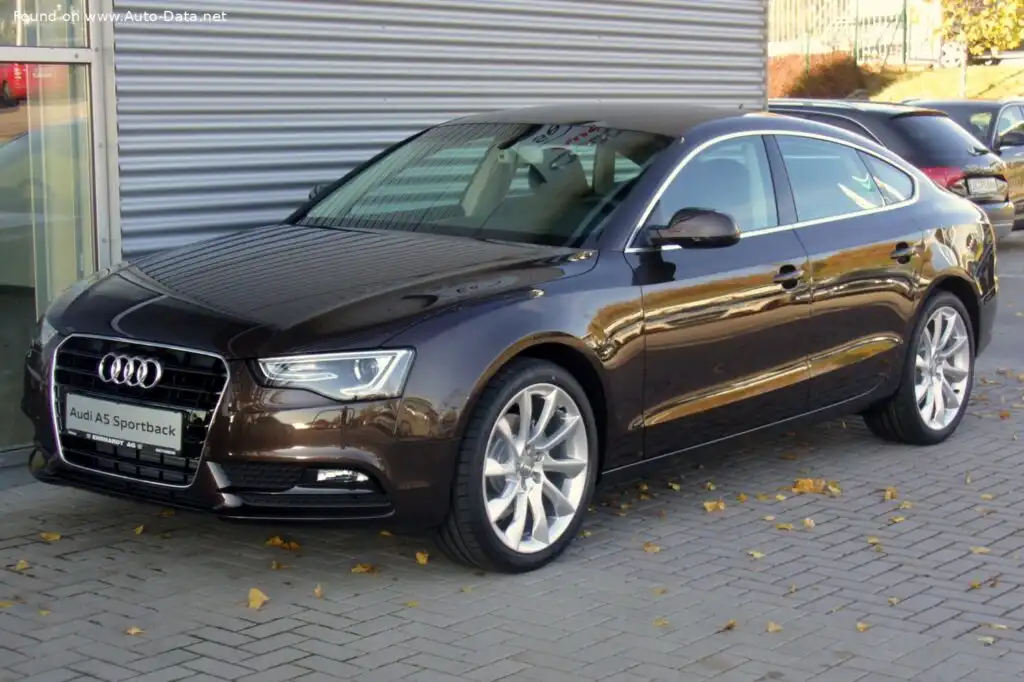
| Generation | A5 Sportback (8TA, facelift 2011) |
| Type (Engine) | 2.0 TDI ultra (136 Hp) Multitronic |
| Start of production | 2015 |
| End of production | 2016 |
| Powertrain Architecture | Internal Combustion engine |
| Body type | Fastback |
| Seats | 5 |
| Doors | 5 |
| Fuel consumption (urban) | 5.3-5.7 l/100 km (44.4 – 41.3 US mpg, 53.3 – 49.6 UK mpg, 18.9 – 17.5 km/l) |
| Fuel consumption (extra urban) | 4.1-4.6 l/100 km (57.4 – 51.1 US mpg, 68.9 – 61.4 UK mpg, 24.4 – 21.7 km/l) |
| Fuel consumption (combined) | 4.6-5.0 l/100 km (51.1 – 47 US mpg, 61.4 – 56.5 UK mpg, 21.7 – 20 km/l) |
| CO2 emissions | 119-131 g/km |
| Fuel Type | Diesel |
| Acceleration 0 – 100 km/h | 9.4 sec |
| Acceleration 0 – 62 mph | 9.4 sec |
| Acceleration 0 – 60 mph | 8.9 sec |
| Maximum speed | 205 km/h (127.38 mph) |
| Emission standard | Euro 6 |
| Weight-to-power ratio | 11.8 kg/Hp, 84.7 Hp/tonne |
| Weight-to-torque ratio | 5 kg/Nm, 199.4 Nm/tonne |
| Power | 136 Hp @ 3000-4400 rpm |
| Power per litre | 69.1 Hp/l |
| Torque | 320 Nm @ 1500-3000 rpm (236.02 lb.-ft. @ 1500-3000 rpm) |
| Engine layout | Front, Longitudinal |
| Engine Model/Code | CJCB |
| Engine displacement | 1968 cm3 (120.09 cu. in.) |
| Number of cylinders | 4 |
| Engine configuration | Inline |
| Cylinder Bore | 81 mm (3.19 in.) |
| Piston Stroke | 95.5 mm (3.76 in.) |
| Compression ratio | 19.5:1 |
| Number of valves per cylinder | 4 |
| Fuel injection system | Diesel Commonrail |
| Engine aspiration | Turbocharger, Intercooler |
| Valvetrain | DOHC |
| Engine oil capacity | 5 l (5.28 US qt | 4.4 UK qt) |
| Kerb Weight | 1605 kg (3538.42 lbs.) |
| Max. weight | 2155 kg (4750.96 lbs.) |
| Max load | 550 kg (1212.54 lbs.) |
| Trunk (boot) space – minimum | 480 l (16.95 cu. ft.) |
| Trunk (boot) space – maximum | 980 l (34.61 cu. ft.) |
| Fuel tank capacity | 63 l (16.64 US gal | 13.86 UK gal) |
| AdBlue tank | 20.5 l (5.42 US gal | 4.51 UK gal) |
| Max. roof load | 90 kg (198.42 lbs.) |
| Permitted trailer load with brakes (8%) | 1900 kg (4188.78 lbs.) |
| Permitted trailer load with brakes (12%) | 1700 kg (3747.86 lbs.) |
| Permitted trailer load without brakes | 750 kg (1653.47 lbs.) |
| Permitted towbar download | 80 kg (176.37 lbs.) |
| Length | 4712 mm (185.51 in.) |
| Width | 1854 mm (72.99 in.) |
| Width including mirrors | 2020 mm (79.53 in.) |
| Height | 1391 mm (54.76 in.) |
| Wheelbase | 2810 mm (110.63 in.) |
| Front track | 1590 mm (62.6 in.) |
| Rear (Back) track | 1575 mm (62.01 in.) |
| Front overhang | 861 mm (33.9 in.) |
| Rear overhang | 1041 mm (40.98 in.) |
| Minimum turning circle (turning diameter) | 11.5 m (37.73 ft.) |
| Drivetrain Architecture | The Internal combustion engine (ICE) drives the front wheels of the vehicle. |
| Drive wheel | Front wheel drive |
| Number of gears and type of gearbox | automatic transmission Multitronic |
| Front suspension | Independent multi-link suspension |
| Rear suspension | Independent on trapezoidal lever |
| Front brakes | Ventilated discs |
| Rear brakes | Disc |
| Assisting systems | ABS (Anti-lock braking system) |
| Steering type | Steering rack and pinion |
| Power steering | Electric Steering |
| Tires size | 225/50 R17 |
| Wheel rims size | 7.5J x 17 |
The Audi A5 Sportback (8TA, facelift 2011) 2.0 TDI ultra (136 Hp) Multitronic, produced from 2015 to 2016, represents a specific configuration within the broader A5 Sportback range. Positioned as a fuel-efficient option, this variant combined a 2.0-liter turbocharged diesel engine with Audi’s continuously variable Multitronic transmission. It aimed to deliver a balance of practicality, reasonable performance, and low running costs within the premium compact executive car segment. The A5 Sportback itself, introduced as a five-door coupe, offered a more versatile alternative to the A5 Coupe and Cabriolet, appealing to buyers seeking style with added space and usability. This particular 2.0 TDI ultra trim was a key player in Audi’s strategy to offer a wider range of powertrain options, catering to diverse customer needs and increasingly stringent emissions regulations.
Powertrain & Engine Architecture
The heart of this A5 Sportback variant is the CJCB engine, a 2.0-liter inline-four cylinder diesel. This engine is part of the Volkswagen Group’s modular engine family and features common-rail direct injection, a turbocharger with an intercooler, and a double overhead camshaft (DOHC) valvetrain with four valves per cylinder. The 19.5:1 compression ratio is typical for a diesel engine, contributing to its efficiency. The Multitronic transmission is a continuously variable transmission (CVT) that offers smooth, stepless gear changes. Unlike traditional automatic transmissions with fixed gear ratios, the Multitronic uses a chain-driven system to provide an infinite number of ratios within its operating range. This allows the engine to operate at its most efficient point more often, further enhancing fuel economy. The engine’s electronic control unit (ECU) manages fuel injection, turbocharger boost, and other parameters to optimize performance and emissions.
Driving Characteristics
The 136 hp and 320 Nm (236 lb-ft) of torque delivered by the 2.0 TDI ultra engine provide adequate, but not exhilarating, performance. Acceleration from 0-60 mph takes around 8.9 seconds, and top speed is limited to 127.38 mph. The Multitronic transmission contributes to a smooth driving experience, particularly during everyday commuting. However, it can sometimes feel less responsive than a traditional automatic or manual gearbox, especially when requiring quick bursts of acceleration. The gear ratios are optimized for fuel efficiency, meaning the engine doesn’t rev as high as it would in a more performance-oriented A5 variant. Compared to the more powerful 2.0 TDI models (177 hp or higher) or the petrol-powered versions, this variant prioritizes economy over outright speed. The front-wheel-drive configuration provides good traction in most conditions, but can exhibit some torque steer under hard acceleration.
Equipment & Trim Levels
The 2.0 TDI ultra Multitronic typically came equipped with a respectable level of standard features. These included Audi’s MMI infotainment system with a color display, automatic climate control, alloy wheels (usually 17-inch), and a leather-wrapped steering wheel. Safety features such as ABS, electronic stability control, and multiple airbags were also standard. Optional extras included features like navigation, upgraded sound systems, parking sensors, and leather upholstery. The ‘ultra’ designation often indicated a focus on efficiency, and as such, some weight-saving measures might have been implemented, potentially affecting interior trim materials. Trim levels varied by market, but generally, this variant sat in the mid-range of the A5 Sportback lineup, offering a good balance of features and affordability.
Chassis & Braking
The A5 Sportback features an independent suspension system on both the front and rear axles. The front suspension utilizes a multi-link setup, while the rear employs a trapezoidal link design. This configuration provides a comfortable ride and good handling characteristics. The 2.0 TDI ultra variant typically came with ventilated front disc brakes and solid rear discs. ABS (Anti-lock Braking System) was standard, enhancing braking performance and stability. The electric power steering provides a precise and responsive feel. Stabilizer bars are fitted to both axles to reduce body roll during cornering. The suspension tuning is geared towards comfort and everyday usability, rather than outright sportiness.
Market Reception & Comparison
The Audi A5 Sportback 2.0 TDI ultra Multitronic was generally well-received by automotive critics for its fuel efficiency and comfortable driving experience. However, some reviewers noted the lack of outright performance compared to higher-powered A5 variants. Its fuel economy figures of 4.6-5.0 l/100 km (51.1 – 47 US mpg) were a significant selling point, particularly in Europe where diesel fuel was more prevalent and fuel costs were higher. Compared to the 1.8 TFSI petrol version, the 2.0 TDI ultra offered superior fuel economy but less overall power. Against competitors like the BMW 3 Series Gran Turismo and the Mercedes-Benz CLA, the A5 Sportback offered a stylish and practical alternative with a strong emphasis on refinement and technology.
Legacy
The CJCB engine, while generally reliable, is known to require regular maintenance, particularly regarding the diesel particulate filter (DPF) and the turbocharger. The Multitronic transmission, while smooth, can be more expensive to repair than traditional automatic transmissions. In the used car market, the A5 Sportback 2.0 TDI ultra Multitronic represents a good value proposition for buyers seeking a stylish, practical, and fuel-efficient vehicle. However, potential buyers should be aware of the potential maintenance costs associated with the DPF and the Multitronic transmission. Overall, this variant remains a popular choice for those prioritizing economy and comfort in a premium compact executive car.