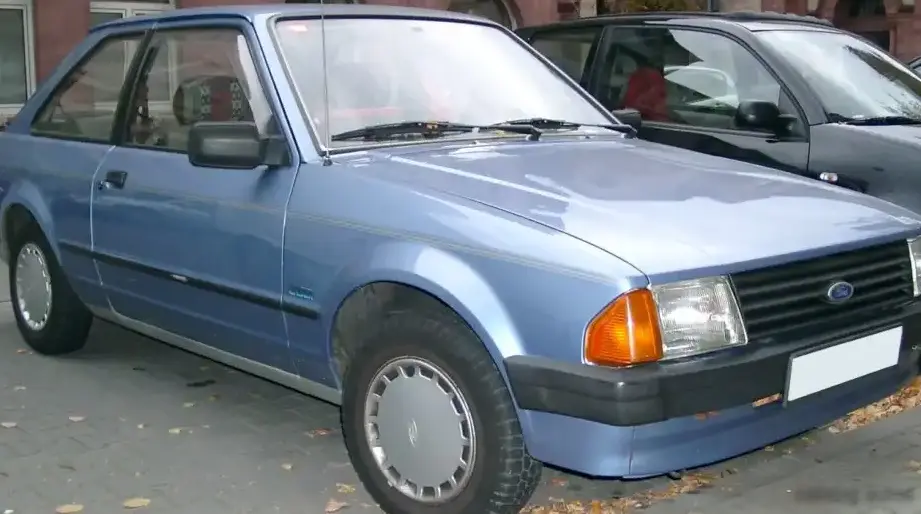
The Ford Escort III, produced between 1980 and 1986, represented a significant evolution of Ford of Europe’s popular compact car. Within the Escort III range, the 1.6 D (54 hp) variant, available from 1984 to 1985, occupied a specific niche as the entry-level diesel offering. This model, identified by chassis codes GAA, AWA, ABFT, and AVA, was designed to provide economical transportation for buyers prioritizing fuel efficiency over outright performance. It played a crucial role in maintaining the Escort’s broad market appeal during a period of increasing fuel costs and growing demand for diesel engines in Europe.
Technical Specifications
| Brand | Ford |
| Model | Escort |
| Generation | Escort III (GAA, AWA, ABFT, AVA) |
| Type (Engine) | 1.6 D (54 hp) |
| Start of Production | 1984 |
| End of Production | 1985 |
| Powertrain Architecture | Internal Combustion Engine |
| Body Type | Hatchback |
| Fuel Type | Diesel |
| Power | 54 hp |
| Engine Aspiration | Naturally Aspirated |
Powertrain & Engine Architecture
The 1.6-liter diesel engine powering the Escort III was a naturally aspirated, indirect injection unit. While Ford had previously utilized diesel engines in larger vehicles, this marked a key step in offering diesel power in its mainstream compact model. The engine, based on Ford’s existing diesel design, featured a robust cast iron block and cylinder head. Indirect injection, common for diesels of this era, involved injecting fuel into a pre-chamber where it partially combusted before entering the main combustion chamber. This design helped reduce engine noise and improve cold-starting performance, though at the expense of some efficiency compared to direct injection systems. The engine’s 54 horsepower output was achieved at a relatively low engine speed, prioritizing torque over peak power. The engine code for this variant is often found as 16D. The transmission paired with this engine was typically a four-speed manual gearbox, although a three-speed automatic transmission was also available, albeit less common. The automatic transmission was a Ford-sourced unit, designed for smooth operation but contributing to slightly reduced fuel economy compared to the manual.
Driving Characteristics
The Escort III 1.6 D was not designed for spirited driving. Its 54 horsepower and relatively low torque output (approximately 85 lb-ft) resulted in modest acceleration. Real-world performance was characterized by a focus on economy rather than speed. The four-speed manual transmission allowed drivers to keep the engine in its optimal power band, but even then, overtaking maneuvers required careful planning. The automatic transmission, while offering convenience, further diminished acceleration. Gear ratios were optimized for fuel efficiency, with taller gearing in top gear to reduce engine RPM at cruising speeds. The engine was relatively noisy, typical of indirect injection diesels of the period, and vibration was noticeable, particularly at idle. However, the engine proved to be durable and capable of covering high mileages with proper maintenance. The suspension, while basic, provided a reasonably comfortable ride, absorbing bumps and imperfections in the road surface adequately for everyday use.
Equipment & Trim Levels
The 1.6 D variant of the Escort III typically represented the base trim level. Standard equipment was relatively sparse, reflecting its position as an affordable transportation option. Interior upholstery was typically cloth, often in durable but plain patterns. The dashboard featured basic instrumentation, including a speedometer, fuel gauge, and temperature gauge. A heater was standard, but air conditioning was rarely fitted to this trim level. Optional extras included a radio, upgraded interior trim, and occasionally, a sunroof. The exterior trim was also minimal, with black plastic bumpers and steel wheels being common features. Higher trim levels of the Escort III, such as the Ghia or XR3, offered more luxurious interiors, alloy wheels, and additional features, but these were significantly more expensive than the 1.6 D.
Chassis & Braking
The Escort III utilized a relatively simple chassis design. Front suspension consisted of MacPherson struts, while the rear suspension employed a live axle with leaf springs. This setup provided a good balance between ride comfort and handling, although it wasn’t particularly sophisticated. Braking systems varied depending on the specific market and year of production. Early models often featured drum brakes on all four wheels, while later models typically had disc brakes on the front and drum brakes on the rear. The braking system was adequate for the vehicle’s performance capabilities, but lacked the stopping power of more modern systems. Stabilizer bars were not typically fitted to the base 1.6 D model, further contributing to a less sporty handling characteristic. The steering was a recirculating ball system, providing a relatively heavy but direct feel.
Market Reception & Comparison
The Escort III 1.6 D was generally well-received as an economical and reliable vehicle. Critics acknowledged its modest performance but praised its fuel efficiency, which was a significant selling point during the early 1980s. Compared to the petrol-powered Escort III models, the 1.6 D offered substantially better fuel economy, making it an attractive option for drivers covering long distances. However, it was significantly slower and less refined. Compared to other diesel-powered cars in the same class, such as the Volkswagen Golf Diesel, the Escort 1.6 D offered a competitive price point but lacked some of the Golf’s perceived build quality and sophistication. The automatic transmission version, while convenient, was often criticized for its sluggish performance and reduced fuel economy. The 1.6 D appealed to a different demographic than the sportier XR3 or more luxurious Ghia models, targeting buyers who prioritized practicality and affordability.
Legacy
The Ford Escort III 1.6 D, while not a performance icon, played a vital role in establishing the Escort as a popular and versatile family car. The powertrain proved to be remarkably durable, and many examples remain on the road today, testament to its robust construction. In the used car market, these Escorts are often sought after by enthusiasts looking for a simple, reliable, and affordable classic car. Maintenance is generally straightforward, and parts availability remains reasonably good. However, potential buyers should be aware of common diesel engine issues, such as injector wear and potential for head gasket failure. The 1.6 D variant represents a significant chapter in the Escort’s history, demonstrating Ford’s commitment to providing economical transportation options to a wide range of buyers.