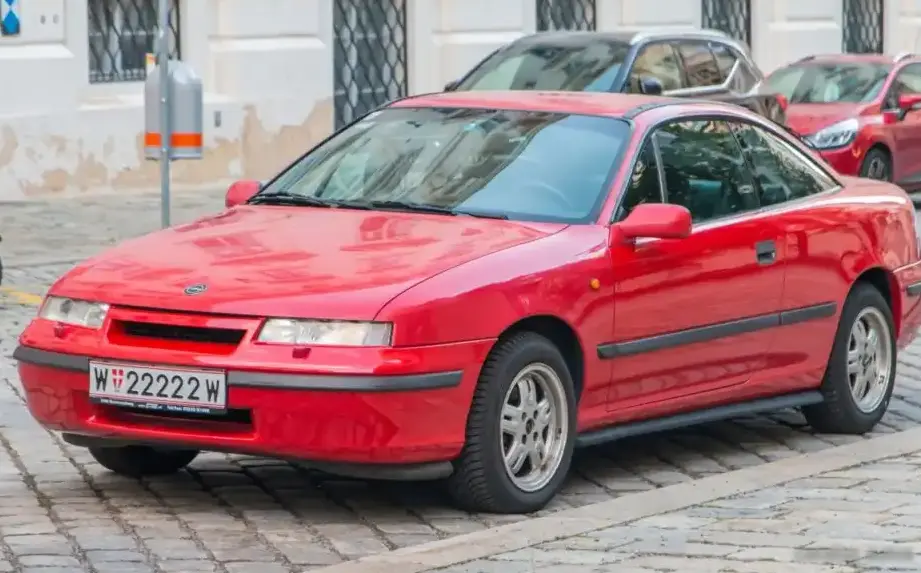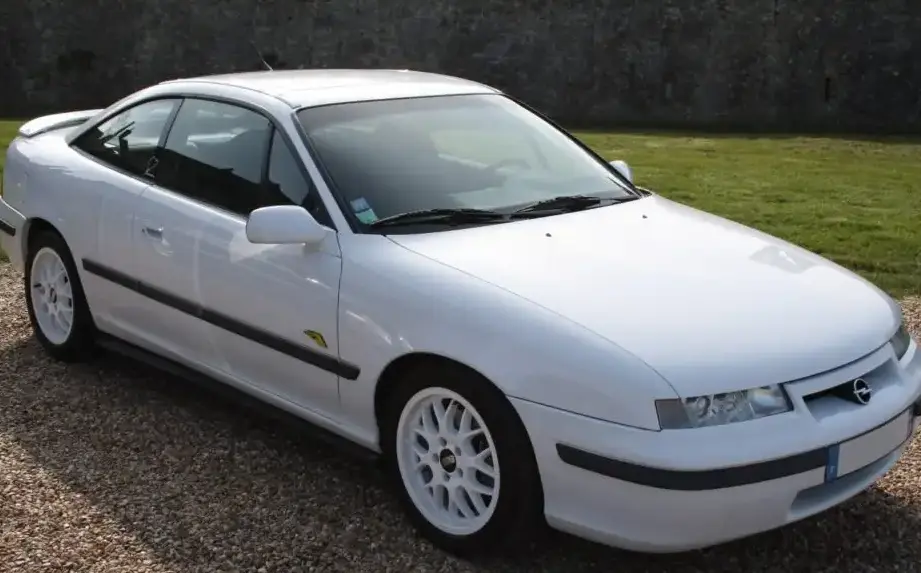
The Opel Calibra, particularly the facelifted version introduced in 1994, represented a significant effort by Opel to create a stylish and technologically advanced coupe. Produced from 1994 to 1997, the 2.0 16V ECOTEC variant, generating 136 horsepower, occupied a key position in the Calibra lineup, offering a balance between performance and affordability. It was positioned as a step up from the base 1.6L models, while remaining more accessible than the range-topping turbocharged versions. The Calibra itself was built on the GM410 platform, shared with the Vectra A, and aimed to appeal to buyers seeking a sporty, modern coupe with a focus on aerodynamic efficiency.
Technical Specifications
| Brand | Opel |
| Model | Calibra |
| Generation | Calibra (facelift 1994) |
| Type (Engine) | 2.0 16V ECOTEC (136 Hp) |
| Start of production | 1994 |
| End of production | 1997 |
| Powertrain Architecture | Internal Combustion engine |
| Body type | Coupe |
| Seats | 4 |
| Doors | 3 |
| Fuel consumption (urban) | 10.5 l/100 km (22.4 US mpg) |
| Fuel consumption (extra urban) | 5.9 l/100 km (39.9 US mpg) |
| Fuel consumption (combined) | 7.8 l/100 km (30.2 US mpg) |
| Fuel Type | Petrol (Gasoline) |
| Acceleration 0 – 100 km/h | 9.5 sec |
| Acceleration 0 – 62 mph | 9.5 sec |
| Acceleration 0 – 60 mph | 9 sec |
| Maximum speed | 215 km/h (133.59 mph) |
| Weight-to-power ratio | 9.2 kg/Hp |
| Weight-to-torque ratio | 6.8 kg/Nm |
| Power | 136 Hp @ 5600 rpm |
| Torque | 185 Nm @ 4000 rpm (136.45 lb.-ft. @ 4000 rpm) |
| Engine layout | Front, Transverse |
| Engine Model/Code | X20XEV |
| Engine displacement | 1998 cm3 (121.93 cu. in.) |
| Number of cylinders | 4 |
| Engine configuration | Inline |
| Cylinder Bore | 86 mm (3.39 in.) |
| Piston Stroke | 86 mm (3.39 in.) |
| Compression ratio | 10.8:1 |
| Number of valves per cylinder | 4 |
| Fuel injection system | Multi-port manifold injection |
| Engine aspiration | Naturally aspirated engine |
| Valvetrain | DOHC |
| Engine oil capacity | 4 l (4.23 US qt | 3.52 UK qt) |
| Coolant capacity | 7.2 l (7.61 US qt | 6.34 UK qt) |
| Kerb Weight | 1250 kg (2755.78 lbs.) |
| Max. weight | 1670 kg (3681.72 lbs.) |
| Max load | 420 kg (925.94 lbs.) |
| Trunk (boot) space – minimum | 300 l (10.59 cu. ft.) |
| Trunk (boot) space – maximum | 980 l (34.61 cu. ft.) |
| Fuel tank capacity | 63 l (16.64 US gal | 13.86 UK gal) |
| Length | 4492 mm (176.85 in.) |
| Width | 1688 mm (66.46 in.) |
| Height | 1320 mm (51.97 in.) |
| Wheelbase | 2600 mm (102.36 in.) |
| Front track | 1426 mm (56.14 in.) |
| Rear track | 1446 mm (56.93 in.) |
| Drag coefficient (Cd) | 0.26 |
| Minimum turning circle | 11.45 m (37.57 ft.) |
| Drivetrain Architecture | Front wheel drive |
| Number of gears | 5 |
| Gearbox type | Manual transmission |
| Front suspension | Independent type McPherson, Transverse stabilizer |
| Rear suspension | Trailing arm, Transverse stabilizer |
| Front brakes | Ventilated discs |
| Rear brakes | Disc |
| Assisting systems | ABS (Anti-lock braking system) |
| Steering type | Steering rack and pinion |
| Power steering | Hydraulic |
| Tires size | 205/55 R15 |
| Wheel rims size | 6J x 15 |
Powertrain & Engine Architecture
The heart of the Calibra 2.0 16V ECOTEC is the X20XEV engine, a 1998cc inline-four cylinder powerplant. This engine is a member of Opel’s Ecotec family, known for its focus on efficiency and refinement. The X20XEV features multi-port fuel injection, a double overhead camshaft (DOHC) valvetrain with four valves per cylinder, and a compression ratio of 10.8:1. These features contribute to a relatively high specific output of 68.1 horsepower per liter. The engine’s design prioritized smooth operation and reduced internal friction. The five-speed manual transmission was the standard offering, providing a direct connection between the engine and the front wheels. The transmission’s gear ratios were tuned for a balance of acceleration and fuel economy, though some reviewers noted that the shift action could feel slightly notchy.
Driving Characteristics
The 136 horsepower and 185 Nm (136 lb-ft) of torque delivered by the X20XEV engine provided the Calibra with respectable, though not blistering, performance. Acceleration from 0 to 60 mph took around 9 seconds, and the top speed was approximately 133.59 mph. Compared to the more powerful turbocharged Calibras, the 2.0 16V felt less urgent, but it offered a more accessible and predictable driving experience. The manual transmission allowed for good driver control, and the chassis, while not exceptionally sporty, provided a stable and comfortable ride. The front-wheel-drive configuration meant that traction could be a limitation under hard acceleration, particularly on slippery surfaces. The steering was reasonably precise, but lacked significant feedback.
Equipment & Trim Levels
The Calibra 2.0 16V typically came with a fairly comprehensive list of standard features for its time. These included power steering, ABS anti-lock brakes, central locking, and electric front windows. Interior appointments generally consisted of cloth upholstery, although leather options were available. The dashboard layout was functional and driver-focused, with clear instrumentation. Optional extras included a sunroof, upgraded audio systems, and alloy wheels. The Calibra aimed for a relatively upscale feel, with attention paid to interior materials and build quality.
Chassis & Braking
The Calibra’s chassis utilized an independent McPherson strut suspension at the front and a trailing arm setup at the rear. This configuration provided a good balance of ride comfort and handling. A transverse stabilizer bar was fitted to both the front and rear axles to reduce body roll during cornering. The braking system consisted of ventilated discs at the front and solid discs at the rear. The ABS system helped to maintain steering control during emergency braking situations. The suspension tuning was geared towards providing a comfortable ride for everyday driving, rather than outright track performance.
Market Reception & Comparison
The Calibra 2.0 16V was generally well-received by automotive critics. It was praised for its stylish design, comfortable interior, and relatively affordable price. However, some reviewers noted that the performance was not as exciting as some of its rivals, such as the Ford Escort Cosworth or the Volkswagen Corrado VR6. In terms of fuel economy, the 2.0 16V offered a reasonable compromise, achieving around 30.2 US mpg on the combined cycle. Compared to the lower-powered 1.6L Calibras, the 2.0 16V provided a noticeable improvement in performance, but at a slightly higher cost. The turbocharged Calibras offered significantly more power, but also came with higher running costs and a greater risk of mechanical issues.
Legacy
The Opel Calibra, and specifically the 2.0 16V ECOTEC variant, has developed a cult following among car enthusiasts. The X20XEV engine is known for its reliability and durability, provided it is properly maintained. Today, well-maintained Calibras are becoming increasingly sought after by collectors and enthusiasts. While not as iconic as some other coupes of the 1990s, the Calibra remains a distinctive and appealing vehicle, representing a high point in Opel’s design and engineering capabilities. The availability of spare parts is generally good, although some specific trim pieces can be difficult to find. The Calibra’s blend of style, comfort, and affordability continues to resonate with those seeking a classic coupe from the 1990s.