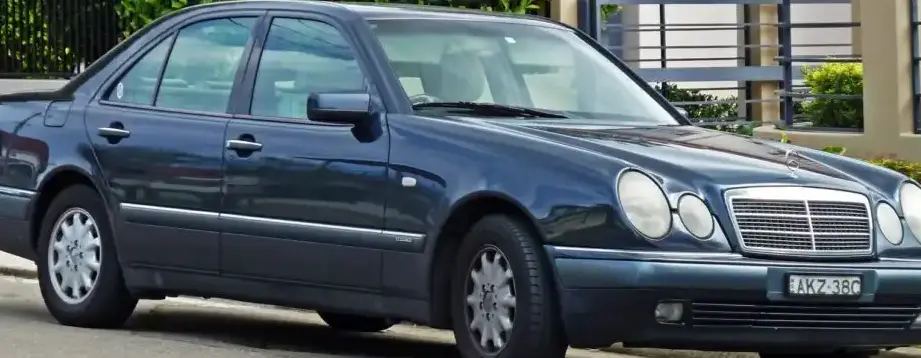
The Mercedes-Benz E 300 D Automatic, produced between August 1994 and March 1997, represents a significant iteration within the W210 E-Class generation. Positioned as a mid-range offering, this variant combined the robust 3.0-liter inline-six diesel engine with a four-speed automatic transmission, appealing to buyers seeking a blend of fuel efficiency, comfortable cruising, and the prestige associated with the Mercedes-Benz brand. It was a key model in the European market, where diesel engines held a substantial share, and also saw moderate sales in other regions. The W210 E-Class, as a whole, aimed to modernize the traditionally conservative E-Class, introducing more rounded styling and advanced technology.
Technical Specifications
| Brand | Mercedes-Benz |
| Model | E-class |
| Generation | E-class (W210) |
| Type (Engine) | E 300 D (136 Hp) Automatic |
| Start of production | August, 1994 |
| End of production | March, 1997 |
| Powertrain Architecture | Internal Combustion engine |
| Body type | Sedan |
| Seats | 5 |
| Doors | 4 |
| Fuel consumption (urban) | 9.5 l/100 km (24.8 US mpg) |
| Fuel consumption (extra urban) | 5.8 l/100 km (40.6 US mpg) |
| Fuel Type | Diesel |
| Acceleration 0 – 100 km/h | 12.9 sec |
| Acceleration 0 – 62 mph | 12.9 sec |
| Acceleration 0 – 60 mph | 12.3 sec |
| Maximum speed | 202 km/h (125.52 mph) |
| Weight-to-power ratio | 11.5 kg/Hp |
| Weight-to-torque ratio | 7.4 kg/Nm |
| Power | 136 Hp @ 5000 rpm |
| Power per litre | 45.4 Hp/l |
| Torque | 210 Nm @ 2200 rpm (154.89 lb.-ft. @ 2200 rpm) |
| Engine layout | Front, Longitudinal |
| Engine Model/Code | OM 606 D 30 / 606.912 |
| Engine displacement | 2996 cm3 (182.83 cu. in.) |
| Number of cylinders | 6 |
| Engine configuration | Inline |
| Cylinder Bore | 87 mm (3.43 in.) |
| Piston Stroke | 84 mm (3.31 in.) |
| Compression ratio | 22:1 |
| Number of valves per cylinder | 4 |
| Fuel injection system | Precombustion chamber injection |
| Engine aspiration | Naturally aspirated engine |
| Valvetrain | DOHC |
| Engine oil capacity | 7 l (7.4 US qt | 6.16 UK qt) |
| Coolant | 9 l (9.51 US qt | 7.92 UK qt) |
| Kerb Weight | 1560 kg (3439.21 lbs.) |
| Max. weight | 2060 kg (4541.52 lbs.) |
| Max load | 500 kg (1102.31 lbs.) |
| Trunk (boot) space – minimum | 520 l (18.36 cu. ft.) |
| Fuel tank capacity | 65 l (17.17 US gal | 14.3 UK gal) |
| Length | 4795 mm (188.78 in.) |
| Width | 1799 mm (70.83 in.) |
| Height | 1438 mm (56.61 in.) |
| Wheelbase | 2833 mm (111.54 in.) |
| Front track | 1542 mm (60.71 in.) |
| Rear (Back) track | 1536 mm (60.47 in.) |
| Drivetrain Architecture | The Internal combustion engine (ICE) drives the rear wheels of the vehicle. |
| Drive wheel | Rear wheel drive |
| Number of gears and type of gearbox | 4 gears, automatic transmission |
| Front suspension | Double wishbone |
| Rear suspension | Independent multi-link spring suspension with stabilizer |
| Front brakes | Ventilated discs |
| Rear brakes | Disc |
| Assisting systems | ABS (Anti-lock braking system) |
| Steering type | Steering rack and pinion |
| Power steering | Hydraulic Steering |
| Tires size | 205/65 R15 |
| Wheel rims size | 7J x 15 |
Powertrain & Engine Architecture
The heart of the E 300 D Automatic is the OM 606 D 30 engine, a 2.996-liter inline-six cylinder diesel. This engine is renowned for its durability and relatively smooth operation for a diesel of its era. It utilizes precombustion chamber injection, a system where fuel is injected into a small pre-chamber connected to the main combustion chamber, promoting more complete combustion and reducing engine noise. The engine produces 136 horsepower at 5000 rpm and 210 Nm (155 lb-ft) of torque at 2200 rpm. The four-speed automatic transmission, a 722.3 unit, was a common choice for Mercedes-Benz vehicles of this period. It’s known for its smooth shifts, but lacks the efficiency and responsiveness of modern automatic transmissions. The transmission’s gear ratios were geared towards comfortable cruising rather than outright performance.
Driving Characteristics
The E 300 D Automatic offered a comfortable and refined driving experience. While not particularly quick – 0-60 mph took around 12.3 seconds – the engine’s ample torque provided sufficient power for everyday driving and overtaking maneuvers. The automatic transmission, while smooth, did contribute to a slight loss of responsiveness compared to the five-speed manual version. The focus was on relaxed cruising, and the car excelled in this role. Compared to the higher-performance E 320 variants, the E 300 D prioritized fuel economy and lower running costs. The automatic transmission also made it a more accessible option for drivers unfamiliar with manual gearboxes.
Equipment & Trim Levels
The E 300 D Automatic typically came equipped with a respectable level of standard features, including power windows, central locking, and air conditioning. Interior upholstery was usually cloth, with leather options available as an upgrade. The dashboard layout was typical of Mercedes-Benz at the time, featuring a wood trim and a clear, functional instrument cluster. Optional extras included a sunroof, upgraded audio system, and heated seats. The trim level generally fell into the mid-range of the W210 lineup, offering a good balance of features and affordability.
Chassis & Braking
The W210 E-Class featured a double wishbone front suspension and an independent multi-link rear suspension, providing a comfortable ride and good handling characteristics. The E 300 D Automatic was equipped with ventilated disc brakes at the front and solid discs at the rear. Anti-lock braking system (ABS) was standard, enhancing safety. The suspension was tuned for comfort, prioritizing ride quality over sporty handling. Stabilizer bars were fitted to both the front and rear axles to reduce body roll during cornering.
Market Reception & Comparison
The E 300 D Automatic was generally well-received by critics and buyers alike. It was praised for its comfortable ride, refined engine, and fuel efficiency. However, some reviewers noted the lack of outright performance compared to the gasoline-powered E 320 models. In terms of fuel economy, the E 300 D Automatic significantly outperformed its gasoline counterparts. Reliability was also a strong point, with the OM 606 engine being known for its longevity. Compared to the E 220 D, the E 300 D offered a noticeable power increase, making it a more versatile option for long-distance driving.
Legacy
The OM 606 engine, found in the E 300 D Automatic, has earned a reputation for exceptional durability. Many examples have surpassed 300,000 miles with proper maintenance. In the used car market today, the W210 E 300 D Automatic remains a popular choice for those seeking a reliable and comfortable classic Mercedes-Benz. Parts availability is generally good, and the relatively simple mechanical design makes it a relatively easy car to maintain. While not a performance icon, the E 300 D Automatic represents a well-engineered and durable vehicle that continues to provide years of service to its owners.