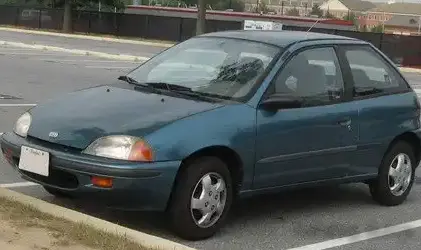
The Geo Metro 1.3, producing 70 horsepower, was a subcompact hatchback sold primarily in the United States and Canada from 1989 to 1995. It represented a joint venture between General Motors (Geo was a GM brand) and Suzuki, leveraging Suzuki’s expertise in small, fuel-efficient vehicles. The Metro was part of the first generation of the model, known internally as the 1HX0, and played a significant role in offering American consumers an affordable and exceptionally economical transportation option, particularly during a period of rising fuel costs and increasing demand for compact cars. This specific 1.3-liter, 70 hp configuration occupied the entry-level position in the Metro lineup, focusing on maximizing fuel economy rather than outright performance.
Technical Specifications
| Brand | Geo |
| Model | Metro |
| Generation | Metro |
| Type (Engine) | 1.3 (70 Hp) |
| Start of production | 1989 year |
| End of production | 1995 year |
| Powertrain Architecture | Internal Combustion engine |
| Body type | Hatchback |
| Seats | 4 |
| Doors | 2 |
| Fuel consumption (economy) – combined | 5.8 l/100 km |
| Fuel consumption (economy) – combined | 40.6 US mpg |
| Fuel consumption (economy) – combined | 48.7 UK mpg |
| Fuel consumption (economy) – combined | 17.2 km/l |
| Fuel Type | Petrol (Gasoline) |
| Weight-to-power ratio | 11.8 kg/Hp |
| Weight-to-power ratio | 84.7 Hp/tonne |
| Weight-to-torque ratio | 8.3 kg/Nm |
| Weight-to-torque ratio | 121.1 Nm/tonne |
| Power | 70 Hp @ 5500 rpm |
| Power per litre | 53.9 Hp/l |
| Torque | 100 Nm @ 3000 rpm |
| Torque | 73.76 lb.-ft. @ 3000 rpm |
| Engine layout | Front, Transverse |
| Engine Model/Code | L72 |
| Engine displacement | 1298 cm3 |
| Engine displacement | 79.21 cu. in. |
| Number of cylinders | 4 |
| Engine configuration | Inline |
| Cylinder Bore | 74 mm |
| Cylinder Bore | 2.91 in. |
| Piston Stroke | 75.5 mm |
| Piston Stroke | 2.97 in. |
| Compression ratio | 9:1 |
| Number of valves per cylinder | 2 |
| Fuel injection system | Single-point injection |
| Engine aspiration | Naturally aspirated engine |
| Kerb Weight | 826 kg |
| Kerb Weight | 1821.02 lbs |
| Fuel tank capacity | 40 l |
| Fuel tank capacity | 10.57 US gal |
| Fuel tank capacity | 8.8 UK gal |
| Length | 3795 mm |
| Length | 149.41 in. |
| Width | 1575 mm |
| Width | 62.01 in. |
| Height | 1390 mm |
| Height | 54.72 in. |
| Wheelbase | 2365 mm |
| Wheelbase | 93.11 in. |
| Front track | 1385 mm |
| Front track | 54.53 in. |
| Rear (Back) track | 1360 mm |
| Rear (Back) track | 53.54 in. |
| Drivetrain Architecture | The Internal combustion engine (ICE) drives the front wheels of the vehicle. |
| Drive wheel | Front wheel drive |
| Number of gears and type of gearbox | 5 gears, manual transmission |
| Front suspension | Wishbone |
| Rear suspension | Spring-loaded rack |
| Front brakes | Ventilated discs |
| Rear brakes | Drum |
| Power steering | Hydraulic Steering |
| Tires size | 125/80 R13 |
| Wheel rims size | 13 |
Powertrain & Engine Architecture
The Geo Metro 1.3 was powered by the Suzuki G10 engine, designated as the L72 in North American markets. This 1.3-liter inline-four cylinder engine featured a single overhead camshaft (SOHC) and two valves per cylinder. The engine utilized a multi-point fuel injection system, which, while relatively basic by modern standards, contributed to its fuel efficiency. The engine’s 9:1 compression ratio was a compromise between performance and the ability to run on regular unleaded gasoline. The engine was transversely mounted in the front of the vehicle, driving the front wheels. The five-speed manual transmission was standard, offering relatively long gear ratios geared towards maximizing fuel economy. The engine’s design prioritized simplicity and reliability over high output.
Driving Characteristics
The 70 horsepower and 100 Nm (73.76 lb-ft) of torque produced by the 1.3-liter engine resulted in modest acceleration. The Metro was not designed for spirited driving; instead, it excelled in urban environments and on highways where maintaining a consistent speed was more important than rapid acceleration. The five-speed manual transmission allowed drivers to keep the engine in its optimal power band, but even with careful shifting, the Metro was noticeably slower than many of its competitors. The long gear ratios contributed to excellent highway fuel economy, but also meant that passing maneuvers required careful planning. Compared to the later, more powerful Metro variants, the 1.3-liter model felt significantly underpowered, particularly when fully loaded with passengers and cargo.
Equipment & Trim Levels
The base-level Geo Metro 1.3 was sparsely equipped, reflecting its position as an affordable transportation option. Standard features typically included cloth upholstery, a basic AM/FM radio, and manual windows and door locks. Air conditioning was often an optional extra, as were power steering and upgraded audio systems. Interior trim was functional and durable, prioritizing practicality over luxury. The dashboard layout was simple and straightforward, with easily accessible controls. The focus was on providing essential features at the lowest possible cost.
Chassis & Braking
The Geo Metro featured a relatively simple chassis design. The front suspension utilized independent wishbones, while the rear suspension employed a torsion beam setup. This configuration provided a comfortable ride, but did not offer particularly sporty handling characteristics. The Metro’s braking system consisted of ventilated disc brakes at the front and drum brakes at the rear. Power steering was often an optional extra, and the steering feel was generally light and easy. The relatively light weight of the vehicle helped to compensate for the modest braking power.
Market Reception & Comparison
The Geo Metro 1.3 was generally well-received by consumers seeking an affordable and fuel-efficient vehicle. Critics praised its exceptional gas mileage, but often criticized its lack of power and basic interior. Compared to other subcompact cars of the time, such as the Ford Festiva and the Toyota Corolla, the Metro offered a compelling combination of price and fuel economy. However, it lacked the refinement and performance of some of its competitors. The Metro’s reliability was generally good, although some owners reported issues with the fuel injection system and the cooling system.
Legacy
The Geo Metro 1.3 remains a popular choice among budget-conscious used car buyers. Its exceptional fuel economy and simple mechanical design make it an attractive option for those seeking a reliable and inexpensive means of transportation. While parts availability can be a challenge, many components are still readily available through aftermarket suppliers. The Metro’s legacy is one of affordability and efficiency, representing a significant contribution to the subcompact car market of the late 1980s and early 1990s. The 1.3L engine, while not powerful, proved to be durable and relatively easy to maintain, contributing to the Metro’s long-term appeal.