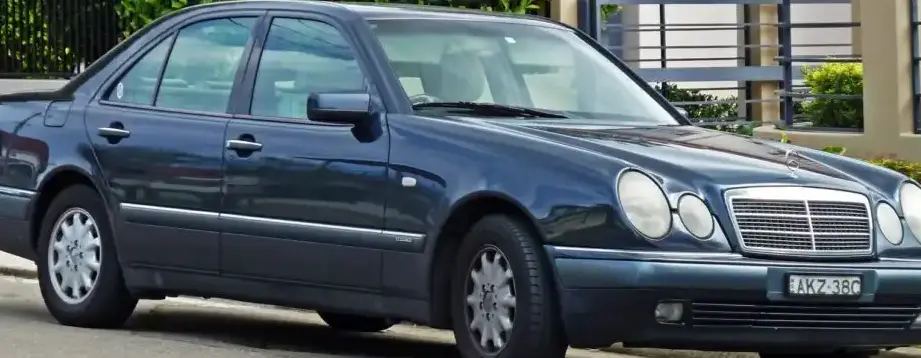
The Mercedes-Benz E 420, produced between June 1995 and February 1998, represented the high-performance variant within the W210 E-Class range. Positioned as a luxury performance sedan, it offered a significant step up in power and refinement compared to the four and six-cylinder models. The E 420 was a key component of Mercedes-Benz’s strategy to offer a compelling alternative to BMW’s performance-oriented sedans, appealing to buyers seeking a blend of comfort, technology, and robust power. It served as a precursor to the later AMG-enhanced E-Class models, establishing a performance lineage within the W210 generation.
Technical Specifications
| Brand | Mercedes-Benz |
| Model | E-class |
| Generation | E-class (W210) |
| Type (Engine) | E 420 V8 (279 Hp) Automatic |
| Start of production | June, 1995 |
| End of production | February, 1998 |
| Powertrain Architecture | Internal Combustion engine |
| Body type | Sedan |
| Seats | 5 |
| Doors | 4 |
| Fuel consumption (urban) | 14.4 l/100 km (16.3 US mpg, 19.6 UK mpg) |
| Fuel consumption (extra urban) | 7.9 l/100 km (29.8 US mpg, 35.8 UK mpg) |
| Fuel Type | Petrol (Gasoline) |
| Acceleration 0 – 100 km/h | 7 sec |
| Acceleration 0 – 62 mph | 7 sec |
| Acceleration 0 – 60 mph | 6.7 sec |
| Maximum speed | 250 km/h (155.34 mph), Electronically limited |
| Weight-to-power ratio | 6.1 kg/Hp, 165.1 Hp/tonne |
| Weight-to-torque ratio | 4.2 kg/Nm, 236.7 Nm/tonne |
| Power | 279 Hp @ 5700 rpm |
| Power per litre | 66.5 Hp/l |
| Torque | 400 Nm @ 3900 rpm (295.02 lb.-ft. @ 3900 rpm) |
| Engine layout | Front, Longitudinal |
| Engine Model/Code | M 119 E 42 / 119.985 |
| Engine displacement | 4196 cm3 (256.06 cu. in.) |
| Number of cylinders | 8 |
| Engine configuration | V-engine |
| Cylinder Bore | 92 mm (3.62 in.) |
| Piston Stroke | 78.9 mm (3.11 in.) |
| Compression ratio | 11:1 |
| Number of valves per cylinder | 4 |
| Fuel injection system | Multi-port manifold injection |
| Engine aspiration | Naturally aspirated engine |
| Valvetrain | DOHC |
| Engine oil capacity | 8 l (8.45 US qt | 7.04 UK qt) |
| Coolant | 11 l (11.62 US qt | 9.68 UK qt) |
| Kerb Weight | 1690 kg (3725.81 lbs.) |
| Max. weight | 2220 kg (4894.26 lbs.) |
| Max load | 530 kg (1168.45 lbs.) |
| Trunk (boot) space – minimum | 500 l (17.66 cu. ft.) |
| Fuel tank capacity | 80 l (21.13 US gal | 17.6 UK gal) |
| Length | 4795 mm (188.78 in.) |
| Width | 1799 mm (70.83 in.) |
| Height | 1439 mm (56.65 in.) |
| Wheelbase | 2833 mm (111.54 in.) |
| Front track | 1534 mm (60.39 in.) |
| Rear (Back) track | 1528 mm (60.16 in.) |
| Drivetrain Architecture | The Internal combustion engine (ICE) drives the rear wheels of the vehicle. |
| Drive wheel | Rear wheel drive |
| Number of gears and type of gearbox | 5 gears, automatic transmission |
| Front suspension | Double wishbone |
| Rear suspension | Independent multi-link spring suspension with stabilizer |
| Front brakes | Ventilated discs |
| Rear brakes | Ventilated discs |
| Assisting systems | ABS (Anti-lock braking system) |
| Steering type | Steering rack and pinion |
| Power steering | Hydraulic Steering |
| Tires size | 215/55 R16 |
| Wheel rims size | 7.5J x 16 |
Powertrain & Engine Architecture
The heart of the E 420 was the M119 E 42 engine, a 4.2-liter naturally aspirated V8. This engine, part of Mercedes-Benz’s highly regarded M119 family, was known for its smooth operation, robust construction, and ample power delivery. The M119 featured a cast-iron block with aluminum cylinder heads, a dual overhead camshaft (DOHC) design with four valves per cylinder, and a Bosch Motronic engine management system controlling multi-port fuel injection. The engine produced 279 horsepower at 5700 rpm and 400 Nm (295 lb-ft) of torque at 3900 rpm. The engine code 119.985 specifically identifies this variant. The five-speed automatic transmission (typically the 722.3) was the only transmission option offered with the E 420, prioritizing smooth shifts and ease of use over outright performance. This transmission was electronically controlled and featured adaptive shift programming, adjusting to the driver’s style.
Driving Characteristics
The E 420 offered a distinctly different driving experience compared to the lower-displacement E-Class models. The V8 engine provided strong acceleration, with a 0-60 mph time of around 6.7 seconds and a governed top speed of 155 mph. While not a sports car, the E 420 delivered effortless cruising and responsive power for overtaking. The automatic transmission, while smooth, wasn’t particularly quick-shifting by modern standards. The gear ratios were tuned for comfortable highway driving and relaxed acceleration rather than aggressive performance. Compared to the manual transmission options available on the six-cylinder models, the E 420 prioritized refinement and ease of driving over driver engagement.
Equipment & Trim Levels
The E 420 was positioned as a premium offering within the W210 range, and as such, came standard with a comprehensive list of features. Standard equipment included leather upholstery, power-adjustable front seats with memory function, automatic climate control, a premium sound system, and wood trim throughout the interior. Optional extras included a sunroof, upgraded sound systems, rear sunshades, and various driver assistance features. The interior design was typical of Mercedes-Benz at the time, emphasizing luxury and understated elegance. The dashboard layout was functional and well-organized, with clear instrumentation and intuitive controls.
Chassis & Braking
The E 420 featured a robust chassis designed to handle the increased power and weight of the V8 engine. The suspension utilized a double wishbone setup at the front and an independent multi-link suspension at the rear, providing a comfortable ride and good handling characteristics. Stabilizer bars were fitted front and rear to reduce body roll. Braking duties were handled by ventilated disc brakes on all four wheels, coupled with an Anti-lock Braking System (ABS) for enhanced safety. The E 420’s braking performance was adequate for its weight and performance level, providing confident stopping power in most driving situations.
Market Reception & Comparison
The E 420 was generally well-received by automotive critics, who praised its smooth engine, comfortable ride, and luxurious interior. However, some reviewers noted that the automatic transmission could feel somewhat sluggish and that the car lacked the sporty handling of some of its rivals. Compared to the E 320 (the six-cylinder model), the E 420 offered significantly more power and refinement, but at a higher price point. Fuel economy was also considerably lower with the V8 engine. The E 420’s main competitors included the BMW 540i and the Lexus LS400, both of which offered similar levels of performance and luxury.
Legacy
The E 420, while not a high-volume seller, holds a special place in the W210 E-Class lineage. The M119 V8 engine is renowned for its durability and reliability, and well-maintained examples continue to provide years of service. Today, the E 420 is sought after by enthusiasts who appreciate its classic Mercedes-Benz styling, smooth power delivery, and overall build quality. Parts availability is generally good, although some specific components may be becoming increasingly difficult to find. The E 420 represents a high point in Mercedes-Benz engineering, offering a blend of luxury, performance, and reliability that remains appealing even decades after its production ended.