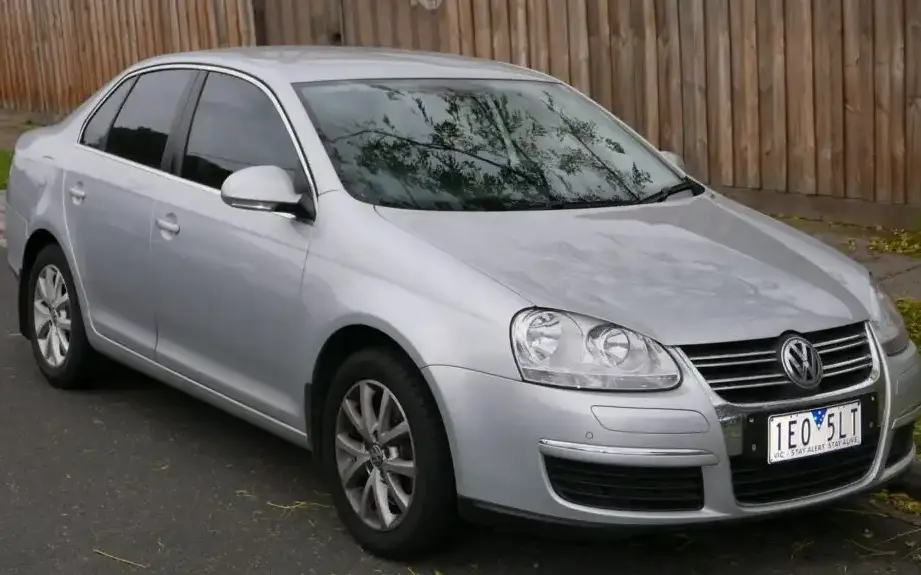
The Volkswagen Jetta V, produced from 2005 to 2010, represented a significant step forward for Volkswagen’s compact sedan. The 1.4 TSI (122 hp) variant, available from 2007 onwards, was a key offering in many European markets, positioned as a fuel-efficient and accessible entry point into the Jetta V range. This model utilized the 1HX0/A3 platform, shared with other Volkswagen Group vehicles like the Golf Mk5 and Audi A3. It aimed to balance practicality, modern technology, and affordability for a broad customer base.
Technical Specifications
| Brand | Volkswagen |
| Model | Jetta |
| Generation | Jetta V |
| Type (Engine) | 1.4 TSI (122 Hp) |
| Start of production | 2007 |
| End of production | 2010 |
| Powertrain Architecture | Internal Combustion engine |
| Body type | Sedan |
| Seats | 5 |
| Doors | 4 |
| Fuel consumption (economy) – urban (NEDC) | 8.3 l/100 km (28.3 US mpg, 34 UK mpg, 12 km/l) |
| Fuel consumption (economy) – extra urban (NEDC) | 5.2 l/100 km (45.2 US mpg, 54.3 UK mpg, 19.2 km/l) |
| Fuel consumption (economy) – combined (NEDC) | 6.3 l/100 km (37.3 US mpg, 44.8 UK mpg, 15.9 km/l) |
| CO2 emissions (NEDC) | 149 g/km |
| Fuel Type | Petrol (Gasoline) |
| Acceleration 0 – 100 km/h | 9.8 sec |
| Acceleration 0 – 62 mph | 9.8 sec |
| Acceleration 0 – 60 mph | 9.3 sec |
| Maximum speed | 199 km/h (123.65 mph) |
| Emission standard | Euro 4 |
| Weight-to-power ratio | 10.7 kg/Hp, 93.8 Hp/tonne |
| Weight-to-torque ratio | 6.5 kg/Nm, 153.8 Nm/tonne |
| Power | 122 Hp @ 5000 rpm |
| Power per litre | 87.8 Hp/l |
| Torque | 200 Nm @ 1500-4000 rpm (147.51 lb.-ft. @ 1500-4000 rpm) |
| Engine layout | Front, Transverse |
| Engine Model/Code | CAXA |
| Engine displacement | 1390 cm3 (84.82 cu. in.) |
| Number of cylinders | 4 |
| Engine configuration | Inline |
| Cylinder Bore | 76.5 mm (3.01 in.) |
| Piston Stroke | 75.6 mm (2.98 in.) |
| Compression ratio | 10:1 |
| Number of valves per cylinder | 4 |
| Fuel injection system | Direct injection |
| Engine aspiration | Turbocharger, Intercooler |
| Valvetrain | DOHC |
| Engine oil capacity | 3.6 l (3.8 US qt | 3.17 UK qt) |
| Coolant | 5.6 l (5.92 US qt | 4.93 UK qt) |
| Kerb Weight | 1300 kg (2866.01 lbs.) |
| Max. weight | 1910 kg (4210.83 lbs.) |
| Max load | 610 kg (1344.82 lbs.) |
| Trunk (boot) space – minimum | 527 l (18.61 cu. ft.) |
| Fuel tank capacity | 55 l (14.53 US gal | 12.1 UK gal) |
| Max. roof load | 75 kg (165.35 lbs.) |
| Permitted trailer load with brakes (8%) | 1600 kg (3527.4 lbs.) |
| Permitted trailer load with brakes (12%) | 1300 kg (2866.01 lbs.) |
| Permitted trailer load without brakes | 680 kg (1499.14 lbs.) |
| Permitted towbar download | 75 kg (165.35 lbs.) |
| Length | 4554 mm (179.29 in.) |
| Width | 1781 mm (70.12 in.) |
| Width including mirrors | 2010 mm (79.13 in.) |
| Height | 1459 mm (57.44 in.) |
| Wheelbase | 2578 mm (101.5 in.) |
| Front track | 1534 mm (60.39 in.) |
| Rear (Back) track | 1512 mm (59.53 in.) |
| Minimum turning circle | 10.9 m (35.76 ft.) |
| Drivetrain Architecture | The Internal combustion engine (ICE) drives the front wheels of the vehicle. |
| Drive wheel | Front wheel drive |
| Number of gears and type of gearbox | 6 gears, manual transmission |
| Front suspension | Coil spring, Wishbone, Transverse stabilizer |
| Rear suspension | Independent multi-link suspension, Transverse stabilizer |
| Front brakes | Ventilated discs |
| Rear brakes | Disc |
| Assisting systems | ABS (Anti-lock braking system) |
| Steering type | Steering rack and pinion |
| Power steering | Electric Steering |
| Tires size | 205/55 R16 |
| Wheel rims size | 6.5J x 16 |
INTRODUCTION
The Jetta V 1.4 TSI (122 hp) was introduced as a more economical and accessible option within the Jetta V lineup. Production ran from 2007 to 2010, primarily targeting European markets where fuel efficiency and lower running costs were highly valued. This variant occupied the lower-mid range of the Jetta V offerings, sitting below the more powerful 1.8 TSI and 2.0 TDI models. It provided a balance between affordability and modern features, making it a popular choice for families and commuters.
Powertrain & Engine Architecture
The heart of the Jetta V 1.4 TSI is the CAXA engine code, a 1.4-liter inline-four cylinder gasoline engine. This engine is a key example of Volkswagen’s TSI (Turbocharged Stratified Injection) technology. It features direct fuel injection, delivering fuel directly into the combustion chamber for improved efficiency and power. The engine utilizes a single turbocharger with an intercooler to boost performance. The valvetrain is a dual overhead camshaft (DOHC) design with four valves per cylinder, optimizing airflow for increased power output. The 1.4 TSI engine produces 122 horsepower at 5000 rpm and 200 Nm (147.51 lb-ft) of torque between 1500 and 4000 rpm. The engine is transversely mounted at the front of the vehicle. The transmission offered was typically a 6-speed manual, although a 7-speed DSG (Direct-Shift Gearbox) dual-clutch automatic was also available as an option, though less common in this specific trim.
Driving Characteristics
The 1.4 TSI with the manual transmission offered a reasonably engaging driving experience, though it wasn’t designed for outright performance. Acceleration from 0-60 mph took around 9.3 seconds, and top speed was limited to 199 km/h (123.65 mph). The turbocharger provides a noticeable boost in power, but the engine can feel somewhat strained at higher speeds or when fully loaded. The 6-speed manual gearbox is well-matched to the engine’s characteristics, offering precise shifts and allowing the driver to keep the engine in its optimal power band. Compared to the more powerful 1.8 TSI, the 1.4 TSI felt noticeably slower, particularly during overtaking maneuvers. However, the 1.4 TSI offered superior fuel economy and a more relaxed driving experience, making it better suited for everyday commuting.
Equipment & Trim Levels
The Jetta V 1.4 TSI typically came with a reasonable level of standard equipment. This included power windows, power mirrors, central locking, and an air conditioning system. Interior upholstery was typically cloth, with a relatively simple dashboard layout. Optional extras included alloy wheels, a CD stereo system, and parking sensors. Higher trim levels, such as the Trendline or Comfortline, added features like cruise control, automatic climate control, and upgraded interior trim. The Jetta V 1.4 TSI was generally positioned as a practical and well-equipped vehicle, but it lacked some of the luxury features found in higher-end trims.
Chassis & Braking
The Jetta V 1.4 TSI utilized a MacPherson strut front suspension and an independent multi-link rear suspension. This setup provided a comfortable ride quality and decent handling characteristics. The front brakes were ventilated discs, while the rear brakes were solid discs. Anti-lock Braking System (ABS) was standard. The suspension was tuned for comfort rather than sporty handling, resulting in a relatively soft ride. Stabilizer bars were fitted to both the front and rear axles to reduce body roll during cornering. The weight distribution was fairly balanced, contributing to predictable handling.
Market Reception & Comparison
The Jetta V 1.4 TSI was generally well-received by automotive critics as a practical and fuel-efficient option. It was praised for its comfortable ride, decent handling, and modern features. However, some critics noted that the engine lacked outright power, particularly when compared to the larger-displacement engines available in the Jetta V range. In terms of fuel economy, the 1.4 TSI outperformed the 1.8 TSI and 2.0 TDI models, making it an attractive option for drivers concerned about running costs. Reliability was generally good, although some owners reported minor issues with the turbocharger and fuel injection system. Compared to competitors like the Ford Focus and Opel Astra, the Jetta V 1.4 TSI offered a similar level of equipment and performance, but with a slightly more refined interior.
Legacy
The 1.4 TSI engine proved to be a reliable and durable powertrain when properly maintained. The CAXA engine code is known for its longevity, and many examples are still on the road today. However, like all turbocharged engines, it requires regular oil changes and careful attention to maintenance. In the used car market, the Jetta V 1.4 TSI remains a popular choice for buyers seeking an affordable and fuel-efficient compact sedan. Its relatively low running costs and decent reliability make it a practical option for everyday use. While it may not offer the same level of performance as some of its rivals, the Jetta V 1.4 TSI represents a well-rounded and dependable vehicle.