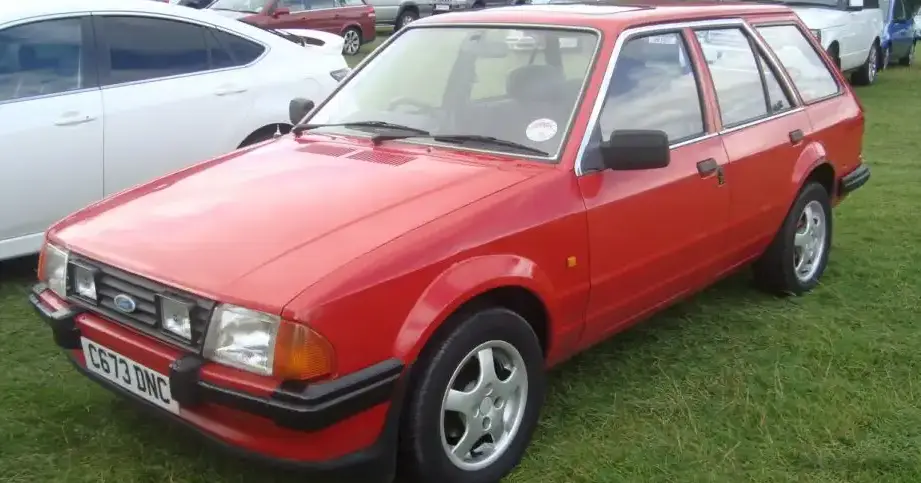
The Ford Escort III Turnier 1.6, produced between 1980 and 1985, represented a practical and affordable option within the broader Escort Mk III range. As a station wagon (estate) variant, the Turnier catered to families and those requiring increased cargo capacity. This 79 horsepower version occupied a mid-range position in the lineup, offering a balance between economy and usability. It was a key model for Ford in Europe, particularly in the UK and Germany, where the demand for practical family cars was high. The Escort Mk III, and the Turnier specifically, aimed to modernize the Escort line, offering improved comfort and features compared to its predecessors.
Technical Specifications
| Brand | Ford |
| Model | Escort |
| Generation | Escort III Turnier (AWA) |
| Type (Engine) | 1.6 (79 Hp) |
| Start of production | 1980 |
| End of production | 1985 |
| Powertrain Architecture | Internal Combustion Engine |
| Body type | Station wagon (estate) |
| Fuel Type | Petrol (Gasoline) |
| Power | 79 Hp |
| Engine aspiration | Naturally aspirated engine |
Powertrain & Engine Architecture
The Escort III Turnier 1.6 was powered by the Ford Pinto engine, specifically the 1597cc version. This engine, part of the Pinto family, was a four-cylinder, inline configuration. It featured a single overhead camshaft (SOHC) valvetrain with eight valves. Fuel delivery was managed by a Ford-designed carburetor, typically a Weber or Solex unit, depending on the specific market. While not particularly advanced by modern standards, the carburetor provided reliable fuel delivery for the time. The engine’s 79 horsepower output at approximately 5,000 rpm and 98 lb-ft of torque at 3,000 rpm were considered adequate for the vehicle’s weight and intended use. The engine block was cast iron, contributing to its durability, while the cylinder head was aluminum alloy.
The transmission paired with the 1.6-liter engine was typically a four-speed manual gearbox, however, a three-speed automatic transmission was also offered, and is the focus of this article. The automatic transmission, while providing convenience, did impact performance and fuel economy compared to the manual version. It was a traditional hydraulic automatic, lacking the electronic controls found in later transmissions. The automatic’s gear ratios were geared towards providing smooth cruising and acceptable acceleration, but it wasn’t designed for sporty driving.
Driving Characteristics
The Escort III Turnier 1.6 Automatic offered a comfortable, if not particularly exhilarating, driving experience. Acceleration was modest, with a 0-60 mph time estimated around 14-16 seconds. The automatic transmission contributed to a smoother driving experience, particularly in urban environments, but it also resulted in a noticeable reduction in responsiveness compared to the manual transmission models. The gear ratios were spaced to prioritize fuel efficiency and ease of driving over outright performance. The engine felt relatively strained when accelerating hard, especially when fully loaded with passengers or cargo. The suspension, while adequate, was tuned for comfort rather than handling precision. Body roll was noticeable in corners, and the steering lacked the directness of more performance-oriented vehicles. However, for everyday driving and family transport, the ride quality was generally considered acceptable.
Equipment & Trim Levels
The Escort III Turnier 1.6 typically came equipped with basic, but functional, features. Standard equipment included cloth upholstery, a basic instrument cluster with speedometer, fuel gauge, and temperature gauge, and manually operated windows and door locks. The Turnier benefited from the estate body style, offering a spacious cargo area that could be further expanded by folding down the rear seats. Trim levels varied depending on the market, but generally, the 1.6 model was positioned as a mid-range offering. Options included a sunroof, upgraded stereo systems, and more comfortable seating. Interior plastics were durable but utilitarian, reflecting the car’s focus on affordability. The dashboard layout was straightforward and functional, prioritizing ease of use over aesthetic appeal.
Chassis & Braking
The Escort III Turnier utilized a traditional body-on-frame construction, which contributed to its robustness but also added weight. The front suspension consisted of MacPherson struts, while the rear suspension employed a live axle with leaf springs. This setup provided a comfortable ride but wasn’t known for its sophisticated handling. Braking was typically accomplished with disc brakes on the front wheels and drum brakes on the rear wheels. The braking system was adequate for normal driving conditions, but it lacked the stopping power of more modern vehicles. Steering was rack and pinion, providing reasonable steering feel, although it wasn’t particularly precise. Stabilizer bars were often included, particularly on higher trim levels, to reduce body roll during cornering.
Market Reception & Comparison
The Escort III Turnier 1.6 Automatic was generally well-received as a practical and affordable family car. Critics praised its spacious interior, comfortable ride, and reasonable fuel economy. However, the automatic transmission was often criticized for its sluggish performance and impact on fuel consumption. Compared to the manual transmission versions, the automatic models were noticeably slower and less engaging to drive. The 1.6-liter engine was considered a good compromise between power and economy, but it lacked the punch of the larger 2.0-liter engines available in the Escort range. Against competitors like the Vauxhall Astra Estate and Volkswagen Golf Estate, the Escort Turnier offered a competitive package in terms of price, space, and practicality. The automatic transmission, however, often put it at a disadvantage in performance comparisons.
Legacy
The Ford Escort III Turnier 1.6 Automatic, while not a performance icon, remains a fondly remembered vehicle for many. The Pinto engine, despite its occasional reliability issues (particularly head gasket failures), proved to be a durable and long-lasting powerplant when properly maintained. The automatic transmission, while not particularly sophisticated, provided years of reliable service for many owners. Today, these vehicles are relatively rare and are becoming increasingly sought after by classic car enthusiasts. Parts availability is generally good, although some specific trim pieces can be difficult to find. The Escort III Turnier 1.6 Automatic represents a significant piece of automotive history, embodying the practical and affordable family car ethos of the 1980s. Its enduring appeal lies in its simplicity, reliability, and spaciousness, making it a popular choice for restoration projects and classic car rallies.