
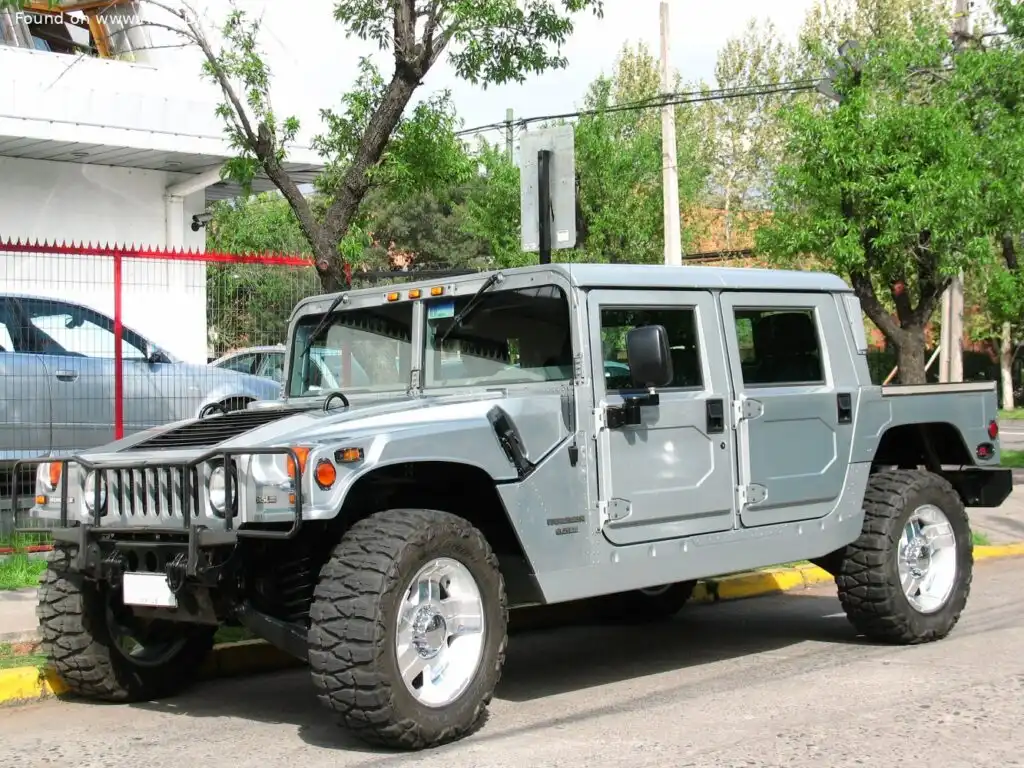
The Hummer H1, specifically the 6.2 V8 (152 Hp) 4×4 Automatic variant produced between 1993 and 1995, represents the initial civilian iteration of the High Mobility Multipurpose Wheeled Vehicle (HMMWV), originally developed for military use. This early model, designated as the H1 I, laid the foundation for the Hummer brand’s entry into the consumer market, capitalizing on the vehicle’s rugged capabilities and distinctive design. It was a bold statement in a market largely dominated by more conventional SUVs, and its production coincided with a growing interest in larger, more capable off-road vehicles. The H1 I was built on a heavy-duty chassis and featured a unique powertrain designed for both on- and off-road performance, though the 152 horsepower diesel engine was considered underpowered by some.
Technical Specifications
| Brand | Hummer |
| Model | H1 |
| Generation | H1 I |
| Type (Engine) | 6.2 V8 (152 Hp) 4×4 Automatic |
| Start of production | 1993 |
| End of production | 1995 |
| Powertrain Architecture | Internal Combustion engine |
| Body type | Off-road vehicle |
| Seats | 4 |
| Doors | 4 |
| Fuel Type | Diesel |
| Maximum speed | 105 km/h (65.24 mph) |
| Weight-to-power ratio | 20.8 kg/Hp, 48.1 Hp/tonne |
| Weight-to-torque ratio | 9.3 kg/Nm, 107.3 Nm/tonne |
| Power | 152 Hp @ 3600 rpm |
| Power per litre | 24.4 Hp/l |
| Torque | 339 Nm @ 2000 rpm (250.03 lb.-ft. @ 2000 rpm) |
| Maximum engine speed | 3600 rpm |
| Engine layout | Front, Longitudinal |
| Engine displacement | 6217 cm3 (379.38 cu. in.) |
| Number of cylinders | 8 |
| Engine configuration | V-engine |
| Cylinder Bore | 101 mm (3.98 in.) |
| Piston Stroke | 97 mm (3.82 in.) |
| Compression ratio | 21.5:1 |
| Number of valves per cylinder | 2 |
| Fuel injection system | Precombustion chamber injection |
| Engine aspiration | Naturally aspirated engine |
| Engine oil capacity | 6.6 l (6.97 US qt | 5.81 UK qt) |
| Coolant | 24.6 l (25.99 US qt | 21.64 UK qt) |
| Kerb Weight | 3160 kg (6966.61 lbs.) |
| Fuel tank capacity | 160 l (42.27 US gal | 35.2 UK gal) |
| Length | 4686 mm (184.49 in.) |
| Width | 2159 mm (85 in.) |
| Height | 1829 mm (72.01 in.) |
| Wheelbase | 3302 mm (130 in.) |
| Front track | 1819 mm (71.61 in.) |
| Rear (Back) track | 1819 mm (71.61 in.) |
| Ride height (ground clearance) | 406 mm (15.98 in.) |
| Drag coefficient (Cd) | 0.7 |
| Minimum turning circle (turning diameter) | 15.2 m (49.87 ft.) |
| Approach angle | 72° |
| Departure angle | 37.5° |
| Ramp-over (brakeover) angle | 29° |
| Drive wheel | All wheel drive (4×4) |
| Number of gears and type of gearbox | 3 gears, automatic transmission |
Powertrain & Engine Architecture
The H1 I was powered by a 6.2-liter naturally aspirated diesel V8 engine. This engine, derived from a General Motors design, was known for its durability and relatively simple mechanical construction. The engine utilized a precombustion chamber injection system, a common diesel technology of the era, which improved combustion efficiency and reduced engine noise compared to direct injection systems. The 152 horsepower output, while substantial for a diesel engine of the time, was considered modest given the H1’s considerable weight. The engine’s torque output of 339 Nm (250 lb-ft) was more significant, providing ample low-end grunt for off-road driving. The engine was paired with a 3-speed automatic transmission, chosen for its ease of use and suitability for both on- and off-road conditions. However, the limited number of gears meant that the engine often operated at higher RPMs during highway cruising, impacting fuel economy and potentially long-term durability.
Driving Characteristics
The 1993-1995 H1 I with the 6.2L diesel and automatic transmission offered a unique driving experience. Acceleration was leisurely, and highway passing required careful planning. The automatic transmission, while convenient, lacked the responsiveness of a manual gearbox, and the limited number of gears meant the engine frequently operated at higher RPMs. Off-road, however, the H1 I truly excelled. The combination of four-wheel drive, generous ground clearance, and a robust suspension system allowed it to traverse challenging terrain with relative ease. The torque-rich diesel engine provided ample low-end power for crawling over obstacles, and the automatic transmission simplified operation in difficult conditions. Compared to later H1 models with more powerful engines, the 152 hp version felt noticeably slower and less refined, but it retained the H1’s core off-road capability.
Equipment & Trim Levels
The H1 I was relatively spartan in terms of standard equipment, reflecting its origins as a military vehicle. Standard features included air conditioning, basic instrumentation, and durable vinyl upholstery. Power windows and locks were not standard, and many H1 I models were equipped with minimal creature comforts. Optional extras included upgraded audio systems, leather upholstery, and various off-road accessories such as winches and auxiliary lighting. The interior was designed for functionality and durability rather than luxury, with a focus on providing a comfortable and practical environment for off-road adventures. The H1 I did not offer a wide range of trim levels; it was largely a single specification with limited customization options.
Chassis & Braking
The H1 I featured a heavy-duty ladder frame chassis, providing exceptional strength and rigidity. The suspension system consisted of solid axles with leaf springs, designed to withstand the stresses of off-road driving. Braking was accomplished via disc brakes on all four wheels, although some early models may have featured rear drum brakes. The braking system was adequate for the vehicle’s weight, but it lacked the sophistication of more modern braking systems. The H1 I’s large tires and high ground clearance contributed to its exceptional off-road capability, but also resulted in a relatively high center of gravity, which could affect handling on paved roads.
Market Reception & Comparison
The initial reception to the H1 I was mixed. Critics acknowledged its impressive off-road capabilities and unique design, but many questioned its on-road manners and relatively high price. The 152 horsepower diesel engine was often criticized for being underpowered, and the automatic transmission was seen as a compromise compared to a manual gearbox. Compared to other SUVs of the time, such as the Chevrolet Suburban or Ford Bronco, the H1 I offered significantly greater off-road capability but lacked the refinement and practicality of those vehicles. Fuel economy was also a concern, with the H1 I averaging around 10-12 mpg in real-world driving. Despite these drawbacks, the H1 I attracted a dedicated following of enthusiasts who appreciated its ruggedness and exclusivity.
Legacy
The Hummer H1 I, while a relatively short-lived model, played a crucial role in establishing the Hummer brand and paving the way for future iterations of the vehicle. The 6.2L diesel engine, while not known for its power, proved to be remarkably durable and reliable, and many H1 I models remain on the road today. The H1 I’s unique design and off-road capabilities have made it a sought-after collectible among enthusiasts, and prices for well-maintained examples have steadily increased in recent years. The H1 I represents a unique chapter in automotive history, bridging the gap between military utility and civilian luxury, and its legacy continues to inspire off-road enthusiasts around the world.
