
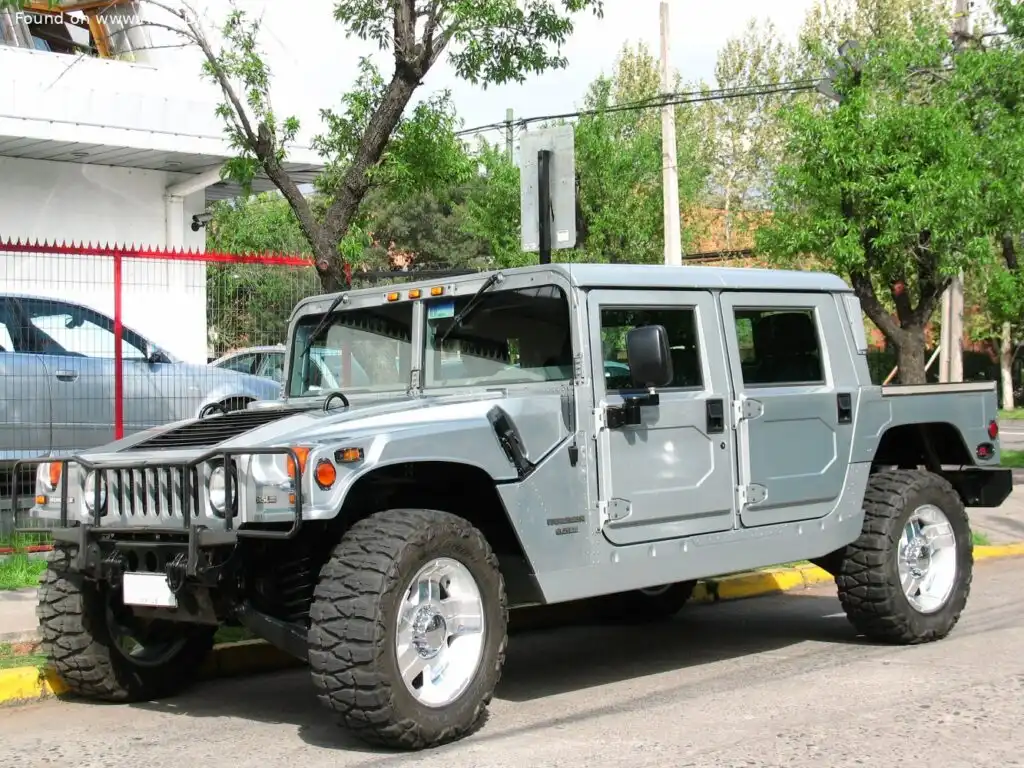
The Hummer H1, specifically the 6.5 D V8 (170 Hp) 4×4 Automatic variant produced between 1995 and 1998, represents a unique chapter in automotive history. Born from the military Humvee, the H1 was the first consumer version of this iconic off-road vehicle, aiming to deliver unparalleled capability to civilian buyers. This particular iteration, powered by a diesel engine and paired with an automatic transmission, occupied a specific niche within the H1 lineup, offering a balance of torque and relative ease of use for those seeking a robust and imposing vehicle. It was the initial offering for the civilian market, establishing the Hummer brand and its reputation for extreme off-road performance.
Technical Specifications
| Brand | Hummer |
| Model | H1 |
| Generation | H1 I |
| Type (Engine) | 6.5 D V8 (170 Hp) 4×4 Automatic |
| Start of production | 1995 year |
| End of production | 1998 year |
| Powertrain Architecture | Internal Combustion engine |
| Body type | Off-road vehicle |
| Seats | 4 |
| Doors | 4 |
| Fuel consumption (economy) – combined | 22 l/100 km |
| Fuel consumption (economy) – combined | 10.7 US mpg |
| Fuel consumption (economy) – combined | 12.8 UK mpg |
| Fuel consumption (economy) – combined | 4.5 km/l |
| Fuel Type | Diesel |
| Maximum speed | 134 km/h |
| Maximum speed | 83.26 mph |
| Weight-to-power ratio | 18.6 kg/Hp |
| Weight-to-power ratio | 53.8 Hp/tonne |
| Weight-to-torque ratio | 8 kg/Nm |
| Weight-to-torque ratio | 124.4 Nm/tonne |
| Power | 170 Hp @ 3400 rpm |
| Power per litre | 26.3 Hp/l |
| Torque | 393 Nm @ 1700 rpm |
| Torque | 289.86 lb.-ft. @ 1700 rpm |
| Maximum engine speed | 3600 rpm |
| Engine layout | Front, Longitudinal |
| Engine displacement | 6466 cm3 |
| Engine displacement | 394.58 cu. in. |
| Number of cylinders | 8 |
| Engine configuration | V-engine |
| Cylinder Bore | 103 mm |
| Cylinder Bore | 4.06 in. |
| Piston Stroke | 97 mm |
| Piston Stroke | 3.82 in. |
| Compression ratio | 21.5:1 |
| Number of valves per cylinder | 2 |
| Fuel injection system | Precombustion chamber injection |
| Engine aspiration | Naturally aspirated engine |
| Engine oil capacity | 7.6 l |
| Engine oil capacity | 8.03 US qt |
| Engine oil capacity | 6.69 UK qt |
| Coolant | 25 l |
| Coolant | 26.42 US qt |
| Coolant | 22 UK qt |
| Kerb Weight | 3159 kg |
| Kerb Weight | 6964.4 lbs |
| Max. weight | 4899 kg |
| Max. weight | 10800.45 lbs |
| Max load | 1740 kg |
| Max load | 3836.04 lbs |
| Fuel tank capacity | 160 l |
| Fuel tank capacity | 42.27 US gal |
| Fuel tank capacity | 35.2 UK gal |
| Length | 4686 mm |
| Length | 184.49 in |
| Width | 2197 mm |
| Width | 86.5 in |
| Height | 1905 mm |
| Height | 75 in |
| Wheelbase | 3302 mm |
| Wheelbase | 130 in |
| Front track | 1819 mm |
| Front track | 71.61 in |
| Rear (Back) track | 1819 mm |
| Rear (Back) track | 71.61 in |
| Ride height (ground clearance) | 406 mm |
| Ride height (ground clearance) | 15.98 in |
| Drag coefficient (Cd) | 0.7 |
| Minimum turning circle (turning diameter) | 16.2 m |
| Minimum turning circle (turning diameter) | 53.15 ft |
| Approach angle | 72° |
| Departure angle | 37.5° |
| Ramp-over (brakeover) angle | 29° |
| Drive wheel | All wheel drive (4×4) |
| Number of gears and type of gearbox | 4 gears, automatic transmission |
| Front brakes | Ventilated discs |
| Rear brakes | Ventilated discs |
Powertrain & Engine Architecture
The heart of this H1 variant is the 6.5-liter naturally aspirated diesel V8 engine. This engine, derived from a General Motors design originally intended for heavy-duty trucks, is characterized by its robust construction and high torque output. The engine utilizes a precombustion chamber injection system, a common diesel technology of the era, which improves combustion efficiency and reduces engine noise compared to direct injection systems. The 170 horsepower peak is reached at 3400 rpm, but the engine’s strength lies in its 393 Nm (289.86 lb-ft) of torque, available from a low 1700 rpm. This makes it exceptionally well-suited for off-road driving and towing. The engine is longitudinally mounted in the chassis. The 4-speed automatic transmission, a TH700R4 variant, was chosen for its durability and relative simplicity. While not known for rapid shifts, it provided a more accessible driving experience for those unfamiliar with manual transmissions, and it was better suited for navigating challenging terrain at low speeds.
Driving Characteristics
The 1.8L Automatic H1 delivers a driving experience distinctly different from its higher-horsepower counterparts. Acceleration is modest, and the vehicle feels substantial in its weight and size. The automatic transmission, while providing convenience, does result in some power loss compared to a manual transmission. However, the abundant low-end torque allows for confident crawling over obstacles and effortless towing. The gear ratios are optimized for off-road performance, prioritizing pulling power over outright speed. On paved roads, the H1 feels somewhat cumbersome, with noticeable body roll and a firm ride. However, its sheer presence and commanding view of the road are undeniable.
Equipment & Trim Levels
The early H1 models, including the 6.5 D V8 Automatic, were relatively spartan in terms of luxury features. Standard equipment included air conditioning, basic instrumentation, and cloth upholstery. Power windows and locks were often optional extras. The interior was designed for functionality and durability rather than opulence. The dashboard layout is straightforward, with large, easy-to-read gauges. Options included upgraded sound systems, leather upholstery, and a winch for enhanced off-road capability. The focus was on providing a capable and reliable vehicle, rather than a luxurious one.
Chassis & Braking
The H1’s chassis is a body-on-frame construction, providing exceptional strength and rigidity. It features a heavy-duty suspension system designed to withstand extreme off-road conditions. The front suspension utilizes coil springs, while the rear suspension employs leaf springs. This configuration provides a good balance of articulation and load-carrying capacity. Braking duties are handled by ventilated discs on all four wheels, providing adequate stopping power for a vehicle of this size and weight. However, the H1’s substantial mass requires a significant distance to come to a complete stop.
Market Reception & Comparison
The initial reception of the Hummer H1 was mixed. Critics acknowledged its unparalleled off-road capability but questioned its practicality and fuel economy. The 22 l/100 km (10.7 US mpg) fuel consumption was considered excessive, even for a large SUV. Compared to the later H1 variants with more powerful engines, the 6.5 D V8 Automatic offered a more affordable entry point into the Hummer world, but at the cost of performance. It appealed to buyers who prioritized torque and durability over speed and refinement. Compared to other large SUVs of the era, the H1 stood out for its extreme off-road prowess and distinctive styling.
Legacy
The Hummer H1 6.5 D V8 Automatic holds a significant place in automotive history as the vehicle that launched the Hummer brand. While its fuel economy and on-road manners were not its strong suits, its off-road capability and iconic design have cemented its status as a collector’s item. Today, well-maintained examples command high prices in the used car market. The powertrain, while robust, requires regular maintenance to ensure longevity. The diesel engine, while durable, can be prone to issues with the injection pump and fuel system. Despite these potential maintenance concerns, the H1 remains a highly sought-after vehicle for those seeking a truly unique and capable off-road experience.
