Technical Specifications
| Brand | Ford |
| Model | Escort |
| Generation | Escort IV Cabrio |
| Type (Engine) | 1.4 (75 Hp) |
| Start of production | 1986 |
| End of production | 1990 |
| Powertrain Architecture | Internal Combustion engine |
| Body type | Cabriolet |
| Fuel Type | Petrol (Gasoline) |
| Power | 75 Hp |
| Engine Model/Code | FUA |
| Engine aspiration | Naturally aspirated engine |
| Engine oil capacity | 3.5 l (3.7 US qt | 3.08 UK qt) |
| Coolant capacity | 7.6 l (8.03 US qt | 6.69 UK qt) |
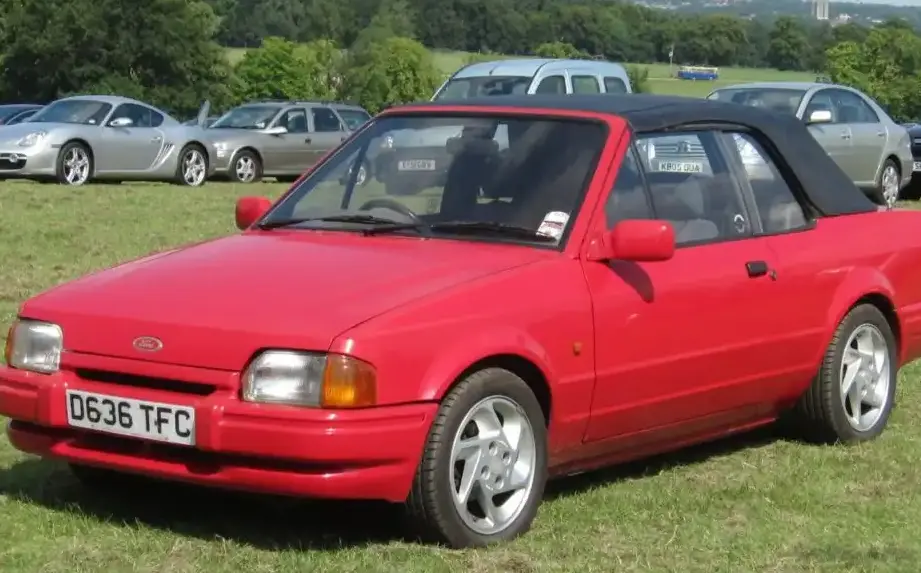
The Ford Escort IV Cabrio 1.4, producing 75 horsepower, was a variant of the fourth-generation Ford Escort produced between 1986 and 1990. This model represented Ford’s entry into the increasingly popular convertible market, offering an affordable and stylish open-top option based on the well-established Escort platform. Positioned as the base-level convertible, it catered to buyers seeking a fun, economical, and accessible way to enjoy open-air motoring. The Escort IV, and specifically the Cabrio, was primarily aimed at the European market, where compact convertibles held significant appeal. While not officially sold in the United States during this generation, the Escort nameplate had a strong presence in North America in earlier and later iterations.
Powertrain & Engine Architecture
The Escort IV Cabrio 1.4 was powered by the Ford FUA engine, a 1.388cc inline-four cylinder gasoline engine. This engine was a relatively simple design, utilizing a single overhead camshaft (SOHC) valvetrain with two valves per cylinder. Fuel delivery was managed by a carburetor, a common feature for vehicles of this era and price point. The FUA engine was known for its reliability and ease of maintenance, though it wasn’t particularly powerful. The engine’s modest output of 75 horsepower at approximately 6,000 rpm and 98 lb-ft of torque at 3,600 rpm was sufficient for comfortable cruising, but didn’t offer particularly brisk acceleration. The engine block was cast iron, contributing to its durability, while the cylinder head was aluminum. The transmission paired with the 1.4L engine was typically a four-speed manual, however, an optional three-speed automatic transmission was available, though less common. The automatic transmission, while offering convenience, further reduced the car’s performance and fuel economy. The three-speed automatic was a Ford-sourced unit, known for its simplicity but lacking the refinement of more modern automatic gearboxes.
Driving Characteristics
The driving experience in the Escort IV Cabrio 1.4 was characterized by its light weight and nimble handling. The car wasn’t designed for outright speed, and the 75 horsepower engine meant acceleration was leisurely. With the manual transmission, the car felt more responsive, allowing the driver to make the most of the available power. The automatic transmission, while providing ease of use, noticeably dulled the driving experience. Gear ratios were optimized for fuel efficiency rather than performance, meaning the engine often felt strained during overtaking maneuvers. The Cabrio’s suspension, consisting of MacPherson struts at the front and a twist-beam rear axle, provided a comfortable ride, though it wasn’t particularly sporty. Steering was light and precise, making the car easy to maneuver in urban environments. The open-top configuration added to the enjoyment, but also introduced some wind noise and reduced structural rigidity compared to the hardtop Escort models. This lack of rigidity was more noticeable on uneven road surfaces.
Equipment & Trim Levels
The Escort IV Cabrio 1.4, as the entry-level convertible, came with a relatively basic level of equipment. Standard features typically included cloth upholstery, a simple dashboard layout with analog gauges, and manual windows and door locks. A basic AM/FM radio was often included, with options for cassette players. The convertible top was manually operated, requiring the driver to physically raise and lower it. Optional extras included upgraded upholstery, a more sophisticated radio system, and power steering. Trim levels were relatively limited, with most variations stemming from the addition of optional equipment. The interior plastics were durable but not particularly luxurious, reflecting the car’s affordable price point. The exterior featured basic chrome trim and steel wheels with hubcaps. Higher trim levels, though rare on the 1.4L Cabrio, might have included alloy wheels and upgraded interior trim.
Chassis & Braking
The Escort IV Cabrio’s chassis was based on the standard Escort IV platform, but with modifications to accommodate the convertible body style. Reinforcements were added to the chassis to compensate for the loss of structural rigidity caused by removing the roof. The front suspension utilized MacPherson struts, while the rear suspension employed a twist-beam axle. Braking was typically accomplished with disc brakes at the front and drum brakes at the rear. The braking system was adequate for the car’s weight and performance, but lacked the stopping power of more modern vehicles. Steering was rack-and-pinion, providing precise and responsive handling. The car’s relatively light weight contributed to its nimble handling characteristics. Stabilizer bars were fitted to both the front and rear axles to reduce body roll during cornering. The rear drum brakes were a cost-saving measure typical of entry-level models of the time.
Market Reception & Comparison
The Escort IV Cabrio 1.4 was generally well-received by critics as an affordable and stylish entry into the convertible market. However, its performance was often criticized as being underwhelming, particularly with the automatic transmission. Compared to other trims in the Escort lineup, such as the 1.6L versions, the 1.4L model offered less power and acceleration. However, it also offered better fuel economy. The 1.6L models were targeted at buyers seeking more performance, while the 1.4L model appealed to those prioritizing economy and affordability. Reliability was generally good, with the FUA engine proving to be durable and relatively trouble-free. Fuel economy was a strong point, with the 1.4L engine achieving around 35-40 mpg in mixed driving conditions. The Cabrio was often compared to other small convertibles of the era, such as the Peugeot 205 Convertible and the Fiat Uno Cabriolet. The Peugeot 205 Convertible, while more expensive, offered a more refined driving experience, while the Fiat Uno Cabriolet was a more basic and affordable alternative.
Legacy
The Ford Escort IV Cabrio 1.4, while not a high-performance vehicle, holds a place in automotive history as an accessible and enjoyable convertible. The FUA engine, while simple, proved to be remarkably durable, and many examples are still on the road today. In the used car market, these Escort Cabrios are sought after by enthusiasts and collectors, particularly those looking for a classic and affordable open-top experience. Maintenance is relatively straightforward, and parts are generally readily available. The car’s simple design and robust construction contribute to its long-term reliability. The Escort IV Cabrio 1.4 represents a significant chapter in Ford’s history, demonstrating the company’s ability to offer stylish and affordable vehicles to a wide range of customers. Its enduring appeal lies in its simplicity, charm, and the joy of open-air motoring. The automatic transmission versions, while less desirable to driving enthusiasts, remain a viable option for those seeking a comfortable and easy-to-drive classic convertible.