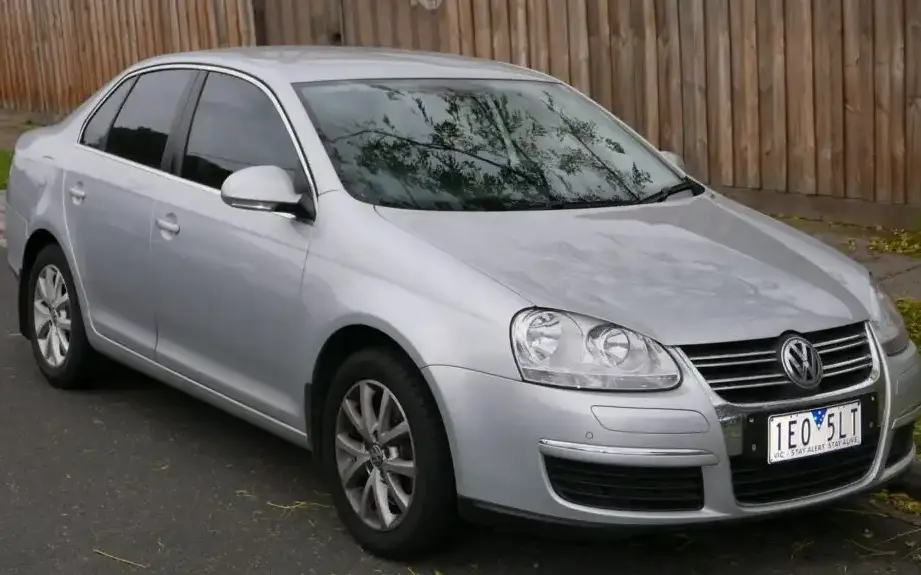
The Volkswagen Jetta V 1.4 TSI (160 hp) with the Direct-Shift Gearbox (DSG) was a key variant in the fifth generation of Volkswagen’s popular Jetta sedan, produced from 2008 to 2010. Positioned as a mid-range offering, it bridged the gap between the more economical base engines and the performance-oriented GTI-inspired trims. This model represented Volkswagen’s push towards incorporating advanced engine technology – specifically turbocharged direct injection – into a mainstream family car, aiming for a balance of fuel efficiency and respectable performance. It was primarily marketed in Europe and other global markets, with limited availability in the United States where the Jetta V was offered with different engine options.
Technical Specifications
| Brand | Volkswagen |
| Model | Jetta |
| Generation | Jetta V |
| Type (Engine) | 1.4 TSI (160 Hp) DSG |
| Start of production | 2008 |
| End of production | 2010 |
| Powertrain Architecture | Internal Combustion engine |
| Body type | Sedan |
| Seats | 5 |
| Doors | 4 |
| Fuel consumption (urban) | 8 l/100 km (29.4 US mpg) |
| Fuel consumption (extra urban) | 5.4 l/100 km (43.6 US mpg) |
| Fuel consumption (combined) | 6.4 l/100 km (36.8 US mpg) |
| Fuel Type | Petrol (Gasoline) |
| Acceleration 0 – 100 km/h | 8.5 sec |
| Acceleration 0 – 62 mph | 8.5 sec |
| Acceleration 0 – 60 mph | 8.1 sec |
| Maximum speed | 220 km/h (136.7 mph) |
| Emission standard | Euro 4 |
| Weight-to-power ratio | 8.6 kg/Hp |
| Weight-to-torque ratio | 5.8 kg/Nm |
| Power | 160 Hp @ 5800 rpm |
| Torque | 240 Nm @ 1750-4000 rpm (177.01 lb.-ft.) |
| Engine layout | Front, Longitudinal |
| Engine Model/Code | CAVD, CTHD, CTKA |
| Engine displacement | 1390 cm3 (84.82 cu. in.) |
| Number of cylinders | 4 |
| Engine configuration | Inline |
| Cylinder Bore | 76.5 mm (3.01 in.) |
| Piston Stroke | 75.6 mm (2.98 in.) |
| Number of valves per cylinder | 4 |
| Fuel injection system | Direct injection |
| Engine aspiration | Turbocharger, Intercooler |
| Valvetrain | DOHC |
| Engine oil capacity | 3.6 l (3.8 US qt | 3.17 UK qt) |
| Coolant | 5.6 l (5.92 US qt | 4.93 UK qt) |
| Kerb Weight | 1380 kg (3042.38 lbs.) |
| Max. weight | 1870 kg (4122.64 lbs.) |
| Max load | 490 kg (1080.27 lbs.) |
| Trunk (boot) space – minimum | 527 l (18.61 cu. ft.) |
| Fuel tank capacity | 55 l (14.53 US gal | 12.1 UK gal) |
| Length | 4554 mm (179.29 in.) |
| Width | 1781 mm (70.12 in.) |
| Height | 1459 mm (57.44 in.) |
| Wheelbase | 2578 mm (101.5 in.) |
| Front track | 1534 mm (60.39 in.) |
| Rear (Back) track | 1512 mm (59.53 in.) |
| Minimum turning circle | 10.9 m (35.76 ft.) |
| Drivetrain Architecture | Front wheel drive |
| Number of gears | 7 |
| Gearbox type | Automatic transmission (DSG) |
| Front suspension | Coil spring, Wishbone, Transverse stabilizer |
| Rear suspension | Independent multi-link suspension, Transverse stabilizer |
| Front brakes | Ventilated discs |
| Rear brakes | Disc |
| Assisting systems | ABS (Anti-lock braking system) |
| Steering type | Steering rack and pinion |
| Power steering | Electric Steering |
| Tires size | 205/55 R16 |
| Wheel rims size | 6.5 x 16 |
INTRODUCTION
The Jetta V, built on the Volkswagen Group’s A5 platform (also known as the 1HX0/A3 platform), represented a significant step forward in refinement and technology for the Jetta line. Introduced in 2005, the fifth generation aimed to offer a more sophisticated and upscale experience compared to its predecessor. The 1.4 TSI (160 hp) DSG variant, launched in 2008, was a key component of this strategy, offering a compelling blend of performance and efficiency. It was positioned as a more desirable alternative to the base 1.6L engine, appealing to drivers seeking a more engaging driving experience without the higher cost of the range-topping models.
Powertrain & Engine Architecture
At the heart of the Jetta V 1.4 TSI was the EA111 engine family, specifically the CAVD, CTHD, or CTKA engine code depending on the market and specific year of production. This 1.4-liter inline-four engine utilized direct fuel injection (FSI) and a turbocharger with an intercooler to deliver 160 horsepower at 5800 rpm and 240 Nm (177 lb-ft) of torque between 1750 and 4000 rpm. The direct injection system allowed for precise fuel delivery, improving combustion efficiency and reducing emissions. The turbocharger boosted power output, providing a noticeable increase in performance over naturally aspirated engines. The engine featured a double overhead camshaft (DOHC) valvetrain with four valves per cylinder, optimizing airflow for improved power and efficiency.
The engine was paired with Volkswagen’s renowned 7-speed Direct-Shift Gearbox (DSG). This dual-clutch transmission offered the convenience of an automatic while maintaining the efficiency and responsiveness of a manual gearbox. The DSG’s quick and seamless shifts contributed to the Jetta’s improved acceleration and overall driving experience. The transmission’s gear ratios were tuned to maximize both fuel economy and performance, providing strong acceleration in everyday driving situations.
Driving Characteristics
The Jetta V 1.4 TSI DSG offered a noticeable improvement in performance compared to the base engine options. While not a sports car, the 160 hp engine and 7-speed DSG provided brisk acceleration, with a 0-60 mph time of around 8.1 seconds. The turbocharger provided a surge of power in the mid-range, making overtaking maneuvers easier and more confident. The DSG transmission shifted quickly and smoothly, enhancing the driving experience. However, compared to higher-output versions like the Jetta GLI (which featured a 2.0L turbo engine), the 1.4 TSI felt less powerful, particularly at higher speeds. The automatic transmission, while convenient, could sometimes feel slightly hesitant in certain driving situations, especially during kickdown maneuvers.
Equipment & Trim Levels
The 1.4 TSI DSG trim typically included standard features such as air conditioning, power windows and locks, a CD stereo system, and alloy wheels. Higher trim levels offered additional features like a sunroof, upgraded audio system, and leather upholstery. Interior upholstery was generally cloth, with optional leather available. Dashboard configuration was consistent across the Jetta V range, featuring a straightforward and functional design. Optional extras included navigation systems, parking sensors, and automatic climate control.
Chassis & Braking
The Jetta V featured a MacPherson strut front suspension and an independent multi-link rear suspension, providing a comfortable and controlled ride. The suspension was tuned to balance ride comfort with handling performance. The 1.4 TSI models typically featured ventilated front disc brakes and solid rear disc brakes. Anti-lock Braking System (ABS) was standard. Stabilizer bars were fitted to both the front and rear axles to reduce body roll during cornering. The suspension setup was generally well-suited to everyday driving conditions, offering a good balance of comfort and stability.
Market Reception & Comparison
The Jetta V 1.4 TSI DSG was generally well-received by automotive critics. It was praised for its fuel efficiency, comfortable ride, and refined driving experience. However, some critics noted that the engine could feel strained when pushed hard, and the DSG transmission could occasionally be jerky at low speeds. Compared to the base 1.6L engine, the 1.4 TSI offered a significant improvement in performance and refinement. Compared to the higher-output 2.0L turbo engine found in the Jetta GLI, the 1.4 TSI was less powerful but more fuel-efficient. Fuel economy figures were competitive for its class, averaging around 36.8 US mpg in combined driving.
Legacy
The 1.4 TSI engine and DSG transmission proved to be a reliable combination, although some owners have reported issues with the DSG’s mechatronic unit over time. Regular maintenance, including fluid changes for the DSG, is crucial for long-term reliability. Today, the Jetta V 1.4 TSI DSG remains a popular choice in the used car market, offering a good balance of affordability, fuel efficiency, and practicality. Its advanced engine technology and refined driving experience continue to appeal to buyers looking for a comfortable and efficient compact sedan. The engine’s design paved the way for future generations of Volkswagen’s turbocharged engines, solidifying its place in the company’s engineering history.