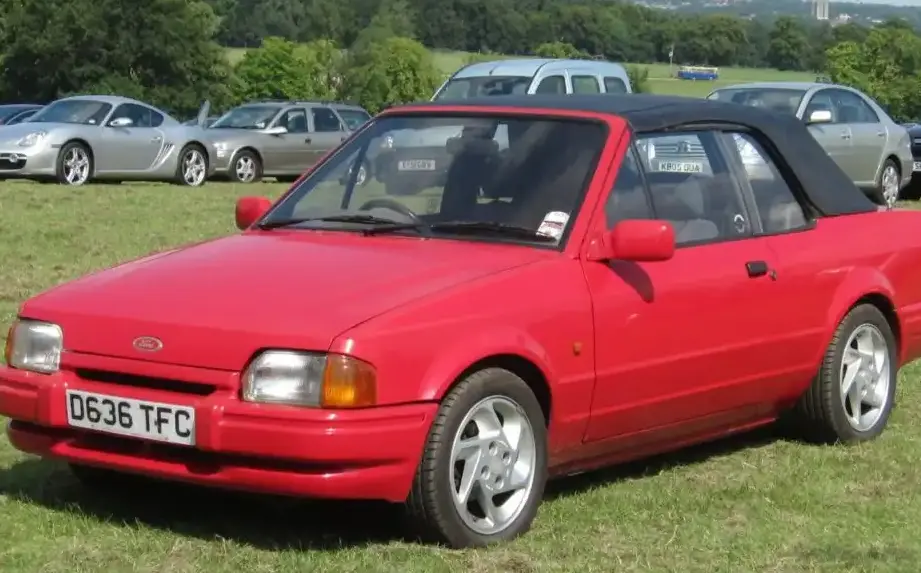
The Ford Escort IV Cabrio 1.6, producing 90 horsepower, was a variant of the fourth-generation Ford Escort, specifically the convertible (Cabriolet) model. Produced between 1986 and 1990, it represented a relatively affordable entry into open-top motoring for the European market. This model occupied a mid-range position within the Escort IV Cabrio lineup, offering a balance between performance and economy, appealing to buyers who desired the style of a convertible without the higher costs associated with the more powerful engine options. It was primarily sold in Europe, where the demand for compact convertibles was significant.
Technical Specifications
| Brand | Ford |
| Model | Escort |
| Generation | Escort IV Cabrio |
| Type (Engine) | 1.6 (90 Hp) |
| Start of production | 1986 |
| End of production | 1990 |
| Powertrain Architecture | Internal Combustion engine |
| Body type | Cabriolet |
| Fuel Type | Petrol (Gasoline) |
| Power | 90 Hp |
| Engine Model/Code | L4B, LUC |
| Engine aspiration | Naturally aspirated engine |
| Engine oil capacity | 3.5 l (3.7 US qt | 3.08 UK qt) |
| Coolant capacity | 7.9 l (8.35 US qt | 6.95 UK qt) |
Powertrain & Engine Architecture
The Escort IV Cabrio 1.6 utilized the Ford L4B or LUC engine, a 1.6-liter inline-four cylinder gasoline engine. This engine was a naturally aspirated unit, meaning it did not employ forced induction like a turbocharger or supercharger. The engine featured a single overhead camshaft (SOHC) valvetrain, operating two valves per cylinder. Fuel delivery was managed by a Bosch fuel injection system, a significant upgrade from the carburetors used in earlier Escort models, improving fuel efficiency and reducing emissions. The LUC variant, introduced later in the production run, featured minor refinements to the fuel injection system for improved performance and emissions compliance. The engine’s relatively simple design contributed to its reliability and ease of maintenance.
The 90 horsepower output was achieved at approximately 5,500 rpm, with peak torque of around 137 Nm (101 lb-ft) delivered at 3,500 rpm. This engine was typically paired with a four-speed automatic transmission, although a five-speed manual transmission was also available as an option. The automatic transmission, while offering convenience, did impact acceleration and fuel economy compared to the manual version. The transmission’s gear ratios were geared towards providing reasonable acceleration in everyday driving conditions, rather than outright performance.
Driving Characteristics
The Escort IV Cabrio 1.6 Automatic offered a comfortable, if not particularly sporty, driving experience. Acceleration from 0 to 60 mph (0 to 97 km/h) was typically around 12-13 seconds, making it slower than the manual transmission versions or those equipped with the larger 1.6 or 1.8-liter engines. The automatic transmission, while smooth in operation, could feel somewhat sluggish during quick overtaking maneuvers. The engine provided adequate power for cruising on highways and navigating city streets, but lacked the punch needed for spirited driving. The convertible top, while adding to the open-air enjoyment, did slightly compromise the car’s structural rigidity, resulting in a small amount of body flex over uneven road surfaces.
The steering was light and responsive, making the car easy to maneuver in tight spaces. The suspension, while not particularly sophisticated, provided a reasonably comfortable ride, absorbing most bumps and imperfections in the road surface. However, the car did exhibit some body roll during cornering, due to its relatively high center of gravity and soft suspension setup.
Equipment & Trim Levels
The Escort IV Cabrio 1.6 typically came equipped with a reasonable level of standard features for its time. These included cloth upholstery, a basic stereo system, and power steering. The interior was functional and relatively simple in design, with a focus on practicality rather than luxury. Optional extras included upgraded stereo systems, alloy wheels, and a more luxurious interior trim. The dashboard layout was straightforward, with clearly labeled controls and gauges. The convertible top was manually operated, although some later models were available with an optional electric operation.
Trim levels varied depending on the market, but generally, the 1.6-liter model represented a mid-range offering. It was positioned above the base models with smaller engines and fewer features, but below the higher-specification models with larger engines and more luxurious appointments.
Chassis & Braking
The Escort IV Cabrio utilized a MacPherson strut front suspension and a twist-beam rear suspension. The front suspension provided good handling characteristics, while the rear suspension offered a comfortable ride. Braking was typically accomplished with disc brakes on the front wheels and drum brakes on the rear wheels. The braking system was adequate for everyday driving, but lacked the stopping power of more modern braking systems. Anti-lock braking system (ABS) was not typically available on this model.
The chassis was reinforced to compensate for the lack of a fixed roof, but still exhibited some flex compared to the hardtop Escort models. Stabilizer bars were fitted to both the front and rear axles to reduce body roll during cornering.
Market Reception & Comparison
The Escort IV Cabrio 1.6 Automatic was generally well-received by critics as an affordable and stylish convertible. It was praised for its comfortable ride, ease of driving, and relatively low running costs. However, it was also criticized for its lack of outright performance and its somewhat dated interior. Compared to the manual transmission versions, the automatic model was noticeably slower and less fuel-efficient. Compared to the higher-specification models with larger engines, the 1.6-liter engine lacked the power and refinement of those units.
The 1.6-liter engine offered a good balance between performance and economy, making it a popular choice for buyers who primarily used the car for commuting and leisure driving. The automatic transmission appealed to those who preferred the convenience of not having to shift gears manually.
Legacy
The Ford Escort IV Cabrio 1.6 Automatic has become a popular classic car among enthusiasts. Its relatively simple mechanical design and readily available parts make it relatively easy to maintain and repair. The 1.6-liter engine is known for its reliability, although regular maintenance is essential to ensure its longevity. The automatic transmission, while not as durable as the manual transmission, can provide many years of reliable service with proper care. Today, well-maintained examples of the Escort IV Cabrio 1.6 Automatic are sought after by collectors and enthusiasts, representing a nostalgic reminder of a bygone era of affordable open-top motoring.