
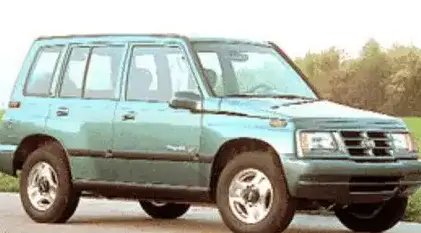
The Geo Tracker 1.6, producing 97 horsepower, was a compact SUV sold primarily in North America from 1988 to 1998. It represented a significant entry for General Motors into the rapidly growing small SUV segment, offering affordability and a degree of off-road capability. The Tracker was initially marketed under the Geo brand, a GM attempt to compete with Japanese imports, and later transitioned to Chevrolet after Geo was discontinued in 1997. This particular 1.6-liter, 97 hp variant with a 3-speed automatic transmission served as the base model, aimed at buyers prioritizing economy and ease of use over outright performance. It was a key component of the first generation Tracker (1989-1998), built on a ladder frame chassis and sharing many components with the Suzuki Sidekick, a result of GM’s partnership with Suzuki.
Technical Specifications
| Brand | Geo |
| Model | Tracker |
| Generation | Tracker (First Generation) |
| Type (Engine) | 1.6 (97 Hp) |
| Start of production | 1988 |
| End of production | 1998 |
| Powertrain Architecture | Internal Combustion engine |
| Body type | SUV |
| Fuel Type | Petrol (Gasoline) |
| Power | 97 Hp |
| Power per litre | 61 Hp/l |
| Engine Model/Code | L01 |
| Engine displacement | 1590 cm3 / 97.03 cu. in. |
| Number of cylinders | 4 |
| Engine configuration | Inline |
| Fuel injection system | Single-point injection |
| Engine aspiration | Naturally aspirated engine |
| Engine oil capacity | 4.2 l / 4.44 US qt | 3.7 UK qt |
| Coolant capacity | 5.3 l / 5.6 US qt | 4.66 UK qt |
| Number of gears and type of gearbox | 3 gears, automatic transmission |
| Steering type | Worm-reduction unit |
| Power steering | Hydraulic Steering |
| Tires size | 205/75 R15 |
| Wheel rims size | 15 |
Powertrain & Engine Architecture
The heart of the Geo Tracker 1.6 was the G16B engine, a 1.6-liter inline-four cylinder powerplant. Designated with the engine code L01 in many markets, this engine was a relatively simple design, reflecting its origins in Suzuki’s engineering. It featured a single overhead camshaft (SOHC) valvetrain with two valves per cylinder. Fuel delivery was handled by a single-point fuel injection system, a cost-effective solution common in vehicles of this era. While not particularly sophisticated, this system provided adequate fuel atomization for the engine’s modest power output. The engine’s block was cast iron, contributing to its durability, while the cylinder head was aluminum. The 3-speed automatic transmission, a common Aisin-Warner unit, was chosen for its simplicity and reliability. It wasn’t known for quick shifts or particularly refined operation, but it suited the Tracker’s intended purpose as a utilitarian vehicle. The transmission’s gear ratios were optimized for low-end torque and fuel efficiency, rather than acceleration.
Driving Characteristics
The 97 horsepower and approximately 108 lb-ft of torque produced by the 1.6-liter engine, coupled with the 3-speed automatic, resulted in modest but adequate performance. Acceleration was leisurely, and passing maneuvers required careful planning. The automatic transmission’s shift points were programmed for economy, meaning the engine often operated at higher RPMs during acceleration. This could be noticeable and contribute to a somewhat noisy driving experience. Compared to the available 1.9-liter engine option (found in later models and some trims), the 1.6L automatic Tracker felt significantly slower. The 1.9L offered a noticeable boost in power and torque, making it a more capable performer, especially when equipped with a manual transmission. However, the 1.6L’s simplicity and fuel efficiency were appealing to many buyers. Off-road, the Tracker 1.6’s relatively light weight and short wheelbase provided decent maneuverability, but its lack of low-end grunt limited its ability to tackle challenging terrain.
Equipment & Trim Levels
The base-model Geo Tracker 1.6 with the automatic transmission was typically sparsely equipped. Standard features generally included cloth upholstery, a basic AM/FM radio, and manual windows and door locks. Air conditioning was often an optional extra, as were power steering and upgraded audio systems. Interior trim was functional and durable, prioritizing practicality over luxury. The dashboard layout was straightforward, with clearly labeled controls. Higher trim levels, such as the LSi, offered additional features like upgraded interior materials, alloy wheels, and a more comprehensive audio system. However, the 1.6L automatic was primarily positioned as the entry-level model, appealing to budget-conscious buyers.
Chassis & Braking
The Geo Tracker utilized a traditional body-on-frame construction, providing a robust and durable platform. The suspension consisted of coil springs and shock absorbers all around, offering a reasonably comfortable ride for a small SUV. The front suspension featured independent double wishbones, while the rear suspension employed a solid axle with leaf springs. This setup provided adequate off-road capability, but it wasn’t particularly refined on paved roads. Braking duties were handled by disc brakes in the front and drum brakes in the rear. The braking system was adequate for the vehicle’s weight and performance, but it lacked the stopping power of more modern vehicles. A stabilizer bar was typically fitted to the front suspension to reduce body roll during cornering.
Market Reception & Comparison
The Geo Tracker 1.6 automatic received mixed reviews from automotive critics. While praised for its affordability and fuel efficiency (typically around 20-25 mpg combined), it was often criticized for its lack of power and refinement. Compared to other small SUVs of the time, such as the Honda CR-V and Toyota RAV4, the Tracker felt less sophisticated and offered a less engaging driving experience. However, its lower price point made it an attractive option for buyers on a tight budget. The 1.9-liter Tracker models were generally favored by reviewers for their improved performance. In terms of reliability, the Tracker 1.6 proved to be a relatively dependable vehicle, although the single-point fuel injection system could occasionally require maintenance.
Legacy
The Geo Tracker, and specifically the 1.6-liter automatic variant, holds a modest but enduring place in automotive history. It represented an important step for GM in the small SUV market and helped to popularize the segment. While not known for its performance or luxury, the Tracker’s affordability, durability, and off-road capability made it a popular choice for many buyers. Today, well-maintained examples of the Tracker 1.6 are becoming increasingly collectible, particularly among enthusiasts who appreciate its simplicity and ruggedness. The powertrain, while not particularly advanced, proved to be relatively reliable, and parts availability remains reasonably good. The Tracker’s legacy lies in its role as a practical and affordable SUV that provided a gateway to the segment for many drivers.
