
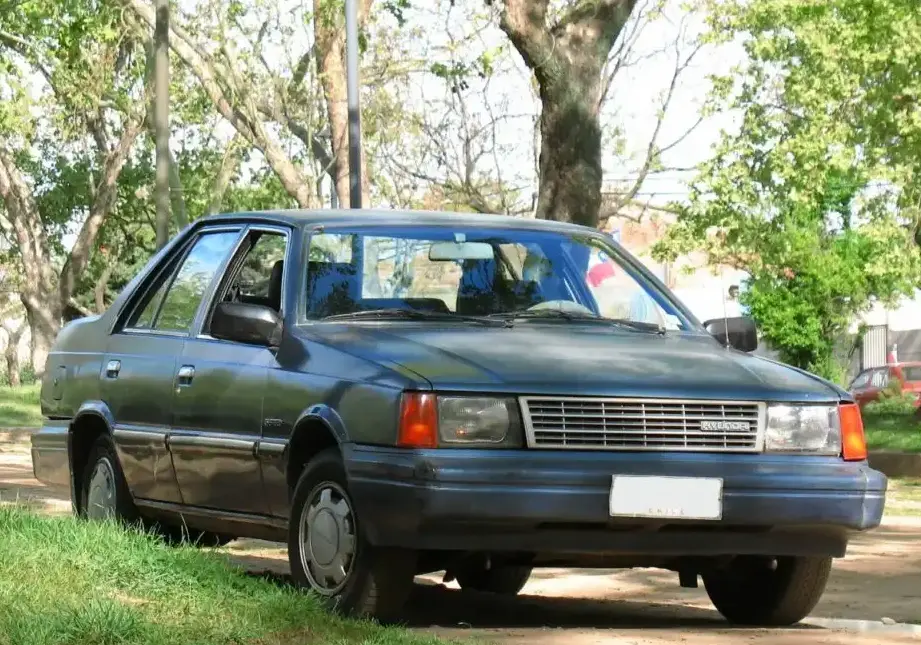
The Hyundai Stellar 2.0, producing 93 horsepower, represents a pivotal moment in the history of the South Korean automotive industry. Produced from 1983 to 1993, the Stellar was Hyundai’s first independently designed and manufactured passenger car. It marked a significant step away from the company’s earlier reliance on licensed production of foreign models, primarily those from Mitsubishi and Ford. The 2.0-liter variant, while not the most powerful in the Stellar lineup, was a mainstay, offering a balance of affordability and practicality for the burgeoning Korean middle class. It played a crucial role in establishing Hyundai as a legitimate automotive manufacturer both domestically and in select export markets.
Technical Specifications
| Brand | Hyundai |
| Model | Stellar |
| Generation | Stellar |
| Type (Engine) | 2.0 (93 Hp) |
| Start of production | 1983 |
| End of production | 1993 |
| Powertrain Architecture | Internal Combustion engine |
| Body type | Sedan |
| Seats | 5 |
| Doors | 4 |
| Fuel consumption (urban) | 14 l/100 km (16.8 US mpg, 20.2 UK mpg, 7.1 km/l) |
| Fuel consumption (extra urban) | 8 l/100 km (29.4 US mpg, 35.3 UK mpg, 12.5 km/l) |
| Fuel Type | Petrol (Gasoline) |
| Maximum speed | 175 km/h (108.74 mph) |
| Weight-to-power ratio | 13.2 kg/Hp (75.6 Hp/tonne) |
| Weight-to-torque ratio | 8.1 kg/Nm (122.8 Nm/tonne) |
| Power | 93 Hp @ 5500 rpm |
| Power per litre | 46.6 Hp/l |
| Torque | 151 Nm @ 3000 rpm (111.37 lb.-ft. @ 3000 rpm) |
| Engine layout | Front, Longitudinal |
| Engine displacement | 1997 cm3 (121.86 cu. in.) |
| Number of cylinders | 4 |
| Engine configuration | Inline |
| Cylinder Bore | 85 mm (3.35 in.) |
| Piston Stroke | 88 mm (3.46 in.) |
| Compression ratio | 8.5:1 |
| Number of valves per cylinder | 2 |
| Fuel injection system | Carburettor |
| Engine aspiration | Naturally aspirated engine |
| Kerb Weight | 1230 kg (2711.69 lbs.) |
| Fuel tank capacity | 54 l (14.27 US gal | 11.88 UK gal) |
| Length | 4415 mm (173.82 in.) |
| Width | 1715 mm (67.52 in.) |
| Height | 1370 mm (53.94 in.) |
| Wheelbase | 2580 mm (101.57 in.) |
| Front track | 1445 mm (56.89 in.) |
| Rear track | 1425 mm (56.1 in.) |
| Drivetrain Architecture | The Internal combustion engine (ICE) drives the rear wheels of the vehicle. |
| Drive wheel | Rear wheel drive |
| Number of gears and type of gearbox | 5 gears, manual transmission |
| Front suspension | Coil spring |
| Rear suspension | Coil spring |
| Front brakes | Disc |
| Rear brakes | Drum |
| Assisting systems | ABS (Anti-lock braking system) |
| Steering type | Steering rack and pinion |
| Power steering | Hydraulic Steering |
| Tires size | 185/70 SR13 |
Powertrain & Engine Architecture
The heart of the Stellar 2.0 was the Mitsubishi-derived 4G63 inline-four cylinder engine, displacing 1,997 cc (121.86 cubic inches). While Hyundai would later develop its own engine families, the 4G63 provided a reliable and relatively modern foundation for the Stellar. The 93 horsepower output was achieved through a single overhead camshaft (SOHC) valvetrain with two valves per cylinder. Fuel delivery was managed by a carburetor, a common feature for vehicles of this era, though less efficient than fuel injection. The engine’s longitudinal front-engine, rear-wheel-drive layout was a conventional setup for sedans of the time, offering balanced handling characteristics. The 5-speed manual transmission was the standard offering, providing drivers with full control over the engine’s power band.
Driving Characteristics
The Stellar 2.0 with the 5-speed manual transmission offered adequate, though not exhilarating, performance. Acceleration was modest, with a 0-60 mph time estimated around 12-13 seconds. The engine’s torque peak of 151 Nm (111.37 lb-ft) at 3000 rpm provided reasonable pulling power for everyday driving and highway cruising. The rear-wheel-drive configuration contributed to a balanced feel, although the relatively narrow tires (185/70 SR13) limited grip. Compared to potential higher-output variants (which were not widely available), the 2.0-liter model prioritized fuel economy and affordability over outright speed. The manual transmission allowed drivers to maximize the engine’s potential, while the gear ratios were tuned for a balance of acceleration and fuel efficiency.
Equipment & Trim Levels
The Stellar 2.0 was generally offered in a relatively basic trim level, reflecting its position as an entry-level or mid-range model. Standard features typically included cloth upholstery, a basic instrument cluster, and manual windows and locks. Air conditioning was often an optional extra, as were features like a radio and upgraded interior trim. The interior design was functional and straightforward, prioritizing practicality over luxury. The dashboard layout was simple and easy to use, with clearly labeled controls. While not lavishly equipped, the Stellar 2.0 provided a comfortable and functional driving environment for its target audience.
Chassis & Braking
The Stellar 2.0 utilized a body-on-frame construction, a common practice for vehicles of its era. The suspension consisted of coil springs all around, providing a reasonably comfortable ride. The front suspension featured independent coil springs, while the rear suspension employed a solid axle with coil springs. Braking duties were handled by disc brakes at the front and drum brakes at the rear. An anti-lock braking system (ABS) was available as an option, enhancing safety by preventing wheel lockup during hard braking. The steering system was a rack-and-pinion setup with hydraulic power steering, providing responsive and relatively effortless steering control.
Market Reception & Comparison
The Hyundai Stellar 2.0 was generally well-received in the Korean market, where it offered a compelling combination of affordability, practicality, and reliability. Critics praised the car’s spacious interior and comfortable ride. However, some noted the engine’s modest power output and the relatively basic interior appointments. Compared to other vehicles in its class, such as the Daewoo Maepsy and the Ford Cortina (which was also assembled in Korea), the Stellar 2.0 offered a competitive value proposition. Fuel economy was reasonable for the time, although not exceptional. Reliability was generally good, although maintenance costs could be higher due to the reliance on imported components.
Legacy
The Hyundai Stellar 2.0 holds a significant place in Korean automotive history as the first fully independent Hyundai passenger car. It laid the groundwork for the company’s future success and helped establish Hyundai as a major player in the global automotive market. While the Stellar itself is now a classic car, its powertrain and chassis design influenced subsequent Hyundai models. Today, well-maintained Stellar 2.0s are sought after by collectors and enthusiasts, representing a tangible piece of Korean automotive heritage. The 4G63 engine, in particular, remains a popular choice for engine swaps and modifications due to its durability and potential for performance upgrades. The Stellar 2.0, despite its age, continues to be remembered as a pioneering vehicle that helped shape the modern Korean automotive industry.
