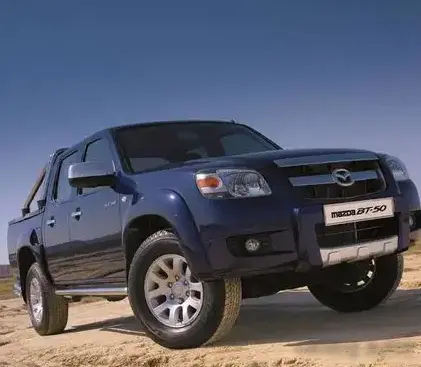
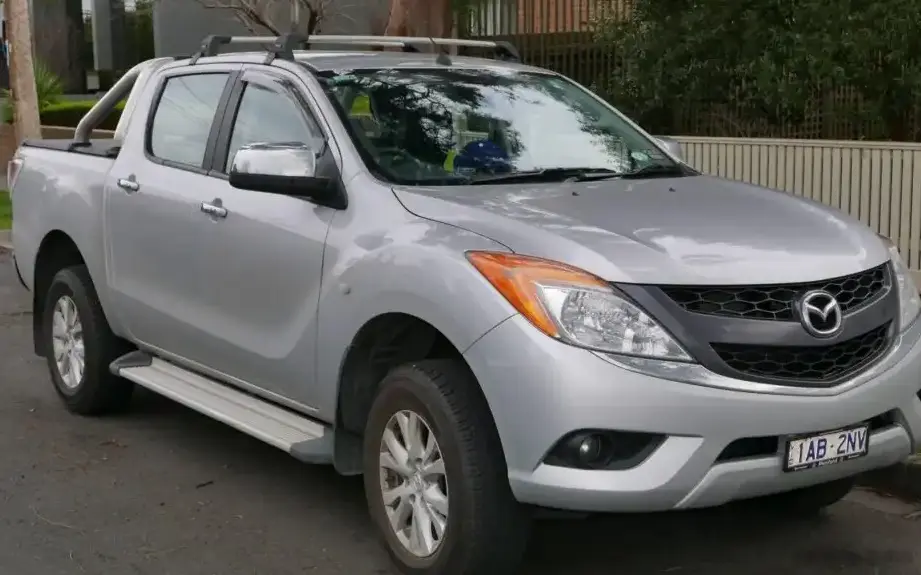
The Mazda BT-50 Freestyle Cab I (facelift 2008) 2.5 TD 4×4 represents Mazda’s entry into the increasingly popular one-tonne pickup truck segment. Produced from 2008 to 2011, this iteration of the BT-50 was a collaborative effort with Ford, sharing a platform and many components with the Ford Ranger T6. The “Freestyle Cab” body style offered a compromise between a traditional single cab and a full four-door cabin, featuring rear-hinged rear doors for improved access to the rear seats. This variant, equipped with the 2.5-liter turbodiesel engine producing 143 horsepower, was positioned as a workhorse offering a balance of capability, fuel efficiency, and affordability within the BT-50 lineup.
Technical Specifications
| Brand | Mazda |
| Model | BT-50 |
| Generation | BT-50 Freestyle Cab I (facelift 2008) |
| Type (Engine) | 2.5 TD (143 Hp) 4×4 |
| Start of production | 2008 |
| End of production | 2011 |
| Powertrain Architecture | Internal Combustion engine |
| Body type | Pick-up |
| Seats | 4 |
| Doors | 4 |
| Fuel consumption (urban) | 11.6 l/100 km (20.3 US mpg, 24.4 UK mpg, 8.6 km/l) |
| Fuel consumption (extra urban) | 8 l/100 km (29.4 US mpg, 35.3 UK mpg, 12.5 km/l) |
| Fuel consumption (combined) | 9.3 l/100 km (25.3 US mpg, 30.4 UK mpg, 10.8 km/l) |
| CO2 emissions | 255 g/km |
| Fuel Type | Diesel |
| Acceleration 0 – 100 km/h | 12.5 sec |
| Acceleration 0 – 62 mph | 12.5 sec |
| Acceleration 0 – 60 mph | 11.9 sec |
| Maximum speed | 158 km/h (98.18 mph) |
| Emission standard | Euro 4 |
| Weight-to-power ratio | 12.5 kg/Hp, 79.9 Hp/tonne |
| Weight-to-torque ratio | 5.4 kg/Nm, 184.4 Nm/tonne |
| Power | 143 Hp @ 3500 rpm |
| Power per litre | 57.2 Hp/l |
| Torque | 330 Nm @ 1800 rpm (243.4 lb.-ft. @ 1800 rpm) |
| Engine layout | Front, Longitudinal |
| Engine Model/Code | WLAA |
| Engine displacement | 2499 cm3 (152.5 cu. in.) |
| Number of cylinders | 4 |
| Engine configuration | Inline |
| Cylinder Bore | 93 mm (3.66 in.) |
| Piston Stroke | 92 mm (3.62 in.) |
| Compression ratio | 18.1:1 |
| Number of valves per cylinder | 4 |
| Fuel injection system | Diesel Commonrail |
| Engine aspiration | Turbocharger, Intercooler |
| Engine oil capacity | 7 l (7.4 US qt | 6.16 UK qt) |
| Coolant | 8.8 l (9.3 US qt | 7.74 UK qt) |
| Kerb Weight | 1790-1885 kg (3946.27 – 4155.71 lbs.) |
| Max. weight | 2990 kg (6591.82 lbs.) |
| Max load | 1105-1200 kg (2436.11 – 2645.55 lbs.) |
| Fuel tank capacity | 70 l (18.49 US gal | 15.4 UK gal) |
| Permitted trailer load with brakes (12%) | 3000 kg (6613.87 lbs.) |
| Permitted trailer load without brakes | 750 kg (1653.47 lbs.) |
| Length | 5075 mm (199.8 in.) |
| Width | 1805 mm (71.06 in.) |
| Height | 1745-1750 mm (68.7 – 68.9 in.) |
| Wheelbase | 3000 mm (118.11 in.) |
| Front track | 1445-1475 mm (56.89 – 58.07 in.) |
| Rear (Back) track | 1440-1470 mm (56.69 – 57.87 in.) |
| Front overhang | 885 mm (34.84 in.) |
| Rear overhang | 1190 mm (46.85 in.) |
| Ride height (ground clearance) | 207 mm (8.15 in.) |
| Minimum turning circle | 12.6 m (41.34 ft.) |
| Approach angle | 34° |
| Departure angle | 33° |
| Ramp-over angle | 22° |
| Wading depth | 750 mm (29.53 in.) |
| Drivetrain Architecture | The Internal combustion engine (ICE) drives permanently the four wheels of the vehicle. |
| Drive wheel | All wheel drive (4×4) |
| Number of gears and type of gearbox | 5 gears, manual transmission |
| Front suspension | Double wishbone |
| Rear suspension | Leaf spring |
| Front brakes | Ventilated discs, 289 mm |
| Rear brakes | Drum, 295 mm |
| Assisting systems | ABS (Anti-lock braking system) |
| Steering type | Steering rack and pinion |
| Power steering | Hydraulic Steering |
| Tires size | 235/75 R15; 245/70 R16 |
| Wheel rims size | 15; 16 |
Powertrain & Engine Architecture
The heart of this BT-50 variant is the WLAA 2.5-liter inline-four turbodiesel engine. This engine, a product of Mazda’s diesel technology, featured a common-rail direct injection system, delivering fuel at extremely high pressure for improved combustion efficiency and reduced emissions. The turbocharger, coupled with an intercooler, boosted power output to 143 horsepower at 3500 rpm and 330 Nm (243 lb-ft) of torque at 1800 rpm. The engine’s robust construction and relatively simple design contributed to its durability. The transmission is a five-speed manual gearbox, chosen for its reliability and cost-effectiveness. While an automatic transmission was offered on other BT-50 trims, it wasn’t available with this specific engine and 4×4 configuration.
Driving Characteristics
The 2.5 TD 4×4 BT-50 offered a practical and capable driving experience. The 143 horsepower and 330 Nm of torque provided adequate power for everyday tasks and moderate towing duties. Acceleration from 0-60 mph took around 11.9 seconds, and top speed was limited to 158 km/h (98 mph). The manual transmission allowed for precise control, but the gear ratios were geared towards fuel efficiency and low-end torque rather than outright performance. Compared to the more powerful 3.0-liter engine options, this variant felt less refined and required more gear changes during acceleration or when climbing hills. However, it offered better fuel economy and a more manageable driving experience for those prioritizing practicality over speed.
Equipment & Trim Levels
The Freestyle Cab 2.5 TD 4×4 typically came with a fairly basic level of equipment, reflecting its position as a work-oriented trim. Standard features generally included air conditioning, power steering, central locking, and an AM/FM radio. Interior upholstery was typically vinyl or a durable cloth material. Optional extras could include alloy wheels, a CD player, and upgraded interior trim. The Freestyle Cab configuration featured rear-hinged rear doors, providing easier access to the rear seats compared to a traditional extended cab.
Chassis & Braking
The BT-50’s chassis was designed for durability and load-carrying capacity. The front suspension utilized a double wishbone setup, while the rear suspension employed leaf springs, a common configuration for pickup trucks. This setup provided a comfortable ride, even when carrying heavy loads. Braking duties were handled by ventilated discs at the front and drum brakes at the rear. ABS (Anti-lock Braking System) was standard, enhancing safety during emergency braking situations. The 4×4 system offered part-time four-wheel drive, selectable via a rotary dial, providing increased traction in off-road conditions.
Market Reception & Comparison
The BT-50 2.5 TD 4×4 was generally well-received as a capable and affordable workhorse. Critics praised its fuel efficiency and durability, but noted that its performance was modest compared to some of its competitors. Compared to the higher-spec BT-50 models with the 3.0-liter engine, this variant offered a more economical option for buyers who didn’t require the extra power. Its fuel economy of around 25.3 US mpg combined was competitive for its class. Reliability was generally good, with the WLAA engine proving to be a robust and dependable unit.
Legacy
The Mazda BT-50 Freestyle Cab I (facelift 2008) 2.5 TD 4×4 remains a relatively common sight on used car markets. The WLAA engine is known for its longevity, and with proper maintenance, these trucks can continue to provide reliable service for many years. While not as sought-after as the higher-powered variants, the 2.5 TD 4×4 offers a cost-effective entry point into the BT-50 ownership experience, appealing to buyers who prioritize practicality, fuel efficiency, and durability over outright performance. Parts availability is generally good, thanks to the shared components with the Ford Ranger.