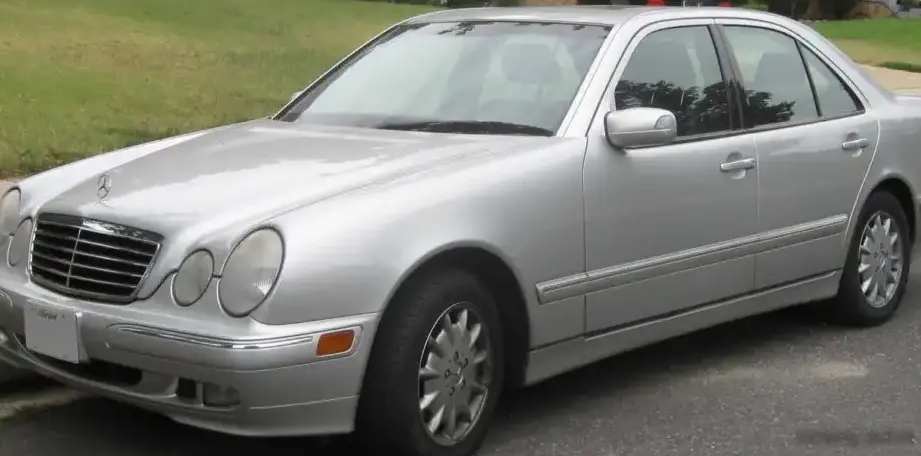
The Mercedes-Benz E 220 CDI, produced from July 1999 to March 2002, was a key variant within the facelifted W210 E-Class range. Representing a significant step towards diesel efficiency and refinement for Mercedes-Benz, this model aimed to provide a balance between economy, performance, and the luxury expected of the E-Class. It occupied a mid-range position in the lineup, slotting below the more powerful E 320 CDI and above the entry-level E 200 CDI. The W210 facelift, introduced in 1999, addressed many criticisms of the pre-facelift models, improving build quality and aesthetics, and the E 220 CDI benefited from these enhancements.
Technical Specifications
| Brand | Mercedes-Benz |
| Model | E-class |
| Generation | E-class (W210, facelift 1999) |
| Type (Engine) | E 220 CDI (143 Hp) |
| Start of production | July, 1999 |
| End of production | March, 2002 |
| Powertrain Architecture | Internal Combustion engine |
| Body type | Sedan |
| Seats | 5 |
| Doors | 4 |
| Fuel consumption (urban) | 8.5 l/100 km (27.7 US mpg, 33.2 UK mpg, 11.8 km/l) |
| Fuel consumption (extra urban) | 4.8 l/100 km (49 US mpg, 58.9 UK mpg, 20.8 km/l) |
| Fuel consumption (combined) | 6.2 l/100 km (37.9 US mpg, 45.6 UK mpg, 16.1 km/l) |
| Fuel Type | Diesel |
| Acceleration 0 – 100 km/h | 10.4 sec |
| Acceleration 0 – 62 mph | 10.4 sec |
| Acceleration 0 – 60 mph | 9.9 sec |
| Maximum speed | 213 km/h (132.35 mph) |
| Weight-to-power ratio | 11.1 kg/Hp, 89.9 Hp/tonne |
| Weight-to-torque ratio | 5 kg/Nm, 198.1 Nm/tonne |
| Power | 143 Hp @ 4200 rpm |
| Power per litre | 66.6 Hp/l |
| Torque | 315 Nm @ 1800 rpm (232.33 lb.-ft. @ 1800 rpm) |
| Engine layout | Front, Longitudinal |
| Engine Model/Code | OM 611 DE 22 LA / 611.961 |
| Engine displacement | 2148 cm3 (131.08 cu. in.) |
| Number of cylinders | 4 |
| Engine configuration | Inline |
| Cylinder Bore | 88 mm (3.46 in.) |
| Piston Stroke | 88.3 mm (3.48 in.) |
| Compression ratio | 18:1 |
| Number of valves per cylinder | 4 |
| Fuel injection system | Diesel Commonrail |
| Engine aspiration | Turbocharger, Intercooler |
| Valvetrain | DOHC |
| Engine oil capacity | 6 l (6.34 US qt | 5.28 UK qt) |
| Coolant | 9.5 l (10.04 US qt | 8.36 UK qt) |
| Kerb Weight | 1590 kg (3505.35 lbs.) |
| Max. weight | 2090 kg (4607.66 lbs.) |
| Max load | 500 kg (1102.31 lbs.) |
| Trunk (boot) space – minimum | 520 l (18.36 cu. ft.) |
| Fuel tank capacity | 65 l (17.17 US gal | 14.3 UK gal) |
| Length | 4818 mm (189.69 in.) |
| Width | 1799 mm (70.83 in.) |
| Height | 1440 mm (56.69 in.) |
| Wheelbase | 2833 mm (111.54 in.) |
| Front track | 1542 mm (60.71 in.) |
| Rear (Back) track | 1536 mm (60.47 in.) |
| Drag coefficient (Cd) | 0.28 |
| Drivetrain Architecture | The Internal combustion engine (ICE) drives the rear wheels of the vehicle. |
| Drive wheel | Rear wheel drive |
| Number of gears and type of gearbox | 6 gears, manual transmission |
| Front suspension | Double wishbone |
| Rear suspension | Independent multi-link spring suspension with stabilizer |
| Front brakes | Ventilated discs |
| Rear brakes | Disc |
| Assisting systems | ABS (Anti-lock braking system) |
| Steering type | Steering rack and pinion |
| Power steering | Hydraulic Steering |
| Tires size | 205/65 R16 |
| Wheel rims size | 7J x 15 |
Powertrain & Engine Architecture
The heart of the E 220 CDI is the OM 611 DE 22 LA engine, a 2.2-liter inline-four cylinder diesel. This engine represented a significant advancement in Mercedes-Benz’s diesel technology, utilizing a common rail direct injection system. This system, supplied by Bosch, allowed for more precise fuel delivery, resulting in improved combustion efficiency, reduced noise, and lower emissions. The engine featured a turbocharger with an intercooler, boosting power output to 143 horsepower at 4200 rpm and 315 Nm (232 lb-ft) of torque at a low 1800 rpm. The DOHC valvetrain, with four valves per cylinder, further enhanced the engine’s breathing and overall performance. The standard transmission for this model was a 6-speed manual gearbox, providing a good balance between fuel economy and driver control. While an automatic transmission was available, it was often criticized for being somewhat sluggish compared to the manual.
Driving Characteristics
The E 220 CDI with the manual transmission offered a surprisingly engaging driving experience. While not a sports car, the engine’s ample torque made it feel responsive in everyday driving situations. The 6-speed gearbox allowed for efficient cruising on the highway, while also providing enough gears for quick acceleration when needed. The gear ratios were well-matched to the engine’s powerband, ensuring that the engine remained in its optimal torque range most of the time. Compared to the higher-output E 320 CDI, the E 220 CDI felt less powerful, but it also offered better fuel economy and a more relaxed driving experience. The automatic transmission versions, while convenient, suffered from noticeable delays in shifting and a tendency to hunt for gears, diminishing the overall driving enjoyment.
Equipment & Trim Levels
The E 220 CDI typically came equipped with a respectable level of standard features, including automatic climate control, power windows and mirrors, central locking, and an audio system. Interior upholstery was usually cloth, although leather was available as an option. The dashboard layout was typical of the W210 facelift, with a functional and understated design. Optional extras included a sunroof, heated seats, a premium audio system, and parking sensors. The trim level could vary depending on the market, but generally, the E 220 CDI was positioned as a well-equipped mid-range offering.
Chassis & Braking
The W210 E-Class featured a robust chassis with a double wishbone front suspension and an independent multi-link rear suspension. This setup provided a comfortable ride and good handling characteristics. The E 220 CDI typically came equipped with ventilated disc brakes at the front and solid disc brakes at the rear. ABS (Anti-lock Braking System) was standard, enhancing safety and stability during braking. The steering was a hydraulic power-assisted rack and pinion system, providing precise and responsive steering feel.
Market Reception & Comparison
The E 220 CDI was generally well-received by critics and consumers alike. It was praised for its fuel efficiency, comfortable ride, and refined interior. However, some critics noted that the engine could be somewhat noisy compared to its gasoline counterparts. Compared to other trims in the E-Class lineup, the E 220 CDI offered a compelling value proposition, providing a good balance between performance, economy, and luxury. It was a popular choice for drivers who prioritized fuel efficiency and long-distance comfort.
Legacy
The OM 611 engine family, including the DE 22 LA variant found in the E 220 CDI, proved to be remarkably durable and reliable. With proper maintenance, these engines can easily exceed 200,000 miles. Today, the W210 E 220 CDI remains a relatively affordable and practical classic car. While finding well-maintained examples can be challenging, they offer a unique blend of Mercedes-Benz luxury and diesel efficiency. The common rail injection system, while advanced for its time, can be susceptible to issues if not properly maintained, and finding parts for some components may become increasingly difficult over time. Nevertheless, the E 220 CDI remains a testament to Mercedes-Benz’s engineering prowess and a popular choice for enthusiasts seeking a reliable and economical classic.