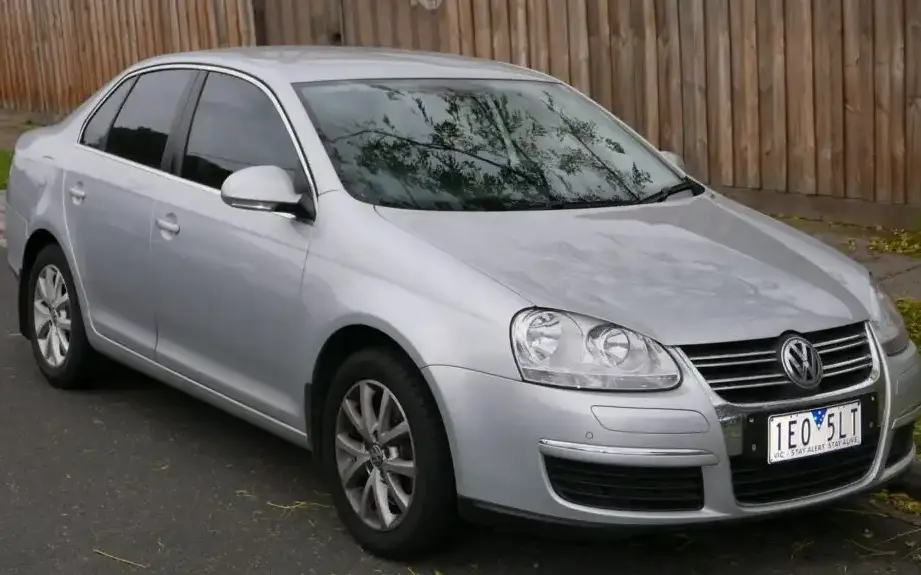
The Volkswagen Jetta V 1.9 TDI PDE (105 hp) was a popular variant of the fifth-generation Jetta (2005-2009), primarily sold in Europe and other markets outside of North America. This model represented a key offering in Volkswagen’s diesel lineup, balancing fuel efficiency with reasonable performance. It occupied a mid-range position within the Jetta V series, slotting below the more powerful petrol engines and above the base-level trims. The “PDE” designation refers to the Pump-nozzle Diesel Engine technology employed, a sophisticated direct injection system.
Technical Specifications
| Brand | Volkswagen |
| Model | Jetta |
| Generation | Jetta V |
| Type (Engine) | 1.9 TDI PDE (105 Hp) |
| Start of production | 2005 |
| End of production | 2009 |
| Powertrain Architecture | Internal Combustion engine |
| Body type | Sedan |
| Seats | 5 |
| Doors | 4 |
| Fuel consumption (urban) | 6.7 l/100 km (35.1 US mpg, 42.2 UK mpg, 14.9 km/l) |
| Fuel consumption (extra urban) | 4.6 l/100 km (51.1 US mpg, 61.4 UK mpg, 21.7 km/l) |
| Fuel consumption (combined) | 5.3 l/100 km (44.4 US mpg, 53.3 UK mpg, 18.9 km/l) |
| Fuel Type | Diesel |
| Acceleration 0 – 100 km/h | 11.9 sec |
| Acceleration 0 – 62 mph | 11.9 sec |
| Acceleration 0 – 60 mph | 11.3 sec |
| Maximum speed | 189 km/h (117.44 mph) |
| Emission standard | Euro 4 |
| Weight-to-power ratio | 12.8 kg/Hp, 78.1 Hp/tonne |
| Weight-to-torque ratio | 5.4 kg/Nm, 185.9 Nm/tonne |
| Power | 105 Hp @ 4000 rpm |
| Power per litre | 55.4 Hp/l |
| Torque | 250 Nm @ 1900 rpm (184.39 lb.-ft. @ 1900 rpm) |
| Engine layout | Front, Transverse |
| Engine Model/Code | EA188 / BXE |
| Engine displacement | 1896 cm3 (115.7 cu. in.) |
| Number of cylinders | 4 |
| Engine configuration | Inline |
| Cylinder Bore | 79.5 mm (3.13 in.) |
| Piston Stroke | 95.5 mm (3.76 in.) |
| Compression ratio | 19:1 |
| Number of valves per cylinder | 2 |
| Fuel injection system | Pump-nozzle (Unit Injector) |
| Engine aspiration | Turbocharger, Intercooler |
| Engine oil capacity | 3.8 l (4.02 US qt | 3.34 UK qt) |
| Coolant | 8 l (8.45 US qt | 7.04 UK qt) |
| Kerb Weight | 1345 kg (2965.22 lbs.) |
| Max. weight | 1940 kg (4276.97 lbs.) |
| Max load | 595 kg (1311.75 lbs.) |
| Trunk (boot) space – minimum | 527 l (18.61 cu. ft.) |
| Fuel tank capacity | 55 l (14.53 US gal | 12.1 UK gal) |
| Length | 4554 mm (179.29 in.) |
| Width | 1781 mm (70.12 in.) |
| Height | 1459 mm (57.44 in.) |
| Wheelbase | 2578 mm (101.5 in.) |
| Front track | 1534 mm (60.39 in.) |
| Rear (Back) track | 1512 mm (59.53 in.) |
| Minimum turning circle | 10.9 m (35.76 ft.) |
| Drivetrain Architecture | Front wheel drive |
| Number of gears | 5 |
| Gearbox type | Manual transmission |
| Front suspension | Coil spring, Wishbone, Transverse stabilizer |
| Rear suspension | Independent multi-link suspension, Transverse stabilizer |
| Front brakes | Ventilated discs |
| Rear brakes | Disc |
| Assisting systems | ABS (Anti-lock braking system) |
| Steering type | Steering rack and pinion |
| Power steering | Electric Steering |
| Tires size | 205/55 R16 |
| Wheel rims size | 6.5 x 16 |
INTRODUCTION
The Jetta V, produced from 2005 to 2010, represented a significant step forward for Volkswagen’s compact sedan. Built on the A5 platform (also known as the 1HX0 platform), it offered improved refinement, safety features, and a wider range of engine options compared to its predecessor. The 1.9 TDI PDE (105 hp) variant was a mainstay in European markets, appealing to drivers seeking economical transportation without sacrificing practicality. This engine was particularly popular in countries with high fuel costs and stringent emissions regulations.
Powertrain & Engine Architecture
The heart of this Jetta variant is the 1.9-liter inline-four cylinder diesel engine, specifically the EA188 series, often identified by the engine code BXE. This engine utilizes Volkswagen’s Pump-nozzle (PDE) direct injection technology. Unlike common rail systems, PDE uses a high-pressure pump for each cylinder, resulting in precise fuel delivery and improved combustion efficiency. The engine features a single overhead camshaft (SOHC) operating two valves per cylinder. A turbocharger with an intercooler is employed to boost power and torque. The five-speed manual transmission was standard, providing a balance between fuel economy and drivability. The transmission’s gear ratios were tuned to maximize the engine’s torque output, offering good acceleration in everyday driving situations.
Driving Characteristics
The 105 hp 1.9 TDI offered a respectable, if not exhilarating, driving experience. Acceleration from 0-60 mph took around 11.3 seconds, and top speed was approximately 117 mph. While not as quick as the higher-powered petrol versions of the Jetta V, the TDI provided ample torque – 250 Nm (184 lb-ft) – from low engine speeds. This made it well-suited for highway cruising and overtaking maneuvers. The five-speed manual transmission allowed for precise control, but the gear ratios were somewhat widely spaced, requiring occasional downshifts for optimal performance. Compared to the 1.6L petrol engine, the 1.9 TDI offered significantly more torque and better fuel economy. However, it lacked the responsiveness and higher revving nature of the petrol engines.
Equipment & Trim Levels
The 1.9 TDI PDE (105 hp) Jetta V typically came equipped with a reasonable level of standard features. These included power windows, central locking, air conditioning, and an audio system. Interior upholstery was usually cloth, with options for upgraded materials available. Trim levels varied depending on the market, but generally included base, Trendline, and Comfortline variants. The Comfortline trim added features such as alloy wheels, a multi-function steering wheel, and upgraded interior trim. Optional extras included a sunroof, navigation system, and parking sensors.
Chassis & Braking
The Jetta V featured a MacPherson strut front suspension and an independent multi-link rear suspension, providing a comfortable and controlled ride. Stabilizer bars were fitted to both axles to reduce body roll during cornering. The braking system consisted of ventilated disc brakes at the front and solid disc brakes at the rear. Anti-lock Braking System (ABS) was standard. The suspension setup was tuned to prioritize comfort and stability, rather than outright sportiness. The chassis was robust and well-engineered, contributing to the Jetta V’s reputation for reliability.
Market Reception & Comparison
The Jetta V 1.9 TDI PDE (105 hp) was well-received by automotive critics for its fuel efficiency, practicality, and comfortable ride. It was often praised as a sensible and economical choice for everyday transportation. Compared to the more powerful petrol versions, the TDI offered superior fuel economy and lower running costs. However, some critics noted that the engine could be somewhat noisy and lacked the refinement of some competitors. Against other diesel offerings in its class, such as the Ford Focus TDCi, the Jetta V TDI held its own in terms of performance and fuel economy.
Legacy
The 1.9 TDI engine, in various iterations, proved to be remarkably durable and reliable. The BXE engine code, found in this Jetta V variant, is known for its longevity when properly maintained. Today, used examples of the Jetta V 1.9 TDI PDE (105 hp) are still relatively common, and well-maintained vehicles can offer years of reliable service. However, potential buyers should be aware of the potential for wear and tear on components such as the turbocharger and fuel injectors. The Jetta V 1.9 TDI remains a popular choice for those seeking an economical and practical compact sedan with a proven track record.