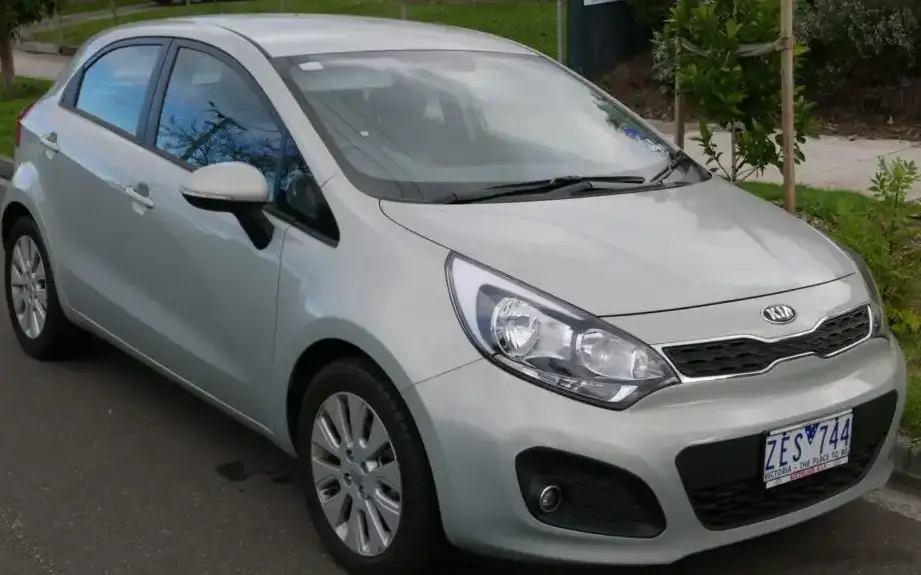
The Kia Rio UB, produced from 2011 to 2015, represented Kia’s third-generation offering in the subcompact hatchback segment. The 1.4 16V automatic variant, powered by the G4FA engine producing 109 horsepower, was positioned as a mainstream, comfort-oriented option within the Rio lineup. It aimed to provide a balance between affordability, fuel efficiency, and ease of driving, appealing to a broad customer base seeking a practical and reliable daily commuter. This model was primarily marketed in Europe, Asia, and parts of South America, with the automatic transmission being a key feature for markets where manual transmissions were less popular.
Technical Specifications
| Brand | Kia |
| Model | Rio |
| Generation | Rio III Hatchback (UB) |
| Type (Engine) | 1.4 16V (109 Hp) automatic |
| Start of production | June, 2011 |
| End of production | 2015 |
| Powertrain Architecture | Internal Combustion engine |
| Body type | Hatchback |
| Seats | 5 |
| Doors | 5 |
| Fuel consumption (urban) | 8.4 l/100 km (28 US mpg, 33.6 UK mpg, 11.9 km/l) |
| Fuel consumption (extra urban) | 5.3 l/100 km (44.4 US mpg, 53.3 UK mpg, 18.9 km/l) |
| Fuel consumption (combined) | 6.4 l/100 km (36.8 US mpg, 44.1 UK mpg, 15.6 km/l) |
| Fuel Type | Petrol (Gasoline) |
| Acceleration 0 – 100 km/h | 13.2 sec |
| Acceleration 0 – 62 mph | 13.2 sec |
| Acceleration 0 – 60 mph | 12.5 sec |
| Maximum speed | 170 km/h (105.63 mph) |
| Emission standard | Euro 5 |
| Weight-to-power ratio | 10 kg/Hp, 99.7 Hp/tonne |
| Weight-to-torque ratio | 8 kg/Nm, 125.3 Nm/tonne |
| Power | 109 Hp |
| Power per litre | 78.1 Hp/l |
| Torque | 137 Nm @ 4200 rpm (101.05 lb.-ft. @ 4200 rpm) |
| Engine layout | Front, Transverse |
| Engine Model/Code | G4FA |
| Engine displacement | 1396 cm3 (85.19 cu. in.) |
| Number of cylinders | 4 |
| Engine configuration | Inline |
| Number of valves per cylinder | 4 |
| Fuel injection system | Multi-port manifold injection |
| Engine aspiration | Naturally aspirated engine |
| Valvetrain | DOHC |
| Engine oil capacity | 3.3 l (3.49 US qt | 2.9 UK qt) |
| Coolant capacity | 5.5 l (5.81 US qt | 4.84 UK qt) |
| Kerb Weight | 1093 kg (2409.65 lbs.) |
| Max. weight | 1630 kg (3593.53 lbs.) |
| Max load | 537 kg (1183.88 lbs.) |
| Trunk (boot) space – minimum | 224 l (7.91 cu. ft.) |
| Fuel tank capacity | 43 l (11.36 US gal | 9.46 UK gal) |
| Length | 4045 mm (159.25 in.) |
| Width | 1720 mm (67.72 in.) |
| Height | 1455 mm (57.28 in.) |
| Wheelbase | 2570 mm (101.18 in.) |
| Front track | 1521 mm (59.88 in.) |
| Rear (Back) track | 1525 mm (60.04 in.) |
| Minimum turning circle | 10.5 m (34.45 ft.) |
| Drivetrain Architecture | The Internal combustion engine (ICE) drives the front wheels of the vehicle. |
| Drive wheel | Front wheel drive |
| Number of gears | 4 gears, automatic transmission |
| Assisting systems | ABS (Anti-lock braking system) |
| Steering type | Steering rack and pinion |
| Tires size | 185/65 R15; 195/55 R16; 205/45 R17 |
| Wheel rims size | 15; 16; 17 |
Powertrain & Engine Architecture
The heart of the Rio 1.4 automatic is the Kia-developed G4FA engine, a 1.4-liter inline-four cylinder gasoline engine. This engine utilizes a multi-point fuel injection system, delivering fuel directly into the intake ports. The engine features a double overhead camshaft (DOHC) valvetrain, operating 16 valves (four per cylinder) to optimize airflow and combustion efficiency. The G4FA is a naturally aspirated engine, meaning it doesn’t employ turbocharging or supercharging. The four-speed automatic transmission, while providing convenience, was a relatively conventional design for its time. It featured electronically controlled shifting, but lacked the efficiency and responsiveness of more modern transmissions with greater gear counts.
Driving Characteristics
The 109 hp output and four-speed automatic combination resulted in a driving experience focused on practicality rather than performance. Acceleration was modest, with a 0-60 mph time around 12.5 seconds. The automatic transmission’s gear ratios were tuned for fuel economy and smooth operation, rather than aggressive acceleration. Compared to the manual transmission versions of the 1.4, the automatic offered less driver engagement and slightly reduced fuel efficiency. Higher-output versions of the Rio, such as those equipped with a larger 1.6-liter engine, provided noticeably quicker acceleration and a more dynamic driving experience. The automatic transmission, while comfortable, could feel somewhat sluggish during overtaking maneuvers.
Equipment & Trim Levels
The 1.4 automatic Rio typically came with a reasonable level of standard equipment. This included air conditioning, power windows, central locking, and a basic audio system with CD player and auxiliary input. Safety features such as ABS (Anti-lock Braking System) and dual front airbags were also standard. Higher trim levels offered options like alloy wheels, a more advanced audio system with Bluetooth connectivity, and a sunroof. Interior upholstery was typically cloth, with a relatively simple dashboard layout. The overall interior design prioritized functionality and durability over luxury.
Chassis & Braking
The Rio UB utilized a front-wheel-drive platform with a MacPherson strut front suspension and a torsion beam rear suspension. This setup provided a comfortable ride quality, suitable for everyday driving conditions. Braking systems varied depending on the trim level, with lower trims often featuring drum brakes on the rear wheels and disc brakes on the front. Higher trims typically had disc brakes on all four wheels. Stabilizer bars were included on both axles to reduce body roll during cornering. The chassis was designed to provide a balance between handling and ride comfort, prioritizing stability and predictability over sporty handling characteristics.
Market Reception & Comparison
The Kia Rio 1.4 automatic was generally well-received as an affordable and practical subcompact hatchback. Critics praised its value for money, comfortable ride, and relatively spacious interior. However, the four-speed automatic transmission was often criticized for its lack of responsiveness and fuel efficiency compared to newer automatic transmissions. Compared to competitors like the Ford Fiesta, Volkswagen Polo, and Renault Clio, the Rio offered a competitive price point and a longer warranty, which were key selling points. Fuel economy was comparable to other vehicles in its class, but not class-leading.
Legacy
The Kia Rio UB 1.4 automatic, while not a performance standout, proved to be a reliable and durable vehicle. The G4FA engine, when properly maintained, is known for its longevity. In the used car market, these Rios are often sought after as affordable and dependable transportation. Common maintenance issues include wear and tear on suspension components and occasional issues with the automatic transmission. However, parts availability is generally good, and repair costs are relatively low. The Rio UB helped establish Kia as a credible player in the European and Asian subcompact car market, paving the way for future generations of Rio models.