
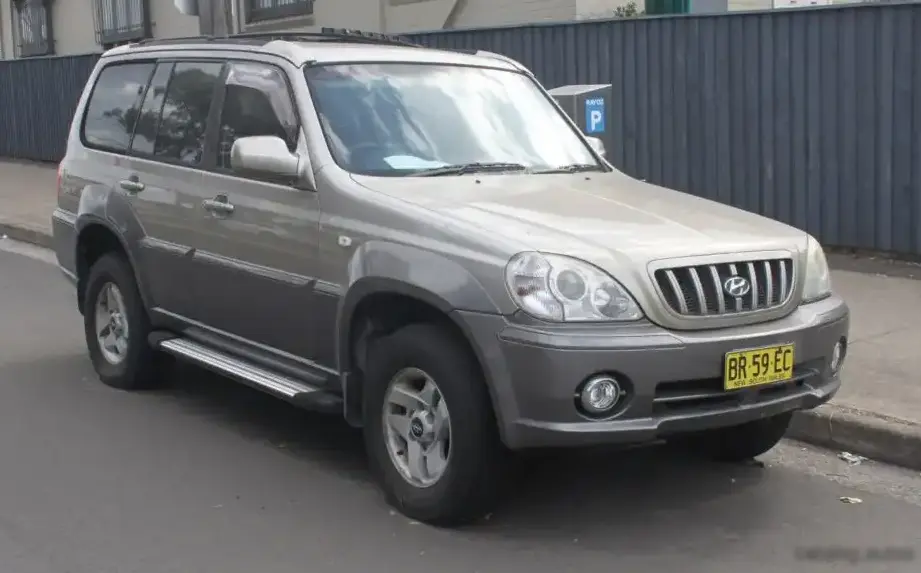
The Hyundai Terracan 2.9 CRDi, produced between 2004 and 2006, was Hyundai’s entry into the mid-size SUV market, primarily aimed at offering a robust and capable vehicle at a competitive price point. Positioned as a more affordable alternative to established Japanese and European SUVs, the Terracan sought to gain traction with buyers needing space, all-wheel drive capability, and diesel fuel efficiency. This specific 2.9 CRDi variant, producing 163 horsepower, represented a mid-range offering within the Terracan lineup, slotting between lower-powered engine options and potential higher-specification trims depending on regional markets. The Terracan was never officially sold in the United States, making it a relatively uncommon sight even among Hyundai enthusiasts.
Technical Specifications
| Brand | Hyundai |
| Model | Terracan |
| Generation | Terracan |
| Type (Engine) | 2.9 CRDi (163 Hp) |
| Start of production | 2004 |
| End of production | 2006 |
| Powertrain Architecture | Internal Combustion engine |
| Body type | SUV |
| Seats | 5 |
| Doors | 5 |
| Fuel consumption (urban) | 10.9 l/100 km (21.6 US mpg) |
| Fuel consumption (extra urban) | 7.4 l/100 km (31.8 US mpg) |
| Fuel consumption (combined) | 8.7 l/100 km (27 US mpg) |
| Fuel Type | Diesel |
| Acceleration 0 – 100 km/h | 13 sec |
| Acceleration 0 – 62 mph | 13 sec |
| Acceleration 0 – 60 mph | 12.4 sec |
| Maximum speed | 168 km/h (104.39 mph) |
| Weight-to-power ratio | 12.7 kg/Hp |
| Weight-to-torque ratio | 6 kg/Nm |
| Power | 163 Hp @ 2800 rpm |
| Torque | 345 Nm @ 1750 rpm (254.46 lb.-ft. @ 1750 rpm) |
| Engine layout | Front, Longitudinal |
| Engine Model/Code | J3 |
| Engine displacement | 2902 cm3 (177.09 cu. in.) |
| Number of cylinders | 4 |
| Engine configuration | Inline |
| Cylinder Bore | 97.1 mm (3.82 in.) |
| Piston Stroke | 98 mm (3.86 in.) |
| Compression ratio | 19.4:1 |
| Number of valves per cylinder | 4 |
| Fuel injection system | Diesel Commonrail |
| Engine aspiration | Turbocharger, Intercooler |
| Engine oil capacity | 6 l (6.34 US qt | 5.28 UK qt) |
| Coolant capacity | 9 l (9.51 US qt | 7.92 UK qt) |
| Kerb Weight | 2065 kg (4552.55 lbs.) |
| Max. weight | 2620 kg (5776.11 lbs.) |
| Max load | 555 kg (1223.57 lbs.) |
| Trunk (boot) space – minimum | 1170 l (41.32 cu. ft.) |
| Trunk (boot) space – maximum | 1955 l (69.04 cu. ft.) |
| Fuel tank capacity | 75 l (19.81 US gal | 16.5 UK gal) |
| Length | 4710 mm (185.43 in.) |
| Width | 1860 mm (73.23 in.) |
| Height | 1790 mm (70.47 in.) |
| Wheelbase | 2750 mm (108.27 in.) |
| Front track | 1500 mm (59.06 in.) |
| Rear track | 1500 mm (59.06 in.) |
| Drive wheel | All wheel drive (4×4) |
| Number of gears | 5 |
| Gearbox type | Manual transmission |
| Front suspension | Double wishbone |
| Rear suspension | Coil spring |
| Front brakes | Ventilated discs |
| Rear brakes | Disc |
| Assisting systems | ABS (Anti-lock braking system) |
| Steering type | Steering rack and pinion |
| Power steering | Hydraulic |
| Tires size | 255/65 R16 |
Powertrain & Engine Architecture
The heart of the Terracan 2.9 CRDi is the Hyundai J3 engine, a 2.9-liter inline-four cylinder diesel. This engine utilizes a common-rail direct injection system, a technology that significantly improved fuel efficiency and reduced noise compared to older diesel injection methods. The J3 engine benefits from a turbocharger with an intercooler, boosting power output to 163 horsepower and 345 Nm (254 lb-ft) of torque. The engine’s 19.4:1 compression ratio is typical for a diesel engine, contributing to its efficiency. The 5-speed manual transmission was the standard offering for this engine, providing a balance between fuel economy and drivability. While an automatic transmission was available in some markets, it wasn’t as commonly paired with the 2.9 CRDi as the manual.
Driving Characteristics
The Terracan 2.9 CRDi with a manual transmission offered a reasonably responsive driving experience for its class. Acceleration from 0-60 mph took around 12.4 seconds, which was adequate but not particularly brisk. The engine’s torque peak at 1750 rpm provided good pulling power for everyday driving and towing, making it suitable for hauling loads or navigating challenging terrain. The manual gearbox allowed for greater driver control, but the shift quality wasn’t always as refined as that of its Japanese competitors. Compared to potential higher-output versions (if offered in certain markets), the 163 hp variant prioritized fuel economy and affordability over outright performance.
Equipment & Trim Levels
The Terracan 2.9 CRDi typically came equipped with a reasonable level of standard features. These generally included air conditioning, power windows, central locking, and an AM/FM radio. Higher trim levels, depending on the market, could add features like alloy wheels, a sunroof, leather upholstery, and upgraded audio systems. Safety features were relatively basic for the time, typically including ABS brakes and driver/passenger airbags. The interior design was functional and durable, prioritizing practicality over luxury.
Chassis & Braking
The Terracan utilized a body-on-frame construction, a traditional SUV design that provided robustness and off-road capability. The front suspension employed a double wishbone setup, while the rear featured a coil spring arrangement. Braking duties were handled by ventilated discs at the front and solid discs at the rear. The all-wheel-drive system was typically part-time, allowing the driver to select between 2WD and 4WD modes. Stabilizer bars were fitted to both the front and rear axles to reduce body roll during cornering.
Market Reception & Comparison
The Hyundai Terracan was generally well-received as a value-for-money SUV, particularly in markets where affordability was a key consideration. Critics praised its spacious interior, robust construction, and capable all-wheel-drive system. However, it was often criticized for its relatively basic interior, somewhat agricultural engine noise, and less refined driving experience compared to established competitors like the Toyota Land Cruiser Prado or Mitsubishi Pajero. Fuel economy was a strong point, offering competitive figures for a vehicle of its size and capability. Compared to lower-powered Terracan variants, the 2.9 CRDi offered a noticeable performance improvement, making it a more appealing option for drivers who frequently carried passengers or cargo.
Legacy
The Hyundai Terracan, while not a long-lived model, laid the groundwork for Hyundai’s later success in the SUV market. The 2.9 CRDi engine proved to be relatively reliable, although regular maintenance is crucial for any diesel engine. On the used car market, Terracans are often sought after by buyers looking for a capable and affordable off-road vehicle. Parts availability can be a concern in some regions, but the engine’s robust design and relatively simple mechanics make it a viable option for those willing to undertake some maintenance themselves. The Terracan represents a significant step forward for Hyundai in terms of engineering and build quality, demonstrating the brand’s growing ambition in the global automotive landscape.
