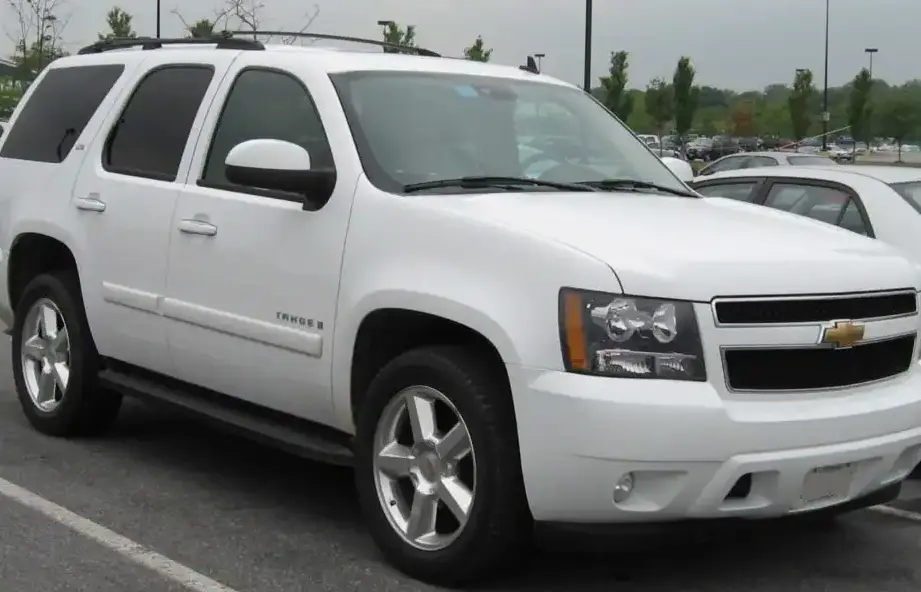
The Chevrolet Tahoe GMT900, specifically the 6.0L V8 (370 hp) Hybrid CVT model, represented a significant step in blending full-size SUV capability with improved fuel efficiency. Produced from 2009 to 2013, this variant occupied a unique position within the second generation Tahoe (GMT900 series), aiming to appeal to buyers seeking the space and towing capacity of a traditional Tahoe but with a reduced environmental impact. It was positioned as a premium offering, bridging the gap between the standard V8 models and the more expensive, fully-equipped trims.
Technical Specifications
| Brand | Chevrolet |
| Model | Tahoe |
| Generation | Tahoe (GMT900) |
| Type (Engine) | 6.0 V8 (370 Hp) Hybrid CVT |
| Start of production | 2009 |
| End of production | 2013 |
| Powertrain Architecture | FHEV (Full Hybrid Electric Vehicle) |
| Body type | SUV |
| Seats | 8 |
| Doors | 5 |
| Fuel consumption (urban) | 11.2 l/100 km (21 US mpg) |
| Fuel consumption (extra urban) | 10.6 l/100 km (22.2 US mpg) |
| Fuel Type | Petrol (Gasoline) |
| Weight-to-power ratio | 6.9 kg/Hp |
| Weight-to-torque ratio | 4 kg/Nm |
| Electric motor power | 82 Hp |
| Electric motor Torque | 320 Nm (236.02 lb.-ft.) |
| System power | 370 Hp @ 5100 rpm |
| System torque | 640 Nm @ 4100 rpm (472.04 lb.-ft. @ 4100 rpm) |
| Internal combustion engine power | 332 Hp @ 5100 rpm |
| Internal combustion engine torque | 498 Nm @ 4100 rpm (367.31 lb.-ft. @ 4100 rpm) |
| Maximum engine speed | 6000 rpm |
| Engine layout | Front, Longitudinal |
| Engine Model/Code | LFA |
| Engine displacement | 5965 cm3 (364.01 cu. in.) |
| Number of cylinders | 8 |
| Engine configuration | V-engine |
| Cylinder Bore | 101.6 mm (4 in.) |
| Piston Stroke | 92 mm (3.62 in.) |
| Compression ratio | 10.8:1 |
| Number of valves per cylinder | 2 |
| Fuel injection system | Multi-port manifold injection |
| Valvetrain | OHV |
| Engine oil capacity | 5.7 l (6.02 US qt | 5.02 UK qt) |
| Coolant capacity | 17.3 l (18.28 US qt | 15.22 UK qt) |
| Kerb Weight | 2548 kg (5617.38 lbs.) |
| Max. weight | 3220 kg (7098.88 lbs.) |
| Max load | 672 kg (1481.51 lbs.) |
| Trunk (boot) space – minimum | 478 l (16.88 cu. ft.) |
| Trunk (boot) space – maximum | 3084 l (108.91 cu. ft.) |
| Fuel tank capacity | 93 l (24.57 US gal | 20.46 UK gal) |
| Permitted trailer load with brakes (12%) | 2812 kg (6199.4 lbs.) |
| Length | 5130 mm (201.97 in.) |
| Width | 2007 mm (79.02 in.) |
| Height | 1954 mm (76.93 in.) |
| Wheelbase | 2946 mm (115.98 in.) |
| Front track | 1732 mm (68.19 in.) |
| Rear (Back) track | 1702 mm (67.01 in.) |
| Ride height (ground clearance) | 229 mm (9.02 in.) |
| Drag coefficient (Cd) | 0.34 |
| Minimum turning circle (turning diameter) | 11.9 m (39.04 ft.) |
| Approach angle | 17° |
| Departure angle | 21.9° |
| Drive wheel | Rear wheel drive |
| Number of gears and type of gearbox | automatic transmission CVT |
| Front suspension | Independent coil spring |
| Rear suspension | Independent multi-link suspension |
| Front brakes | Ventilated discs |
| Rear brakes | Disc |
| Assisting systems | ABS (Anti-lock braking system) |
| Steering type | Steering rack and pinion |
| Tires size | 265/65 R18 |
| Wheel rims size | 8.0J x 18 |
Powertrain & Engine Architecture
The heart of the Tahoe Hybrid was the 6.0-liter LFA V8 engine. This engine utilized a cast iron block and aluminum cylinder heads, featuring a traditional overhead valve (OHV) valvetrain and multi-port fuel injection. The engine produced 332 horsepower and 367 lb-ft of torque on its own. However, the hybrid system added a significant boost. An 82-horsepower electric motor, powered by a nickel-metal hydride battery pack, worked in conjunction with the V8. The system seamlessly blended power from both sources, resulting in a combined output of 370 horsepower and 472 lb-ft of torque. The Continuously Variable Transmission (CVT) was a key component, allowing the engine to operate at its most efficient RPM regardless of vehicle speed. This was a departure from the traditional automatic transmissions found in other Tahoe models.
Driving Characteristics
The 6.0L Hybrid CVT Tahoe offered a noticeably different driving experience compared to its V8-only siblings. The CVT, while efficient, lacked the direct feel of a traditional automatic. Acceleration was smooth and linear, but didn’t provide the immediate punch of the 6-speed automatic found in other Tahoe trims. The electric motor provided instant torque at low speeds, aiding in city driving and initial acceleration. However, at highway speeds, the engine often relied heavily on the V8, and the CVT’s programming sometimes resulted in the engine droning under heavy load. The hybrid system did improve fuel economy, but the added weight of the battery pack and electric motor slightly diminished the Tahoe’s overall towing capacity compared to non-hybrid models.
Equipment & Trim Levels
The Tahoe Hybrid was generally well-equipped, often including features like tri-zone automatic climate control, a premium sound system, leather upholstery, and power-adjustable front seats. Standard safety features included ABS, stability control, and multiple airbags. Optional extras included a navigation system, rear-seat entertainment system, and power-folding rear seats. The interior trim was typically more upscale than the base Tahoe models, reflecting its higher price point. The exterior styling was largely similar to other GMT900 Tahoes, with subtle hybrid badging being the primary visual differentiator.
Chassis & Braking
The Tahoe Hybrid utilized a body-on-frame construction, typical of full-size SUVs. It featured an independent coil spring front suspension and an independent multi-link rear suspension. The braking system consisted of ventilated discs at the front and solid discs at the rear. The ABS system was standard. Due to the added weight of the hybrid components, the suspension was often tuned slightly firmer to maintain stability and handling. The rear axle ratio was optimized for fuel efficiency, which could slightly impact towing performance compared to models with different gearing.
Market Reception & Comparison
The Tahoe Hybrid received mixed reviews. Critics praised its improved fuel economy compared to traditional V8 Tahoes, but some found the CVT transmission to be less engaging. The higher price tag also presented a barrier to entry for some buyers. Compared to the standard 5.3L V8 Tahoe, the Hybrid offered better fuel economy but less towing capacity and a different driving feel. Against the 6.2L V8 Tahoe, the Hybrid offered comparable power but a more complex and potentially more expensive-to-maintain powertrain. Fuel economy figures were around 21 mpg city and 22 mpg highway, a noticeable improvement over the non-hybrid models.
Legacy
The Chevrolet Tahoe Hybrid GMT900 represented an early attempt to bring hybrid technology to the full-size SUV segment. While it didn’t achieve widespread popularity, it paved the way for future hybrid and electric SUVs from Chevrolet. The LFA engine, while not known for exceptional reliability, proved to be reasonably durable with proper maintenance. The CVT transmission, however, remains a potential point of concern for used car buyers, as it can be more expensive to repair or replace than a traditional automatic. Today, the GMT900 Hybrid Tahoe is a relatively rare sight on the used car market, often appealing to buyers seeking a unique and somewhat more fuel-efficient full-size SUV.