
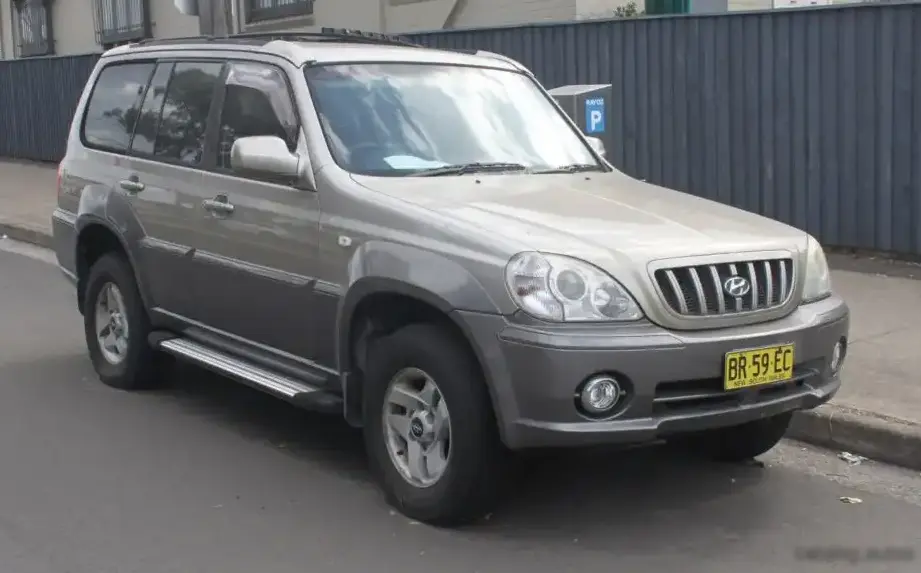
The Hyundai Terracan 2.9 CRDi Automatic, produced between 2004 and 2006, represents Hyundai’s entry into the mid-size SUV market, primarily aimed at offering a robust and capable vehicle at a competitive price point. Positioned as a mid-range offering within the Terracan lineup, it slotted between the base gasoline models and potentially higher-trim diesel variants depending on regional availability. The Terracan, internally designated as the HP, was Hyundai’s first attempt at a dedicated SUV platform, diverging from earlier models that were often based on pickup truck chassis. This model was primarily sold in markets outside of North America, finding popularity in Europe, Australia, and parts of Asia.
Technical Specifications
| Brand | Hyundai |
| Model | Terracan |
| Generation | Terracan |
| Type (Engine) | 2.9 CRDi (163 Hp) Automatic |
| Start of production | 2004 |
| End of production | 2006 |
| Powertrain Architecture | Internal Combustion engine |
| Body type | SUV |
| Seats | 5 |
| Doors | 5 |
| Fuel consumption (urban) | 11.5 l/100 km (20.5 US mpg) |
| Fuel consumption (extra urban) | 7.5 l/100 km (31.4 US mpg) |
| Fuel consumption (combined) | 8.7 l/100 km (27 US mpg) |
| Fuel Type | Diesel |
| Acceleration 0 – 100 km/h | 13.4 sec |
| Acceleration 0 – 62 mph | 13.4 sec |
| Acceleration 0 – 60 mph | 12.7 sec |
| Maximum speed | 172 km/h (106.88 mph) |
| Weight-to-power ratio | 12.7 kg/Hp |
| Weight-to-torque ratio | 6 kg/Nm |
| Power | 163 Hp @ 2800 rpm |
| Torque | 345 Nm @ 1750 rpm (254.46 lb.-ft. @ 1750 rpm) |
| Engine layout | Front, Longitudinal |
| Engine Model/Code | J3 |
| Engine displacement | 2902 cm3 (177.09 cu. in.) |
| Number of cylinders | 4 |
| Engine configuration | Inline |
| Cylinder Bore | 97.1 mm (3.82 in.) |
| Piston Stroke | 98 mm (3.86 in.) |
| Compression ratio | 19.4:1 |
| Number of valves per cylinder | 4 |
| Fuel injection system | Diesel Commonrail |
| Engine aspiration | Turbocharger, Intercooler |
| Engine oil capacity | 6 l (6.34 US qt | 5.28 UK qt) |
| Coolant capacity | 9 l (9.51 US qt | 7.92 UK qt) |
| Kerb Weight | 2065 kg (4552.55 lbs.) |
| Max. weight | 2620 kg (5776.11 lbs.) |
| Max load | 555 kg (1223.57 lbs.) |
| Trunk (boot) space – minimum | 1170 l (41.32 cu. ft.) |
| Trunk (boot) space – maximum | 1955 l (69.04 cu. ft.) |
| Fuel tank capacity | 75 l (19.81 US gal | 16.5 UK gal) |
| Length | 4710 mm (185.43 in.) |
| Width | 1860 mm (73.23 in.) |
| Height | 1790 mm (70.47 in.) |
| Wheelbase | 2750 mm (108.27 in.) |
| Front track | 1500 mm (59.06 in.) |
| Rear track | 1500 mm (59.06 in.) |
| Drive wheel | All wheel drive (4×4) |
| Number of gears | 4 |
| Gearbox type | Automatic transmission |
| Front suspension | Double wishbone |
| Rear suspension | Coil spring |
| Front brakes | Ventilated discs |
| Rear brakes | Disc |
| Assisting systems | ABS (Anti-lock braking system) |
| Steering type | Steering rack and pinion |
| Power steering | Hydraulic |
| Tires size | 255/65 R16 |
| Wheel rims size | 16 |
Powertrain & Engine Architecture
The heart of the Terracan 2.9 CRDi Automatic is the Hyundai J3 engine, a 2.9-liter inline-four cylinder diesel. This engine utilizes a common-rail direct injection (CRDi) system, a technology that significantly improved fuel efficiency and reduced noise compared to older diesel injection methods. The CRDi system, supplied by Bosch, injects fuel directly into the cylinders at extremely high pressure, optimizing combustion. The J3 engine features a single turbocharger with an intercooler, boosting power output to 163 horsepower at 2800 rpm and 345 Nm (254.46 lb-ft) of torque at 1750 rpm. The automatic transmission is a conventional four-speed unit, chosen for its ease of use and suitability for a wider range of drivers. While not offering the efficiency of more modern transmissions, it provided smooth shifts and adequate performance for typical SUV duties.
Driving Characteristics
The 2.9 CRDi Automatic Terracan delivers a driving experience focused on practicality and capability rather than outright performance. The 13.4-second 0-60 mph acceleration time reflects this. The engine’s torque peak at 1750 rpm provides reasonable pulling power for everyday driving and towing, but the four-speed automatic transmission limits its ability to keep the engine in its optimal power band. Compared to a manual transmission version (if available in certain markets), the automatic sacrifices some responsiveness. Against higher-output diesel variants, the 2.9 CRDi feels noticeably less powerful, particularly when fully loaded or tackling steep inclines. However, the automatic transmission makes it a more comfortable choice for urban driving and long journeys.
Equipment & Trim Levels
The Terracan 2.9 CRDi Automatic typically came equipped with a reasonable level of standard features. These generally included air conditioning, power windows and locks, a basic audio system, and ABS brakes. Interior upholstery was usually cloth, with options for leather upgrades depending on the market and trim level. Optional extras could include a sunroof, upgraded audio systems, alloy wheels, and parking sensors. The dashboard layout was functional and straightforward, prioritizing usability over aesthetic flair. The trim level of the 2.9 CRDi Automatic often positioned it as a mid-range offering, bridging the gap between basic workhorse models and more luxurious trims.
Chassis & Braking
The Terracan utilizes a body-on-frame construction, a traditional SUV design that prioritizes durability and off-road capability. The front suspension employs a double wishbone setup, while the rear features a coil spring arrangement. This configuration provides a comfortable ride on paved roads, although it can exhibit some body roll during cornering. Braking duties are handled by ventilated discs at the front and solid discs at the rear. ABS (Anti-lock Braking System) was standard, enhancing safety during emergency braking situations. The steering is rack and pinion with hydraulic assistance, providing a reasonably direct feel.
Market Reception & Comparison
The Hyundai Terracan 2.9 CRDi Automatic was generally well-received as a value-for-money SUV. Critics praised its spacious interior, robust build quality, and capable diesel engine. However, the four-speed automatic transmission was often cited as a weakness, hindering performance and fuel economy compared to more modern transmissions. Compared to competitors like the Mitsubishi Pajero or Toyota Land Cruiser, the Terracan offered a more affordable entry point, but lacked the same level of refinement and brand prestige. Fuel economy was respectable for its class, averaging around 27 US mpg in combined driving conditions. Reliability was generally good, although some owners reported issues with the turbocharger and fuel injection system.
Legacy
The Hyundai Terracan, while not a long-lived model, played a significant role in establishing Hyundai as a credible SUV manufacturer. The 2.9 CRDi Automatic powertrain, while not without its flaws, proved to be relatively durable and reliable. On the used car market, Terracans are often sought after for their affordability and off-road capability. However, potential buyers should be aware of the age-related issues common to older diesel engines, such as turbocharger wear and potential problems with the fuel injection system. Parts availability can vary depending on the region, but generally remains adequate. The Terracan represents a pivotal moment in Hyundai’s history, demonstrating their ambition to compete in the global SUV market.
