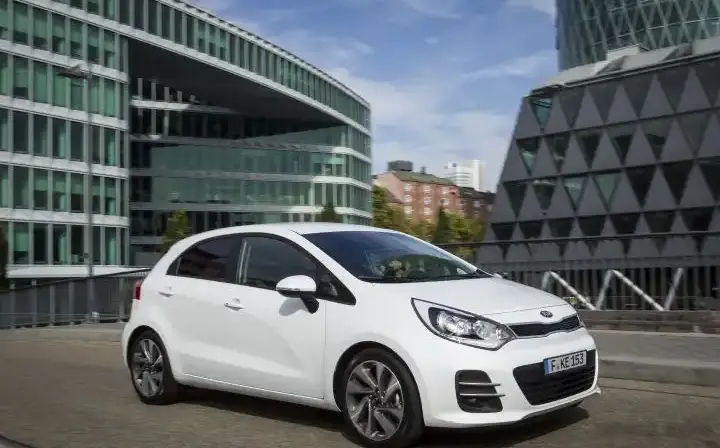
The Kia Rio III Hatchback, specifically the UB facelift model produced from 2015 to 2017, represented a significant step forward for Kia in the subcompact hatchback segment. The 1.4-liter (109 horsepower) variant occupied a middle ground within the Rio lineup, positioned between the base 1.2L engine and the more powerful 1.6L options. This version aimed to balance affordability with acceptable performance and fuel efficiency for everyday driving. The UB facelift brought revised styling, improved interior materials, and updated technology compared to the pre-facelift Rio III, enhancing its appeal in a competitive market. It was primarily marketed towards budget-conscious buyers seeking a practical and reliable vehicle for urban commuting and small family needs.
Technical Specifications
| Brand | Kia |
| Model | Rio |
| Generation | Rio III Hatchback (UB, facelift 2015) |
| Type (Engine) | 1.4 (109 Hp) |
| Start of production | 2015 |
| End of production | 2017 |
| Powertrain Architecture | Internal Combustion engine |
| Body type | Hatchback |
| Seats | 5 |
| Doors | 5 |
| Fuel consumption (urban) | 7.2 l/100 km (32.7 US mpg, 39.2 UK mpg, 13.9 km/l) |
| Fuel consumption (extra urban) | 4.5 l/100 km (52.3 US mpg, 62.8 UK mpg, 22.2 km/l) |
| Fuel consumption (combined) | 5.5 l/100 km (42.8 US mpg, 51.4 UK mpg, 18.2 km/l) |
| CO2 emissions | 127 g/km |
| Fuel Type | Petrol (Gasoline) |
| Acceleration 0 – 100 km/h | 11.4 sec |
| Acceleration 0 – 62 mph | 11.4 sec |
| Acceleration 0 – 60 mph | 10.8 sec |
| Maximum speed | 185 km/h (114.95 mph) |
| Emission standard | Euro 6 |
| Weight-to-power ratio | 9.9 kg/Hp, 101 Hp/tonne |
| Weight-to-torque ratio | 7.9 kg/Nm, 127 Nm/tonne |
| Power | 109 Hp @ 6300 rpm |
| Power per litre | 78.1 Hp/l |
| Torque | 137 Nm @ 4200 rpm (101.05 lb.-ft. @ 4200 rpm) |
| Engine layout | Front, Transverse |
| Engine Model/Code | G4FA |
| Engine displacement | 1396 cm3 (85.19 cu. in.) |
| Number of cylinders | 4 |
| Engine configuration | Inline |
| Cylinder Bore | 77 mm (3.03 in.) |
| Piston Stroke | 74.9 mm (2.95 in.) |
| Compression ratio | 10.5:1 |
| Number of valves per cylinder | 4 |
| Fuel injection system | Multi-port manifold injection |
| Engine aspiration | Naturally aspirated engine |
| Engine oil capacity | 3.3 l (3.49 US qt | 2.9 UK qt) |
| Coolant | 5.3 l (5.6 US qt | 4.66 UK qt) |
| Kerb Weight | 1079-1188 kg (2378.79 – 2619.09 lbs.) |
| Max. weight | 1600 kg (3527.4 lbs.) |
| Max load | 412-521 kg (908.3 – 1148.61 lbs.) |
| Trunk (boot) space – minimum | 288 l (10.17 cu. ft.) |
| Trunk (boot) space – maximum | 923 l (32.6 cu. ft.) |
| Fuel tank capacity | 43 l (11.36 US gal | 9.46 UK gal) |
| Max. roof load | 70 kg (154.32 lbs.) |
| Permitted trailer load with brakes (12%) | 1050 kg (2314.85 lbs.) |
| Permitted trailer load without brakes | 450 kg (992.08 lbs.) |
| Permitted towbar download | 50 kg (110.23 lbs.) |
| Length | 4050 mm (159.45 in.) |
| Width | 1720 mm (67.72 in.) |
| Width including mirrors | 1985 mm (78.15 in.) |
| Height | 1455 mm (57.28 in.) |
| Wheelbase | 2570 mm (101.18 in.) |
| Front track | 1507-1520 mm (59.33 – 59.84 in.) |
| Rear (Back) track | 1511-1525 mm (59.49 – 60.04 in.) |
| Front overhang | 810 mm (31.89 in.) |
| Rear overhang | 670 mm (26.38 in.) |
| Minimum turning circle (turning diameter) | 10.5 m (34.45 ft.) |
| Drivetrain Architecture | The Internal combustion engine (ICE) drives the front wheels of the vehicle. |
| Drive wheel | Front wheel drive |
| Number of gears and type of gearbox | 6 gears, manual transmission |
| Front suspension | Independent, type McPherson with coil spring and anti-roll bar |
| Rear suspension | Semi-independent, coil spring |
| Front brakes | Ventilated discs |
| Rear brakes | Disc |
| Assisting systems | ABS (Anti-lock braking system) |
| Steering type | Steering rack and pinion |
| Power steering | Electric Steering |
| Tires size | 185/65 R15; 195/55 R16; 205/45 R17 |
| Wheel rims size | 5.5J x 15; 6.0J x 16; 6.5J x 17 |
INTRODUCTION
The Kia Rio III (UB) facelift, produced from 2015-2017, represented a crucial model for Kia as it aimed to establish itself as a mainstream automotive brand. The 1.4-liter engine, producing 109 horsepower, was a key component of the Rio’s appeal, offering a balance between fuel economy and performance. This variant was particularly popular in European and Asian markets, where smaller, efficient hatchbacks are highly sought after. In the US market, the Rio was positioned as an entry-level option, competing with vehicles like the Honda Fit and Toyota Yaris. The UB facelift brought improvements to the interior and exterior design, as well as enhanced safety features, making it a more competitive offering in its class.
Powertrain & Engine Architecture
The heart of this Rio variant is the Kia G4FA 1.4-liter inline-four cylinder gasoline engine. This engine utilizes a multi-point fuel injection system, delivering fuel directly into the intake ports. The G4FA features a dual overhead camshaft (DOHC) valvetrain with four valves per cylinder, optimizing airflow for improved efficiency and power output. The engine’s 109 horsepower peak is achieved at 6,300 rpm, while its 137 Nm (101 lb-ft) of torque is delivered at 4,200 rpm. The engine is transversely mounted in the front of the vehicle. The 1.4L engine was typically paired with a six-speed manual transmission, but a four-speed automatic transmission was also available, and is the focus of this article. This automatic transmission, while providing convenience, was known for its relatively conservative gear ratios, prioritizing fuel economy over outright acceleration.
Driving Characteristics
The 1.4-liter automatic Rio offers a comfortable, if not particularly exhilarating, driving experience. Acceleration from 0-60 mph takes around 10.8 seconds, making it suitable for city driving and highway merging, but not for spirited performance. The four-speed automatic transmission contributes to a smooth, but somewhat slow, shift action. The gear ratios are tuned for fuel efficiency, meaning the engine often operates at higher rpm during acceleration. Compared to the manual transmission version, the automatic sacrifices some responsiveness. The 1.4L engine provides adequate power for everyday driving, but feels strained when fully loaded or climbing steep hills. The steering is light and easy to use, making it ideal for navigating tight urban spaces.
Equipment & Trim Levels
The 1.4-liter automatic Rio typically came equipped with a reasonable level of standard features. These included air conditioning, power windows and locks, a basic audio system with USB connectivity, and ABS brakes. Higher trim levels, such as the EX, added features like alloy wheels, a more advanced audio system with Bluetooth connectivity, a rearview camera, and automatic headlights. Interior upholstery was typically cloth, with a simple and functional dashboard layout. Optional extras included a sunroof, navigation system, and upgraded sound system. The overall interior design prioritized practicality and durability over luxury.
Chassis & Braking
The Rio III utilizes a McPherson strut front suspension and a semi-independent coil spring rear suspension. This setup provides a comfortable ride quality, absorbing bumps and imperfections in the road surface effectively. The front brakes are ventilated discs, offering good stopping power, while the rear brakes are discs. ABS (Anti-lock Braking System) is standard, enhancing safety during emergency braking situations. The chassis is relatively lightweight, contributing to the car’s fuel efficiency. Stabilizer bars are present on both the front and rear axles, helping to reduce body roll during cornering.
Market Reception & Comparison
The 1.4-liter automatic Rio received generally positive reviews for its affordability, fuel efficiency, and practicality. Critics noted that the automatic transmission could feel sluggish, and that the engine lacked significant power. However, it was praised for its comfortable ride and well-equipped interior for its price point. Compared to the 1.6-liter Rio, the 1.4L offered lower running costs but less performance. The 1.6L was favored by drivers who prioritized acceleration and responsiveness. In terms of reliability, the G4FA engine proved to be generally dependable, with few major issues reported. Fuel economy was a strong point, consistently achieving around 42.8 US mpg in combined driving conditions.
Legacy
The Kia Rio III (UB) 1.4-liter automatic has become a popular choice in the used car market due to its affordability and reputation for reliability. The G4FA engine, while not a powerhouse, has proven to be durable and relatively inexpensive to maintain. The four-speed automatic transmission, while not the most modern, is known for its simplicity and robustness. These Rios represent a good value for budget-conscious buyers seeking a practical and dependable hatchback. While not a performance car, the 1.4L automatic Rio provides a comfortable and efficient transportation solution for everyday needs.