
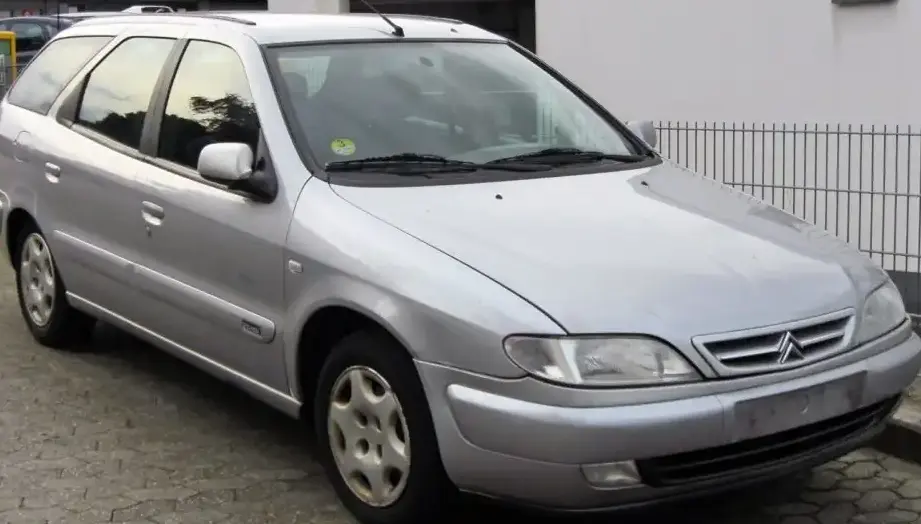
The Citroën Xsara Break 1.4i, produced between 1998 and 2000, represents the entry-level engine option within the N2 series of the Xsara Break (estate) model. Positioned as a practical and economical choice, this variant aimed to provide affordable family transport within the European market. The N2 Xsara Break was Citroën’s offering in the compact family wagon segment, competing with vehicles like the Ford Focus Estate, Renault Mégane Estate, and Peugeot 306 Break. This particular 1.4-liter engine and five-speed manual transmission combination was designed for buyers prioritizing fuel efficiency and lower running costs over outright performance.
Technical Specifications
| Brand | Citroën |
| Model | Xsara |
| Generation | Xsara Break (N2, Phase I) |
| Type (Engine) | 1.4 i (75 Hp) |
| Start of production | 1998 |
| End of production | 2000 |
| Powertrain Architecture | Internal Combustion engine |
| Body type | Station wagon (estate) |
| Seats | 5 |
| Doors | 5 |
| Fuel consumption (urban) | 10.1 l/100 km (23.3 US mpg, 28 UK mpg, 9.9 km/l) |
| Fuel consumption (extra urban) | 6 l/100 km (39.2 US mpg, 47.1 UK mpg, 16.7 km/l) |
| Fuel consumption (combined) | 7.6 l/100 km (30.9 US mpg, 37.2 UK mpg, 13.2 km/l) |
| CO2 emissions | 180 g/km |
| Fuel Type | Petrol (Gasoline) |
| Acceleration 0 – 100 km/h | 14.6 sec |
| Acceleration 0 – 62 mph | 14.6 sec |
| Acceleration 0 – 60 mph | 13.9 sec |
| Maximum speed | 175 km/h (108.74 mph) |
| Weight-to-power ratio | 14.4 kg/Hp, 69.4 Hp/tonne |
| Weight-to-torque ratio | 9.7 kg/Nm, 102.8 Nm/tonne |
| Power | 75 Hp @ 5500 rpm |
| Power per litre | 55.1 Hp/l |
| Torque | 111 Nm @ 3400 rpm (81.87 lb.-ft. @ 3400 rpm) |
| Engine layout | Front, Transverse |
| Engine Model/Code | KFX TU3JP |
| Engine displacement | 1360 cm3 (82.99 cu. in.) |
| Number of cylinders | 4 |
| Engine configuration | Inline |
| Cylinder Bore | 75 mm (2.95 in.) |
| Piston Stroke | 77 mm (3.03 in.) |
| Compression ratio | 10.2:1 |
| Number of valves per cylinder | 2 |
| Fuel injection system | Multi-port manifold injection |
| Engine aspiration | Naturally aspirated engine |
| Valvetrain | OHC |
| Engine oil capacity | 3.5 l (3.7 US qt, 3.08 UK qt) |
| Coolant | 6.5 l (6.87 US qt, 5.72 UK qt) |
| Kerb Weight | 1080 kg (2380.99 lbs.) |
| Max. weight | 1630 kg (3593.53 lbs.) |
| Max load | 550 kg (1212.54 lbs.) |
| Trunk (boot) space – minimum | 517 l (18.26 cu. ft.) |
| Trunk (boot) space – maximum | 1512 l (53.4 cu. ft.) |
| Fuel tank capacity | 54 l (14.27 US gal, 11.88 UK gal) |
| Max. roof load | 100 kg (220.46 lbs.) |
| Permitted trailer load with brakes (12%) | 1100 kg (2425.08 lbs.) |
| Permitted trailer load without brakes | 575 kg (1267.66 lbs.) |
| Permitted towbar download | 70 kg (154.32 lbs.) |
| Length | 4354 mm (171.42 in.) |
| Width | 1698 mm (66.85 in.) |
| Width including mirrors | 1994 mm (78.5 in.) |
| Height | 1426 mm (56.14 in.) |
| Wheelbase | 2540 mm (100 in.) |
| Front track | 1423 mm (56.02 in.) |
| Rear (Back) track | 1430 mm (56.3 in.) |
| Front overhang | 868 mm (34.17 in.) |
| Rear overhang | 946 mm (37.24 in.) |
| Minimum turning circle | 11.5 m (37.73 ft.) |
| Drivetrain Architecture | Front wheel drive |
| Number of gears and type of gearbox | 5 gears, manual transmission |
| Front suspension | Independent, type McPherson with coil spring and anti-roll bar |
| Rear suspension | Torsion |
| Front brakes | Ventilated discs |
| Rear brakes | Drum |
| Assisting systems | ABS (Anti-lock braking system) |
| Steering type | Steering rack and pinion |
| Power steering | Hydraulic Steering |
| Tires size | 185/65 R14 |
Powertrain & Engine Architecture
The heart of the Xsara Break 1.4i is the KFX (TU3JP) engine, a 1.4-liter inline-four cylinder petrol engine. This engine was a mainstay in many Citroën and Peugeot models of the era. It features a single overhead camshaft (OHC) design operating two valves per cylinder. Fuel delivery is managed by a multi-port fuel injection system, providing a balance between efficiency and performance. The TU3JP engine is known for its relative simplicity and durability, though it isn’t a powerhouse. The engine’s 75 horsepower output at 5500 rpm and 111 Nm (82 lb-ft) of torque at 3400 rpm are modest, but adequate for everyday driving. The engine is transversely mounted, driving the front wheels. The five-speed manual transmission was the standard offering for this variant, providing a reasonable spread of gears for both urban and highway driving.
Driving Characteristics
The 1.4i Xsara Break offers a predictable, if uninspiring, driving experience. Acceleration is leisurely, taking approximately 14.6 seconds to reach 62 mph (100 km/h). The engine feels strained when pushed hard, particularly when fully loaded. The five-speed gearbox is well-matched to the engine’s characteristics, allowing for relatively relaxed cruising at highway speeds. Compared to the more powerful 1.6 or 2.0-liter versions of the Xsara, or even the diesel variants, the 1.4i feels significantly underpowered. However, this translates to better fuel economy and lower running costs. The steering is light and precise, making it easy to maneuver in urban environments. The suspension provides a comfortable ride, absorbing bumps and imperfections in the road surface effectively.
Equipment & Trim Levels
The 1.4i Xsara Break typically came with a basic level of equipment. Standard features included power steering, central locking, and an adjustable steering column. Interior upholstery was typically cloth, with a functional, if somewhat basic, dashboard layout. Optional extras included air conditioning, electric windows, and a radio/cassette player. Higher trim levels, available with the more powerful engines, offered features like alloy wheels, upgraded interior trim, and additional safety equipment. The 1.4i was often seen as a fleet vehicle or a budget-conscious family car, so manufacturers often kept the standard equipment list relatively sparse.
Chassis & Braking
The Xsara Break utilizes a McPherson strut front suspension with a torsion beam rear suspension. This setup provides a good balance between ride comfort and handling. The front brakes are ventilated discs, offering adequate stopping power, while the rear brakes are drums. ABS (Anti-lock Braking System) was standard, enhancing safety in emergency braking situations. The chassis is relatively lightweight, contributing to the car’s fuel efficiency. The suspension is tuned for comfort rather than sporty handling, prioritizing a smooth ride over sharp cornering.
Market Reception & Comparison
The Citroën Xsara Break 1.4i was generally well-received as a practical and affordable family car. Critics praised its spacious interior, comfortable ride, and fuel efficiency. However, the engine’s lack of power was a common criticism. Compared to the 1.6 and 2.0-liter variants, the 1.4i offered significantly less performance. The diesel models, while more expensive to purchase, provided better fuel economy and more torque. Despite its limitations, the 1.4i remained a popular choice for buyers prioritizing value for money.
Legacy
The KFX (TU3JP) engine, found in the Xsara Break 1.4i, is known for its reliability and longevity. With regular maintenance, these engines can cover high mileages. However, they are prone to oil leaks as they age. The 1.4i Xsara Break remains a relatively affordable used car today, making it a good option for budget-conscious buyers. Parts availability is generally good, and maintenance costs are relatively low. While not a performance icon, the 1.4i Xsara Break represents a solid and dependable family wagon from the late 1990s and early 2000s.
