
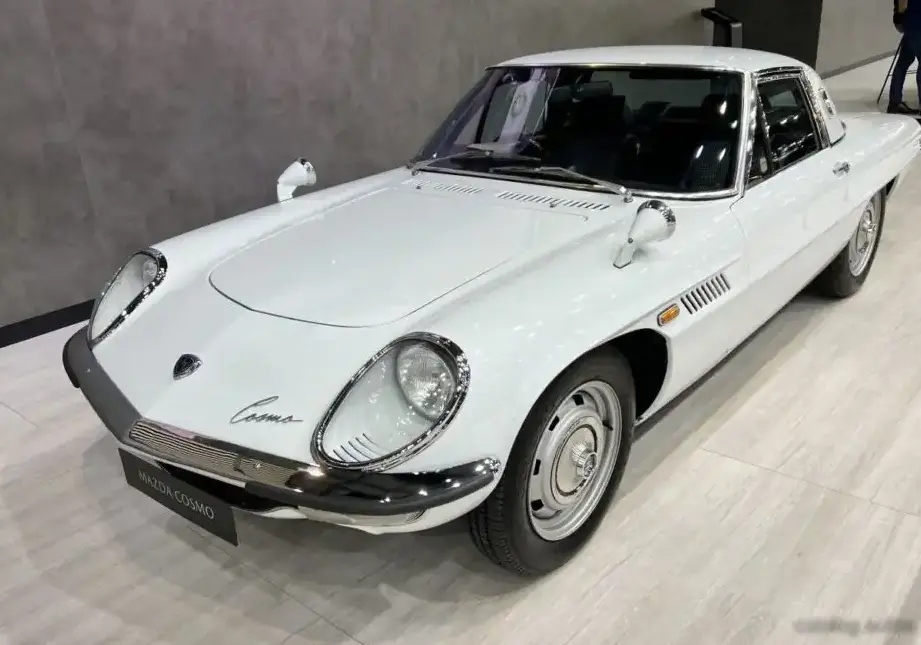
The Mazda Cosmo (L10A), produced between May 1967 and July 1968, represents a pivotal moment in automotive history as the world’s first production rotary engine vehicle. This coupe, a product of Mazda’s relentless engineering, showcased the potential of the Wankel engine and established Mazda as a technological innovator. The L10A Cosmo was a relatively limited production vehicle, primarily aimed at the Japanese domestic market, but it quickly gained international recognition for its unique powertrain and stylish design. It was the first iteration of the Cosmo series, laying the groundwork for future generations and cementing the rotary engine’s place in Mazda’s identity.
Technical Specifications
| Brand | Mazda |
| Model | Cosmo |
| Generation | Cosmo (L10A) |
| Type (Engine) | 1.0 Wankel (110 Hp) |
| Start of production | May, 1967 |
| End of production | July, 1968 |
| Powertrain Architecture | Internal Combustion engine |
| Body type | Coupe |
| Seats | 4 |
| Doors | 2 |
| Fuel Type | Petrol (Gasoline) |
| Maximum speed | 185 km/h (114.95 mph) |
| Weight-to-power ratio | 8.5 kg/Hp, 117 Hp/tonne |
| Weight-to-torque ratio | 7.4 kg/Nm, 135.1 Nm/tonne |
| Power | 110 Hp @ 7000 rpm |
| Power per litre | 112 Hp/l |
| Torque | 127 Nm @ 3500 rpm (93.67 lb.-ft. @ 3500 rpm) |
| Engine layout | Front, Longitudinal |
| Engine Model/Code | 0810 |
| Engine displacement | 982 cm3 (59.93 cu. in.) |
| Number of cylinders | 2 |
| Engine configuration | Rotary (Wankel) |
| Number of valves per cylinder | 3 |
| Fuel injection system | Carburettor |
| Engine aspiration | Naturally aspirated engine |
| Kerb Weight | 940 kg (2072.35 lbs) |
| Fuel tank capacity | 57 l (15.06 US gal | 12.54 UK gal) |
| Length | 4140 mm (162.99 in) |
| Width | 1595 mm (62.8 in) |
| Height | 1165 mm (45.87 in) |
| Wheelbase | 2200 mm (86.61 in) |
| Front track | 1250 mm (49.21 in) |
| Rear (Back) track | 1240 mm (48.82 in) |
| Ride height (ground clearance) | 125 mm (4.92 in) |
| Minimum turning circle (turning diameter) | 9.8 m (32.15 ft) |
| Drivetrain Architecture | The Internal combustion engine (ICE) drives the rear wheels of the vehicle. |
| Drive wheel | Rear wheel drive |
| Number of gears and type of gearbox | 4 gears, manual transmission |
| Front suspension | Wishbone |
| Rear suspension | Suspension De-Dion, Leaf spring |
| Front brakes | Disc |
| Rear brakes | Drum |
| Steering type | Steering rack and pinion |
Powertrain & Engine Architecture
The heart of the Cosmo L10A is the 982cc (59.93 cu. in.) 0810 rotary engine. This engine, a single-rotor Wankel design, produced 110 horsepower at 7000 rpm and 127 Nm (93.67 lb.-ft.) of torque at 3500 rpm. Unlike traditional piston engines, the Wankel engine utilizes a triangular rotor spinning within a specially shaped housing to generate power. The L10A’s engine featured a single carburetor for fuel delivery, a relatively simple system for the time. The engine’s architecture, while compact and lightweight, presented unique challenges in terms of sealing and thermal management. The rotor housing and apex seals were critical components, and their durability was a key focus of Mazda’s engineering efforts. The engine was mounted longitudinally in the front of the vehicle, driving the rear wheels.
Driving Characteristics
The 1.0-liter Wankel engine in the Cosmo L10A delivered a unique driving experience. While the horsepower figure of 110 hp might seem modest by modern standards, the engine’s smooth and high-revving nature provided a surprisingly spirited performance. The four-speed manual transmission allowed drivers to fully exploit the engine’s powerband. Compared to potential future iterations with more power, the L10A prioritized smoothness and refinement over outright acceleration. The relatively low weight of the vehicle (940 kg / 2072.35 lbs) contributed to its nimble handling. The rear-wheel-drive configuration provided a traditional sports car feel, although the De-Dion rear suspension with leaf springs offered a somewhat firm ride quality.
Equipment & Trim Levels
The Cosmo L10A was positioned as a relatively upscale coupe for its time. Standard features included comfortable seating for four, a stylish interior design, and a comprehensive instrument panel. Interior upholstery was typically cloth, and the dashboard featured a woodgrain finish. Optional extras included a radio, upgraded interior trim, and various exterior color options. The Cosmo wasn’t offered in a wide range of trim levels; it was largely a single, well-equipped model with limited customization options. The focus was on providing a premium experience centered around the innovative rotary engine.
Chassis & Braking
The Cosmo L10A featured a robust chassis designed to handle the unique characteristics of the rotary engine. The front suspension utilized a wishbone setup, while the rear employed a De-Dion axle with leaf springs. This combination aimed to provide a balance between ride comfort and handling stability. Braking duties were handled by disc brakes at the front and drum brakes at the rear. The steering system was a rack and pinion type, offering precise and responsive control. The relatively narrow tires of the era limited grip compared to modern standards, but the Cosmo’s lightweight construction helped to mitigate this limitation.
Market Reception & Comparison
The Mazda Cosmo L10A received considerable attention from automotive journalists and enthusiasts upon its release. Critics praised the innovative rotary engine, its smooth operation, and the car’s stylish design. However, some concerns were raised regarding the engine’s long-term reliability and fuel economy. Compared to other coupes of the era, the Cosmo offered a unique and technologically advanced alternative. It wasn’t directly comparable to traditional piston-engined sports cars, as the rotary engine offered a different driving experience. The Cosmo’s fuel economy was generally comparable to other vehicles in its class, but the rotary engine’s oil consumption was a notable characteristic.
Legacy
The Mazda Cosmo L10A holds a significant place in automotive history as the first production vehicle powered by a rotary engine. It paved the way for future Mazda models, such as the RX-7 and RX-8, which continued to utilize the Wankel engine. The L10A’s engine, while prone to certain issues like apex seal wear, proved to be a durable and reliable powerplant when properly maintained. Today, the Cosmo L10A is a highly sought-after classic car, prized by collectors and enthusiasts for its historical significance and unique engineering. The value of well-preserved examples has steadily increased over the years, reflecting the car’s enduring appeal and its place as a pioneering vehicle in the automotive world. Finding parts can be challenging, but a dedicated community of enthusiasts continues to support the preservation and restoration of these iconic vehicles.
