Technical Specifications
| Brand | Opel |
| Model | Campo |
| Generation | Campo Single Cab |
| Type (Engine) | 2.3 (98 Hp) |
| Start of production | 1994 |
| End of production | 1995 |
| Powertrain Architecture | Internal Combustion engine |
| Body type | Pick-up |
| Seats | 2 |
| Doors | 2 |
| Fuel Type | Petrol (Gasoline) |
| Power | 98 Hp @ 5000 rpm |
| Power per litre | 43.5 Hp/l |
| Engine Model/Code | 4ZD1 |
| Engine displacement | 2255 cm3 / 137.61 cu. in. |
| Number of cylinders | 4 |
| Engine configuration | Inline |
| Cylinder Bore | 89.3 mm / 3.52 in. |
| Piston Stroke | 90 mm / 3.54 in. |
| Number of valves per cylinder | 2 |
| Engine aspiration | Naturally aspirated engine |
| Valvetrain | SOHC |
| Engine oil capacity | 3.5 l / 3.7 US qt | 3.08 UK qt |
| Coolant | 9 l / 9.51 US qt | 7.92 UK qt |
| Length | 4980 mm / 196.06 in. |
| Width | 1690 mm / 66.54 in. |
| Height | 1595 mm / 62.8 in. |
| Wheelbase | 3025 mm / 119.09 in. |
| Drivetrain Architecture | The Internal combustion engine (ICE) drives the rear wheels of the vehicle. |
| Drive wheel | Rear wheel drive |
| Number of gears and type of gearbox | 5 gears, manual transmission |
| Front suspension | Independent coil spring |
| Rear suspension | dependent spring suspension |
| Front brakes | Ventilated discs |
| Rear brakes | Drum |
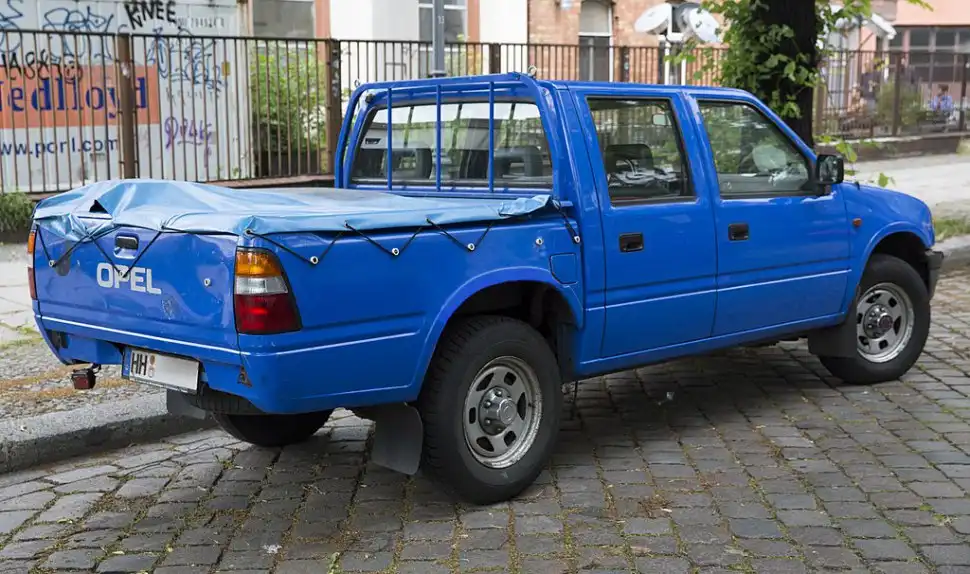
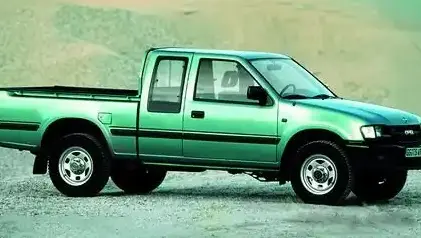
The Opel Campo Single Cab 2.3 (98 hp) was a utilitarian pickup truck manufactured by Opel between 1994 and 1995. This variant represented an entry-level offering within the first generation Campo range (1991-1998), primarily aimed at commercial users and those seeking a basic, affordable work vehicle. Developed in collaboration with Isuzu and heavily based on the Isuzu Faster, the Campo was Opel’s attempt to address a growing demand for compact pickup trucks in the European market. It filled a niche in Opel’s lineup, offering a smaller, more affordable alternative to larger, more expensive pickup options.
Powertrain & Engine Architecture
The Opel Campo Single Cab 2.3 was powered by the 4ZD1 engine, a 2.3-liter inline-four cylinder gasoline engine sourced from Isuzu. This engine was a relatively straightforward design, featuring a single overhead camshaft (SOHC) valvetrain with two valves per cylinder. Fuel delivery was handled by a carburetor, a common feature for vehicles of this era and price point. The 4ZD1 produced 98 horsepower at 5000 rpm and approximately 168 Nm (124 lb-ft) of torque. The engine’s design emphasized durability and low-end torque, making it well-suited for hauling and light commercial applications. The engine was exclusively paired with a five-speed manual transmission, reflecting the vehicle’s utilitarian focus. There were no automatic transmission options available for this specific configuration.
Driving Characteristics
The driving experience of the Campo 2.3 was decidedly practical. The 98 hp engine provided adequate power for general use, but acceleration was not particularly quick. The five-speed manual transmission allowed drivers to keep the engine within its optimal power band, but the vehicle was not designed for performance. The rear-wheel-drive configuration offered reasonable traction under normal conditions, though it could become challenging on slippery surfaces. The suspension, consisting of independent coil springs at the front and a dependent spring setup in the rear, provided a comfortable ride when unladen, but the ride quality tended to firm up when carrying a load. The gear ratios were optimized for hauling capability rather than high-speed cruising. Compared to potential future turbocharged or diesel variants, the 2.3L petrol engine was the least powerful and least fuel-efficient option in the Campo lineup.
Equipment & Trim Levels
The Campo Single Cab 2.3 was a fairly spartan vehicle in terms of standard equipment. As an entry-level model, it featured minimal creature comforts. Standard features typically included a basic dashboard with essential gauges, vinyl upholstery, and a simple steering wheel. Power steering was not standard equipment, and air conditioning was generally offered as an optional extra. The interior was designed for durability and ease of cleaning, reflecting its intended use as a work vehicle. Optional extras could include a radio, upgraded interior trim, and a more robust bed liner. The overall focus was on functionality and practicality rather than luxury or refinement.
Chassis & Braking
The Campo’s chassis utilized a body-on-frame construction, providing a robust and durable platform for hauling and off-road use. The front suspension employed independent coil springs, offering a degree of ride comfort and handling precision. The rear suspension used a dependent spring setup, which was simpler and more durable, but less refined in terms of ride quality. The braking system consisted of ventilated discs on the front wheels and drum brakes on the rear. This configuration was typical for vehicles in this class and price range during the 1990s. The brakes provided adequate stopping power for normal driving conditions, but were not designed for high-performance braking scenarios.
Market Reception & Comparison
The Opel Campo Single Cab 2.3 was generally regarded as a practical and affordable work vehicle. Critics acknowledged its simplicity and durability, but also noted its lack of refinement and relatively low power output. Compared to other pickups available in Europe at the time, such as the Toyota Hilux and the Nissan Datsun, the Campo offered a more affordable entry point, but lacked the established reputation for long-term reliability of its Japanese competitors. The 2.3L petrol engine was often criticized for its fuel consumption, particularly when compared to the diesel options available in other pickups. The manual transmission was appreciated for its durability and ease of use, but some drivers found it to be somewhat notchy in its operation.
Legacy
The Opel Campo, and specifically the 2.3-liter Single Cab variant, has become a relatively uncommon sight on the roads today. While generally durable, the 4ZD1 engine is susceptible to age-related issues such as oil leaks and carburetor problems. Parts availability can be challenging, as Opel discontinued production of the Campo in 1998. However, the vehicle’s simplicity and robust construction make it a popular choice among enthusiasts and those seeking a classic work vehicle. In the used car market, well-maintained examples of the Campo 2.3 can command a modest premium, particularly among collectors and those looking for a unique and affordable pickup truck. Its enduring appeal lies in its straightforward design and its ability to fulfill its original purpose as a reliable and affordable workhorse.