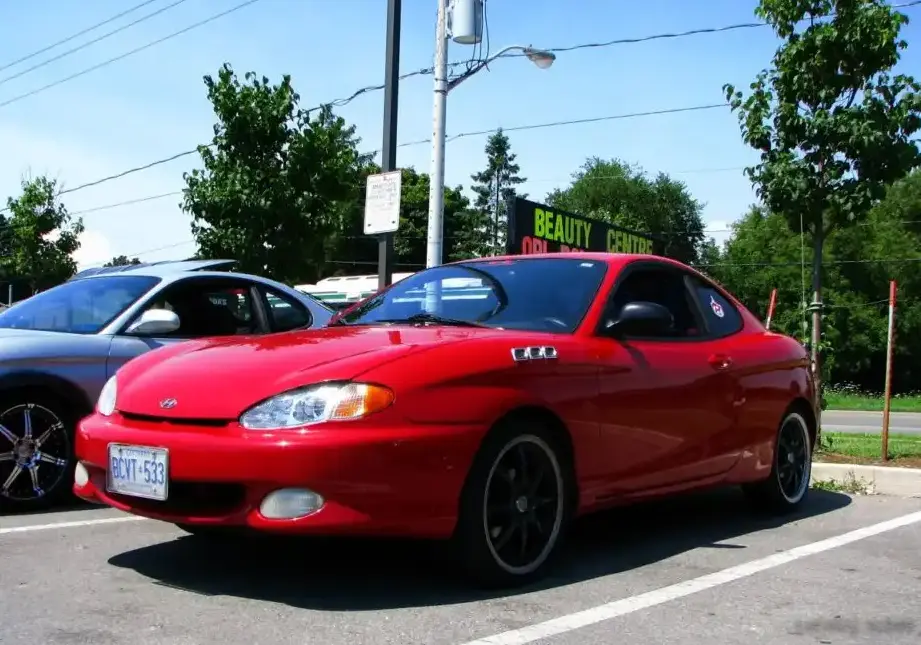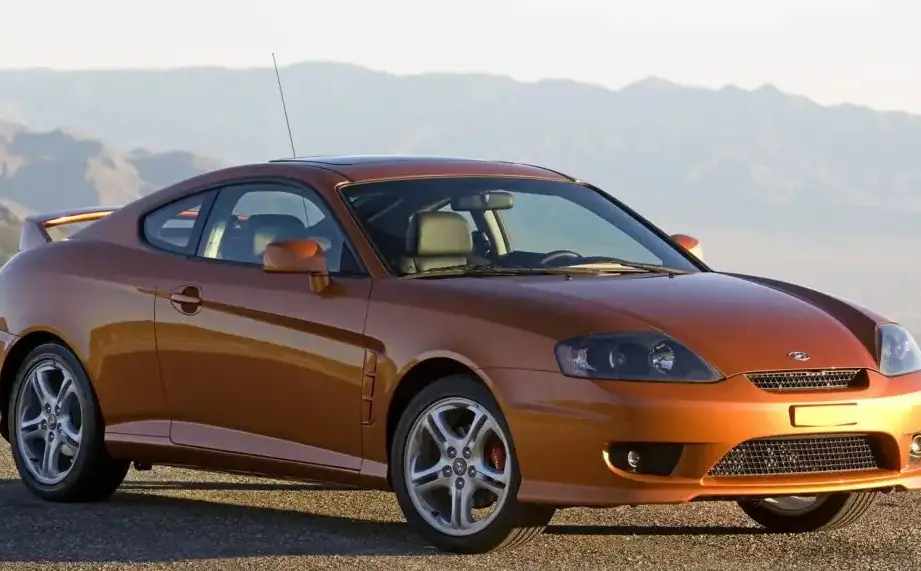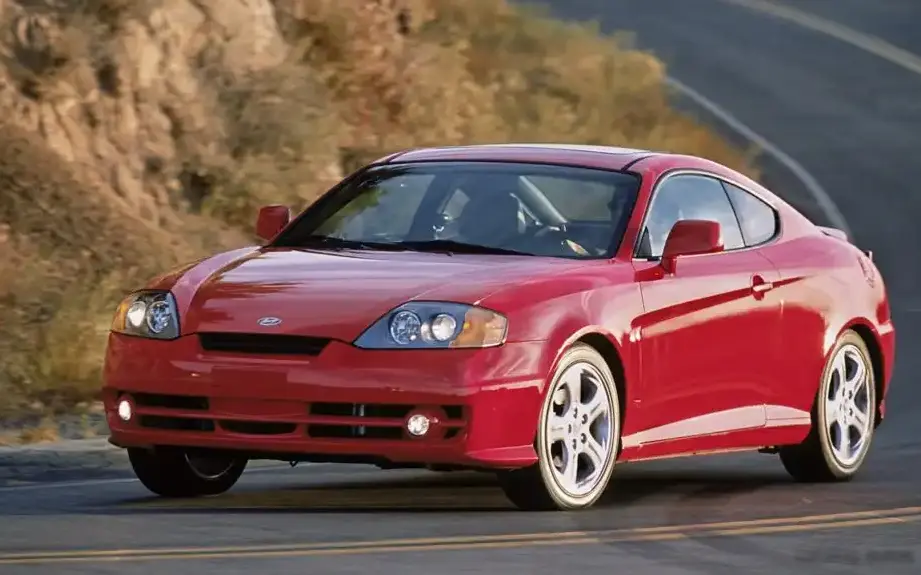
The Hyundai Tiburon II (GK) 2.0, equipped with the Shiftronic automatic transmission, represents a significant step forward in Hyundai’s attempt to establish itself as a maker of sporty, affordable coupes in the North American market. Produced from 2002 to 2004, this variant occupied a mid-range position within the GK Tiburon lineup, slotting between the base 1.6L engine and the more performance-oriented models. The GK Tiburon, as a whole, aimed to provide a stylish and relatively practical alternative to established Japanese and European sports coupes, offering a blend of performance, features, and value. This particular 2.0L Shiftronic model was designed to appeal to buyers seeking a comfortable and convenient driving experience without sacrificing too much in the way of performance.
Technical Specifications
| Brand | Hyundai |
| Model | Tiburon |
| Generation | Tiburon II (GK) |
| Type (Engine) | 2.0 (138 Hp) Shiftronic |
| Start of production | 2002 |
| End of production | 2004 |
| Powertrain Architecture | Internal Combustion engine |
| Body type | Coupe |
| Seats | 4 |
| Doors | 3 |
| Fuel consumption (economy) – urban (EPA) | 10.2 l/100 km (23.1 US mpg) |
| Fuel consumption (economy) – extra urban (EPA) | 8.1 l/100 km (29 US mpg) |
| Fuel Type | Petrol (Gasoline) |
| Weight-to-power ratio | 9.8 kg/Hp |
| Weight-to-torque ratio | 7.4 kg/Nm |
| Power | 138 Hp @ 6000 rpm |
| Power per litre | 69.9 Hp/l |
| Torque | 184 Nm @ 4500 rpm (135.71 lb.-ft. @ 4500 rpm) |
| Engine layout | Front, Transverse |
| Engine Model/Code | Beta II / G4GC |
| Engine displacement | 1975 cm3 (120.52 cu. in.) |
| Number of cylinders | 4 |
| Engine configuration | Inline |
| Cylinder Bore | 82 mm (3.23 in.) |
| Piston Stroke | 93.5 mm (3.68 in.) |
| Compression ratio | 10.1:1 |
| Number of valves per cylinder | 4 |
| Fuel injection system | Multi-port manifold injection |
| Engine aspiration | Naturally aspirated engine |
| Valvetrain | DOHC, CVVT |
| Engine oil capacity | 4 l (4.23 US qt | 3.52 UK qt) |
| Coolant | 7 l (7.4 US qt | 6.16 UK qt) |
| Kerb Weight | 1359 kg (2996.08 lbs.) |
| Trunk (boot) space – minimum | 416 l (14.69 cu. ft.) |
| Fuel tank capacity | 55 l (14.53 US gal | 12.1 UK gal) |
| Length | 4395 mm (173.03 in.) |
| Width | 1760 mm (69.29 in.) |
| Height | 1330 mm (52.36 in.) |
| Wheelbase | 2530 mm (99.61 in.) |
| Front track | 1490 mm (58.66 in.) |
| Rear (Back) track | 1490 mm (58.66 in.) |
| Drivetrain Architecture | Front wheel drive |
| Number of gears and type of gearbox | 4 gears, automatic transmission Shiftronic |
| Front suspension | Independent, type McPherson with coil spring and anti-roll bar |
| Rear suspension | Independent multi-link spring suspension with stabilizer |
| Front brakes | Ventilated discs |
| Rear brakes | Disc |
| Assisting systems | ABS (Anti-lock braking system) |
| Steering type | Steering rack and pinion |
| Power steering | Hydraulic Steering |
| Tires size | 205/55 R16 |
| Wheel rims size | 6.5J x 16 |
Powertrain & Engine Architecture
The heart of the Tiburon II 2.0 Shiftronic is the Hyundai Beta II engine, specifically the G4GC code. This 1.975-liter inline-four cylinder engine utilizes a multi-port fuel injection system and a double overhead camshaft (DOHC) valvetrain with continuously variable valve timing (CVVT) on the intake side. The CVVT system helps optimize engine performance and fuel efficiency across a wider range of engine speeds. The engine produces 138 horsepower at 6000 rpm and 184 Nm (135.71 lb-ft) of torque at 4500 rpm. The Shiftronic transmission is a 4-speed automatic with a manual shift mode, offering drivers some control over gear selection. While not a particularly advanced transmission by modern standards, it provided a smoother and more convenient driving experience than a traditional automatic.
Driving Characteristics
The 2.0L Shiftronic Tiburon offered a comfortable and predictable driving experience. Acceleration was adequate for everyday driving, but it wasn’t a particularly quick car. The automatic transmission, while convenient, did detract somewhat from the sporty feel of the Tiburon. The gear ratios were tuned for fuel economy and smooth cruising rather than aggressive acceleration. Compared to the 5-speed manual version of the 2.0L engine, the Shiftronic model felt noticeably slower, particularly during overtaking maneuvers. The automatic transmission also tended to hunt for gears on hilly terrain. However, the suspension provided a good balance between ride comfort and handling, making it a pleasant car to drive on both city streets and highways.
Equipment & Trim Levels
The 2.0L Shiftronic Tiburon typically came standard with features such as air conditioning, power windows and locks, a CD player, and alloy wheels. Higher trim levels added features like a sunroof, leather upholstery, and upgraded audio systems. The interior design was generally considered modern for its time, with a driver-focused layout and reasonably comfortable seats. Optional extras included a premium sound system, side airbags, and a rear spoiler. The overall interior quality was decent, but it didn’t quite match the fit and finish of some of its Japanese competitors.
Chassis & Braking
The Tiburon II utilized an independent McPherson strut suspension in the front and an independent multi-link suspension in the rear. This setup provided a good level of ride comfort and handling. The front brakes were ventilated discs, while the rear brakes were solid discs. Anti-lock braking system (ABS) was standard. The steering was a rack-and-pinion system with hydraulic power assistance, providing a reasonably responsive feel. The standard tire size was 205/55 R16, mounted on 6.5J x 16 inch alloy wheels.
Market Reception & Comparison
The Tiburon II 2.0 Shiftronic received mixed reviews from automotive critics. While praised for its styling and value, it was often criticized for its lack of outright performance and the somewhat unrefined nature of the automatic transmission. Compared to the manual transmission version, the Shiftronic model was seen as less engaging to drive. Fuel economy was generally considered average for its class. In terms of reliability, the Tiburon II proved to be reasonably dependable, although some owners reported issues with the automatic transmission over the long term. Compared to competitors like the Honda Civic Coupe and the Nissan Sentra SE-R Spec V, the Tiburon offered a more aggressive styling but lacked the same level of refinement and performance.
Legacy
The Hyundai Tiburon II, particularly the 2.0L Shiftronic variant, represents an important milestone in Hyundai’s history. It demonstrated the company’s ambition to compete in the sporty coupe segment and helped to raise its brand image. While not a groundbreaking vehicle, the Tiburon II offered a compelling combination of style, features, and value. Today, the Tiburon II is becoming increasingly popular among enthusiasts and collectors, particularly well-maintained examples. The Beta II engine is known for its durability, and the Shiftronic transmission, while not the most exciting, can provide years of reliable service with proper maintenance. The 2.0L Shiftronic model remains an affordable and accessible entry point into the world of Korean sports coupes.