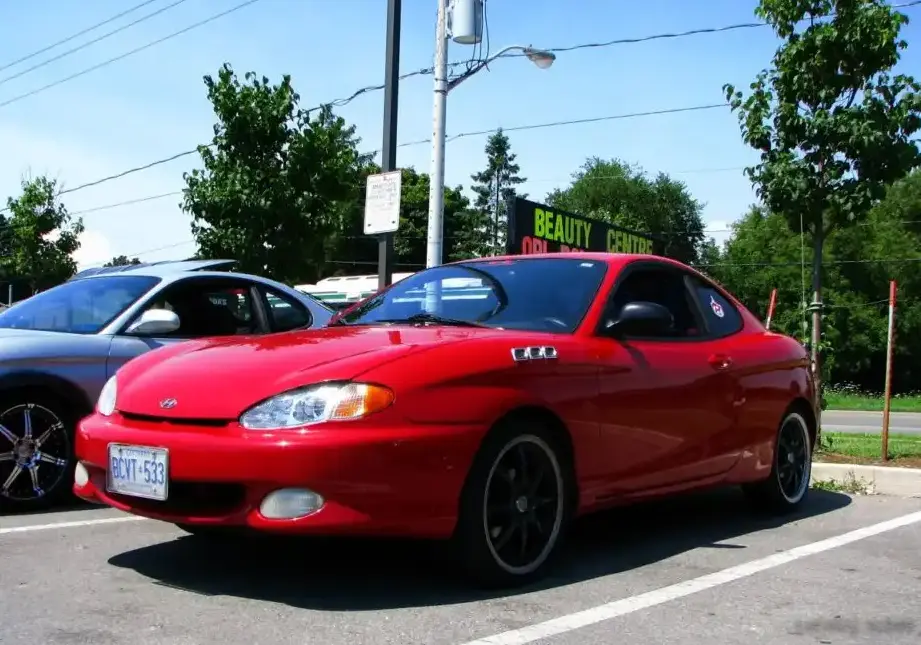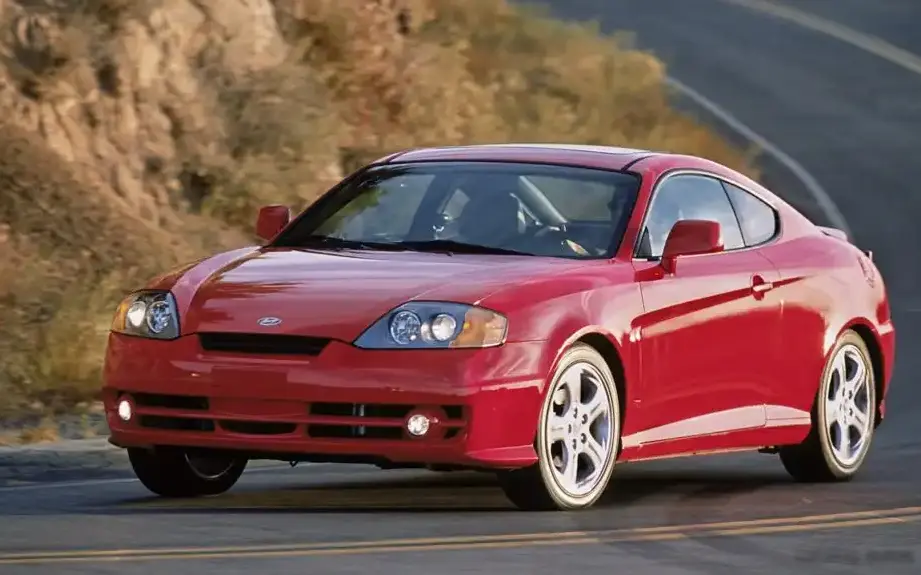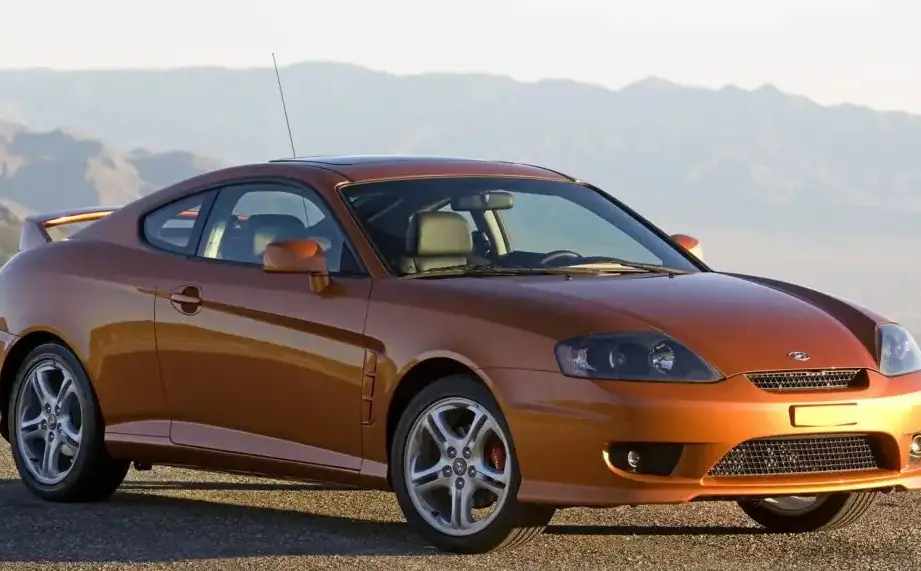
The Hyundai Tiburon II, specifically the facelifted version produced from 2004 to 2006 (internally designated GK), represented a significant step forward for Hyundai in terms of styling and performance. This generation, built on the updated platform of the first Tiburon, aimed to attract a younger demographic with its sporty coupe design. The 2.0-liter (138 hp) variant occupied a middle ground in the Tiburon II lineup, positioned between the base 1.6-liter engine and the more powerful 2.7-liter V6. It offered a balance of affordability, reasonable performance, and available features, making it a popular choice in the North American and European markets where the Tiburon was sold.
Technical Specifications
| Brand | Hyundai |
| Model | Tiburon |
| Generation | Tiburon II (GK, facelift 2004) |
| Type (Engine) | 2.0 (138 Hp) |
| Start of production | September, 2004 |
| End of production | 2006 |
| Powertrain Architecture | Internal Combustion engine |
| Body type | Coupe |
| Seats | 4 |
| Doors | 3 |
| Fuel consumption (economy) – urban (EPA) | 9.8 l/100 km (24 US mpg, 28.8 UK mpg, 10.2 km/l) |
| Fuel consumption (economy) – extra urban (EPA) | 7.8 l/100 km (30.2 US mpg, 36.2 UK mpg, 12.8 km/l) |
| Fuel Type | Petrol (Gasoline) |
| Weight-to-power ratio | 9.5 kg/Hp, 104.9 Hp/tonne |
| Weight-to-torque ratio | 7.1 kg/Nm, 139.9 Nm/tonne |
| Power | 138 Hp @ 6000 rpm |
| Power per litre | 69.9 Hp/l |
| Torque | 184 Nm @ 4500 rpm (135.71 lb.-ft. @ 4500 rpm) |
| Engine layout | Front, Transverse |
| Engine Model/Code | Beta II / G4GC |
| Engine displacement | 1975 cm3 (120.52 cu. in.) |
| Number of cylinders | 4 |
| Engine configuration | Inline |
| Cylinder Bore | 82 mm (3.23 in.) |
| Piston Stroke | 93.5 mm (3.68 in.) |
| Compression ratio | 10.1:1 |
| Number of valves per cylinder | 4 |
| Fuel injection system | Multi-port manifold injection |
| Engine aspiration | Naturally aspirated engine |
| Valvetrain | DOHC, CVVT |
| Engine oil capacity | 4.2 l (4.44 US qt | 3.7 UK qt) |
| Coolant | 7 l (7.4 US qt | 6.16 UK qt) |
| Kerb Weight | 1315 kg (2899.08 lbs.) |
| Trunk (boot) space – minimum | 419 l (14.8 cu. ft.) |
| Fuel tank capacity | 55 l (14.53 US gal | 12.1 UK gal) |
| Length | 4395 mm (173.03 in.) |
| Width | 1760 mm (69.29 in.) |
| Height | 1330 mm (52.36 in.) |
| Wheelbase | 2530 mm (99.61 in.) |
| Front track | 1490 mm (58.66 in.) |
| Rear (Back) track | 1490 mm (58.66 in.) |
| Drivetrain Architecture | The Internal combustion engine (ICE) drives the front wheels of the vehicle. |
| Drive wheel | Front wheel drive |
| Number of gears and type of gearbox | 5 gears, manual transmission |
| Front suspension | Independent, type McPherson with coil spring and anti-roll bar |
| Rear suspension | Independent multi-link spring suspension with stabilizer |
| Front brakes | Ventilated discs |
| Rear brakes | Disc |
| Assisting systems | ABS (Anti-lock braking system) |
| Steering type | Steering rack and pinion |
| Power steering | Hydraulic Steering |
| Tires size | 205/55 R16 |
| Wheel rims size | 6.5J x 16 |
Powertrain & Engine Architecture
The heart of the 2004-2006 Hyundai Tiburon II 2.0-liter was the Beta II engine, specifically the G4GC code. This 1.975-liter inline-four cylinder engine utilized a cast iron block with an aluminum cylinder head. It featured dual overhead camshafts (DOHC) and Hyundai’s Continuously Variable Valve Timing (CVVT) technology. CVVT adjusted the timing of the intake valves based on engine speed and load, improving both performance and fuel efficiency. Fuel delivery was handled by a multi-port fuel injection system. The engine produced 138 horsepower at 6000 rpm and 184 Nm (135.71 lb-ft) of torque at 4500 rpm. This engine was paired with a 5-speed manual transmission as standard, offering drivers a direct connection to the powertrain.
Driving Characteristics
The 2.0-liter Tiburon offered a noticeable step up in performance compared to the base 1.6-liter model. While not a sports car in the purest sense, the 138 hp engine provided adequate acceleration for everyday driving and even some spirited maneuvers. The 5-speed manual transmission allowed drivers to keep the engine in its optimal power band. Compared to the 2.7-liter V6, the 2.0-liter felt less powerful, particularly at higher speeds, but it offered a more balanced driving experience due to its lighter weight. The front-wheel-drive configuration meant that torque steer was present under hard acceleration, but it was generally manageable. The gear ratios were tuned for a blend of acceleration and fuel economy, making it a practical choice for daily commuting.
Equipment & Trim Levels
The 2.0-liter Tiburon typically came with a reasonable level of standard equipment. This included power windows, power locks, air conditioning, and an AM/FM stereo with a CD player. Higher trim levels added features such as alloy wheels, a sunroof, upgraded interior upholstery, and a premium sound system. Optional extras included leather seats, a rear spoiler, and various cosmetic enhancements. The interior design was modern for its time, with a driver-focused layout and relatively comfortable seating. The dashboard featured a straightforward instrument cluster and easy-to-use controls.
Chassis & Braking
The Tiburon II utilized an independent suspension system at all four wheels. The front suspension employed McPherson struts with coil springs and an anti-roll bar, while the rear suspension featured a multi-link setup with a stabilizer bar. This suspension configuration provided a good balance of ride comfort and handling. The braking system consisted of ventilated discs at the front and solid discs at the rear. Anti-lock Braking System (ABS) was standard, enhancing safety by preventing wheel lockup during hard braking. The steering was rack-and-pinion with hydraulic power assistance, providing precise and responsive steering feel.
Market Reception & Comparison
The 2.0-liter Tiburon was generally well-received by automotive critics as a stylish and affordable coupe. It was praised for its sporty design, comfortable interior, and reasonable performance. However, some critics noted that the engine lacked the outright power of its competitors, such as the Honda Civic Si or the Nissan Sentra SE-R Spec V. In terms of fuel economy, the 2.0-liter Tiburon offered competitive figures, achieving around 24 mpg in the city and 30 mpg on the highway. Compared to the V6 model, the 2.0-liter was more fuel-efficient and less expensive to insure. Reliability was generally good, although some owners reported minor issues with the cooling system and electrical components.
Legacy
The Hyundai Tiburon II, particularly the 2.0-liter variant, has developed a modest following among enthusiasts. The Beta II engine is known for its durability and relatively simple maintenance requirements. While not a highly sought-after classic, well-maintained examples of the 2.0-liter Tiburon can still be found on the used car market at affordable prices. These cars offer a unique blend of style, practicality, and affordability, making them an attractive option for those seeking a sporty coupe on a budget. The Tiburon II played a crucial role in establishing Hyundai as a credible competitor in the automotive market, demonstrating the brand’s ability to produce stylish and well-equipped vehicles.