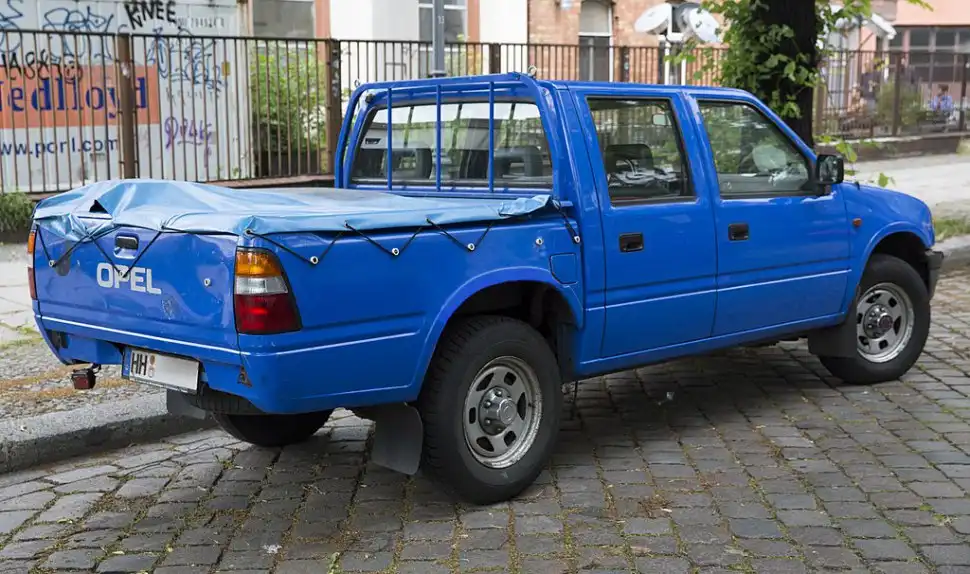
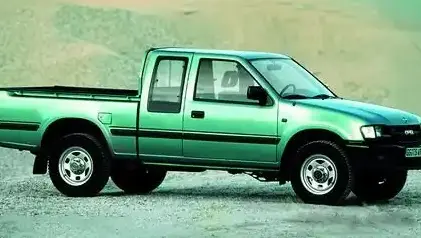
The Opel Campo Single Cab 2.5 DTI, produced from 1991 to December 2001, was a utilitarian pickup truck designed primarily for commercial and agricultural use in Europe. Positioned as a workhorse within Opel’s lineup, the Campo offered a robust and affordable transportation solution. The Single Cab configuration, as the name suggests, featured a two-seater cabin and a separate cargo bed. This variant, powered by the 2.5-liter DTI diesel engine producing 100 horsepower, represented a mid-range offering within the Campo family, balancing affordability with reasonable performance for its intended purpose. It competed directly with other compact pickups like the Volkswagen Caddy and Ford Courier.
Technical Specifications
| Brand | Opel |
| Model | Campo |
| Generation | Campo Single Cab |
| Type (Engine) | 2.5 DTI (100 Hp) |
| Start of production | 1991 |
| End of production | December, 2001 |
| Powertrain Architecture | Internal Combustion engine |
| Body type | Pick-up |
| Seats | 2 |
| Doors | 2 |
| Fuel consumption (combined) | 8.1 l/100 km (29 US mpg, 34.9 UK mpg, 12.3 km/l) |
| Fuel Type | Diesel |
| Acceleration 0 – 100 km/h | 18.3 sec |
| Acceleration 0 – 62 mph | 18.3 sec |
| Acceleration 0 – 60 mph | 17.4 sec |
| Maximum speed | 140 km/h (86.99 mph) |
| Power | 100 Hp @ 3800 rpm |
| Power per litre | 40 Hp/l |
| Torque | 226 Nm @ 2000 rpm (166.69 lb.-ft. @ 2000 rpm) |
| Engine Model/Code | 4JA1, 4JA1TC |
| Engine displacement | 2499 cm3 (152.5 cu. in.) |
| Number of cylinders | 4 |
| Engine configuration | Inline |
| Cylinder Bore | 93 mm (3.66 in.) |
| Piston Stroke | 92 mm (3.62 in.) |
| Engine aspiration | Turbocharger |
| Engine oil capacity | 4.3 l (4.54 US qt | 3.78 UK qt) |
| Coolant | 7 l (7.4 US qt | 6.16 UK qt) |
| Length | 4980 mm (196.06 in.) |
| Width | 1690 mm (66.54 in.) |
| Height | 1595 mm (62.8 in.) |
| Wheelbase | 3025 mm (119.09 in.) |
| Drivetrain Architecture | Rear wheel drive |
| Number of gears and type of gearbox | 5 gears, manual transmission |
| Front suspension | Independent coil spring |
| Front brakes | Ventilated discs |
Powertrain & Engine Architecture
The heart of the Campo 2.5 DTI was the Isuzu-sourced 4JA1 (and later 4JA1TC) 2.5-liter inline-four diesel engine. This engine, a common sight in light commercial vehicles of the era, was known for its durability and relatively simple mechanical design. The “DTI” designation indicated a direct injection system, which improved fuel efficiency and reduced emissions compared to older indirect injection diesels. The turbocharger, standard on this variant, significantly boosted power output to 100 horsepower and 226 Nm (166.69 lb-ft) of torque. The engine utilized a mechanically controlled fuel injection pump, a robust system that required minimal electronic intervention. The five-speed manual transmission was the only gearbox option available with this engine, providing a relatively wide range of gears for hauling and towing.
Driving Characteristics
The Campo 2.5 DTI was not designed for speed or sporty handling. Its focus was squarely on providing reliable and affordable transportation of goods. Acceleration was slow, with a 0-60 mph time of around 17.4 seconds. However, the engine’s torque output provided adequate pulling power for moderate loads. The manual transmission allowed for precise control, but the gear ratios were geared towards maximizing fuel economy and minimizing engine strain rather than providing quick acceleration. The ride quality was typical of a light commercial vehicle – firm and utilitarian, prioritizing load-carrying capacity over passenger comfort. Compared to a potential gasoline-powered variant (which wasn’t offered), the diesel provided significantly better fuel economy, but at the cost of refinement and performance.
Equipment & Trim Levels
The Campo Single Cab 2.5 DTI was a fairly basic vehicle, reflecting its commercial orientation. Standard equipment typically included a vinyl interior, basic instrumentation, and a robust cargo bed. Power steering was often included, but air conditioning, central locking, and electric windows were usually optional extras. Trim levels were minimal; the focus was on providing a functional and durable vehicle rather than luxurious appointments. The Single Cab configuration meant limited space for passengers, making it unsuitable for family use. Optional extras often included a tow hitch, bed liner, and upgraded suspension for heavier loads.
Chassis & Braking
The Campo featured a body-on-frame construction, providing a robust and durable chassis capable of handling significant payloads. The front suspension utilized independent coil springs, offering a degree of ride comfort, while the rear suspension employed leaf springs, designed for load-carrying capacity. Braking was provided by ventilated discs at the front and drum brakes at the rear. The braking system was adequate for the vehicle’s weight and performance, but lacked the sophistication of more modern systems. Steering was typically recirculating ball, providing a direct but somewhat unrefined feel.
Market Reception & Comparison
The Opel Campo 2.5 DTI was generally well-received in its target market. Critics praised its durability, affordability, and fuel efficiency. However, it was often criticized for its basic interior, slow performance, and lack of refinement. Compared to other pickups in its class, the Campo offered a competitive price point and a reputation for reliability. The 2.5 DTI engine provided a good balance between power and economy, making it a popular choice for commercial users. However, the manual transmission was sometimes seen as a drawback by drivers accustomed to automatic gearboxes.
Legacy
The Opel Campo, while not a particularly glamorous vehicle, established a reputation for being a dependable and hard-working pickup truck. The 2.5 DTI engine, in particular, proved to be remarkably durable, with many examples still in service today. In the used car market, the Campo 2.5 DTI remains a relatively affordable option for those seeking a simple and robust work vehicle. Maintenance is generally straightforward, and parts availability is still reasonable. However, potential buyers should be aware of the age-related issues common to older diesel engines, such as injector wear and turbocharger problems. The Campo represents a bygone era of utilitarian vehicles, prioritizing functionality and durability over luxury and performance.