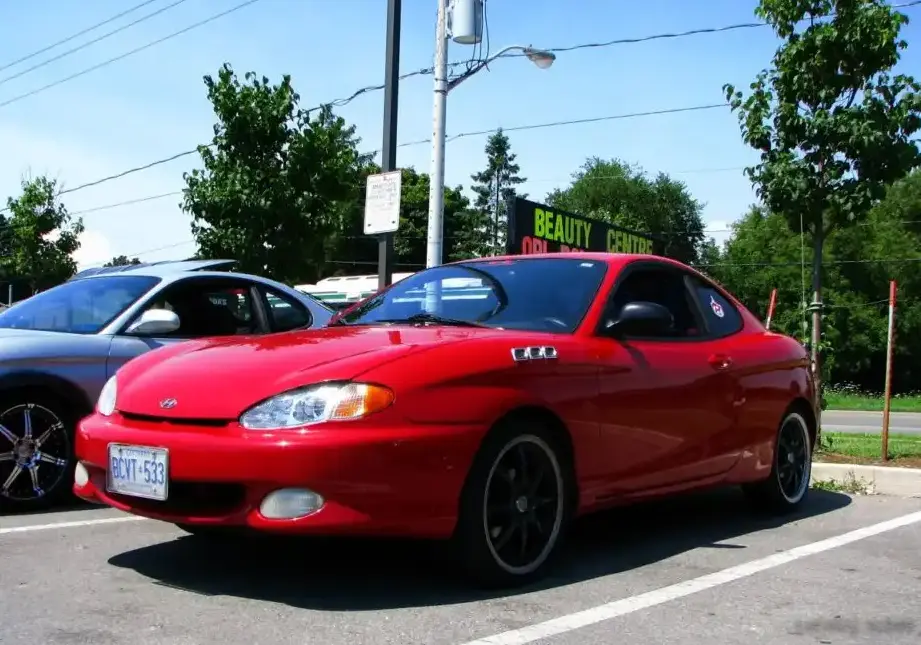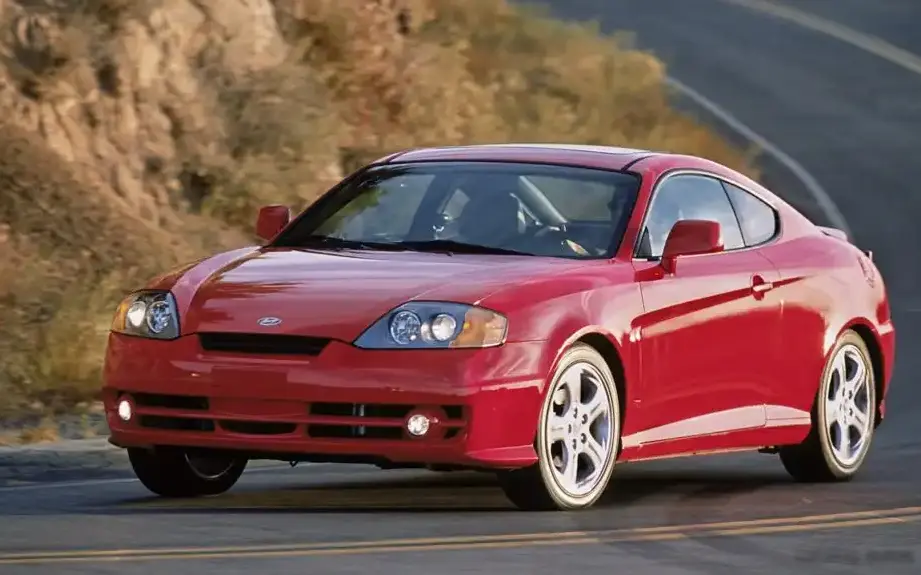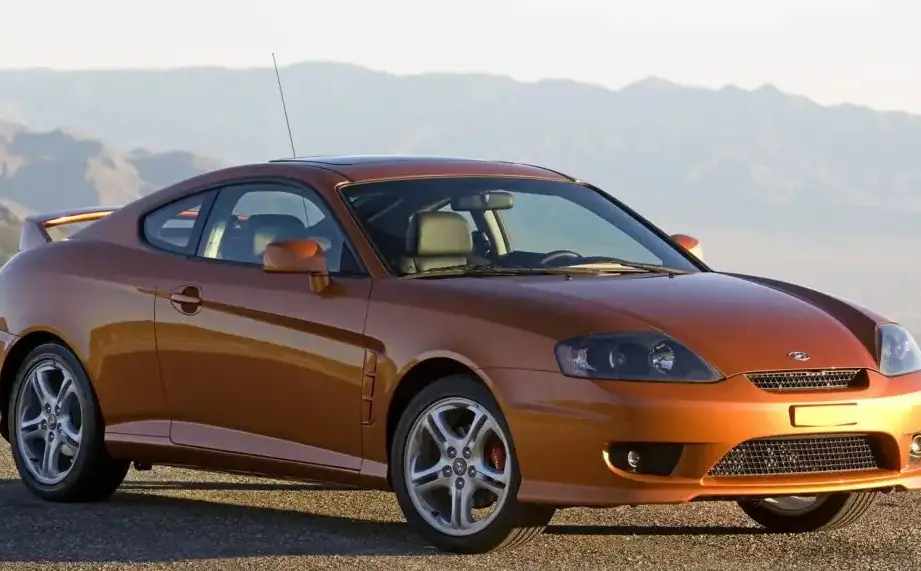
The Hyundai Tiburon II, specifically the facelifted version produced from 2004 to 2006, represented a significant step forward for Hyundai’s ambitions in the sporty coupe market. This generation, internally designated GK, aimed to offer a more refined and mature alternative to established players like the Honda Civic Coupe and Mitsubishi Eclipse. The 2.0-liter (138 hp) Shiftronic variant occupied a middle ground within the Tiburon II lineup, positioned between the base 1.6-liter engine and the more performance-oriented 2.7-liter V6. It was designed to appeal to buyers seeking a balance of style, comfort, and reasonable performance with the convenience of an automatic transmission.
Technical Specifications
| Brand | Hyundai |
| Model | Tiburon |
| Generation | Tiburon II (GK, facelift 2004) |
| Type (Engine) | 2.0 (138 Hp) Shiftronic |
| Start of production | September, 2004 |
| End of production | 2006 |
| Powertrain Architecture | Internal Combustion engine |
| Body type | Coupe |
| Seats | 4 |
| Doors | 3 |
| Fuel consumption (economy) – urban (EPA) | 10.7 l/100 km (22 US mpg, 26.4 UK mpg, 9.3 km/l) |
| Fuel consumption (economy) – extra urban (EPA) | 7.8 l/100 km (30.2 US mpg, 36.2 UK mpg, 12.8 km/l) |
| Fuel Type | Petrol (Gasoline) |
| Weight-to-power ratio | 9.8 kg/Hp, 102.4 Hp/tonne |
| Weight-to-torque ratio | 7.3 kg/Nm, 136.5 Nm/tonne |
| Power | 138 Hp @ 6000 rpm |
| Power per litre | 69.9 Hp/l |
| Torque | 184 Nm @ 4500 rpm (135.71 lb.-ft. @ 4500 rpm) |
| Engine layout | Front, Transverse |
| Engine Model/Code | Beta II / G4GC |
| Engine displacement | 1975 cm3 (120.52 cu. in.) |
| Number of cylinders | 4 |
| Engine configuration | Inline |
| Cylinder Bore | 82 mm (3.23 in.) |
| Piston Stroke | 93.5 mm (3.68 in.) |
| Compression ratio | 10.1:1 |
| Number of valves per cylinder | 4 |
| Fuel injection system | Multi-port manifold injection |
| Engine aspiration | Naturally aspirated engine |
| Valvetrain | DOHC, CVVT |
| Engine oil capacity | 4.2 l (4.44 US qt | 3.7 UK qt) |
| Coolant | 7 l (7.4 US qt | 6.16 UK qt) |
| Kerb Weight | 1348 kg (2971.83 lbs.) |
| Trunk (boot) space – minimum | 419 l (14.8 cu. ft.) |
| Fuel tank capacity | 55 l (14.53 US gal | 12.1 UK gal) |
| Length | 4395 mm (173.03 in.) |
| Width | 1760 mm (69.29 in.) |
| Height | 1330 mm (52.36 in.) |
| Wheelbase | 2530 mm (99.61 in.) |
| Front track | 1490 mm (58.66 in.) |
| Rear (Back) track | 1490 mm (58.66 in.) |
| Drivetrain Architecture | The Internal combustion engine (ICE) drives the front wheels of the vehicle. |
| Drive wheel | Front wheel drive |
| Number of gears and type of gearbox | 4 gears, automatic transmission Shiftronic |
| Front suspension | Independent, type McPherson with coil spring and anti-roll bar |
| Rear suspension | Independent multi-link spring suspension with stabilizer |
| Front brakes | Ventilated discs |
| Rear brakes | Disc |
| Assisting systems | ABS (Anti-lock braking system) |
| Steering type | Steering rack and pinion |
| Power steering | Hydraulic Steering |
| Tires size | 205/55 R16 |
| Wheel rims size | 6.5J x 16 |
Powertrain & Engine Architecture
The heart of the 2.0-liter Tiburon was the Hyundai Beta II engine, specifically the G4GC code. This inline-four cylinder engine featured a cast iron block and an aluminum cylinder head. It utilized multi-port fuel injection and a double overhead camshaft (DOHC) valvetrain with continuously variable valve timing (CVVT) on the intake side. This CVVT system was crucial for optimizing engine performance and fuel efficiency across a wider range of engine speeds. The engine produced 138 horsepower at 6000 rpm and 184 Nm (135.71 lb-ft) of torque at 4500 rpm. Paired with this engine was a four-speed automatic transmission marketed as “Shiftronic.” This transmission offered a degree of driver control, allowing for manual gear selection, though it wasn’t a fully manual gearbox. The Shiftronic transmission was designed to provide smooth shifts and enhance the driving experience for those preferring the convenience of an automatic.
Driving Characteristics
The 2.0-liter Shiftronic Tiburon offered a comfortable and relatively refined driving experience. Acceleration was adequate for everyday driving, but it wasn’t particularly sporty. The four-speed automatic transmission, while smooth, lacked the responsiveness of a manual gearbox or a more modern automatic with more gears. The gear ratios were tuned for fuel economy and cruising comfort rather than outright performance. Compared to the five-speed manual version of the 2.0-liter, the automatic suffered a slight performance penalty. The V6-powered Tiburon offered significantly more power and a more engaging driving experience, but at a higher price point and with reduced fuel efficiency. The 1.6L engine was more economical but lacked the punch of the 2.0L.
Equipment & Trim Levels
The 2.0-liter Shiftronic Tiburon typically came standard with features such as air conditioning, power windows and locks, a CD player with AM/FM radio, and alloy wheels. Safety features included ABS brakes. Optional extras included a sunroof, leather upholstery, upgraded audio systems, and side airbags. The interior featured a relatively simple and functional design, with a focus on ergonomics. The dashboard layout was straightforward, and the seats provided adequate support for both driver and passengers. Trim levels varied slightly depending on the market, but generally, the 2.0-liter Shiftronic represented a mid-range offering, bridging the gap between the base model and the more luxurious V6 variant.
Chassis & Braking
The Tiburon II utilized an independent suspension system, with McPherson struts at the front and a multi-link setup at the rear. This suspension configuration provided a good balance of ride comfort and handling. A front stabilizer bar helped to reduce body roll during cornering. The braking system consisted of ventilated discs at the front and solid discs at the rear. ABS (Anti-lock Braking System) was standard, enhancing braking performance and stability, particularly in adverse conditions. The chassis was designed to provide a stable and predictable driving experience, though it wasn’t as stiff or focused as some of its more performance-oriented competitors.
Market Reception & Comparison
The 2.0-liter Shiftronic Tiburon received mixed reviews from automotive critics. While praised for its stylish design and comfortable interior, it was often criticized for its lack of outright performance and the somewhat dated feel of the four-speed automatic transmission. Fuel economy was considered reasonable for its class, but not exceptional. Compared to the manual transmission version, the automatic offered less driver engagement. Against competitors like the Honda Civic Coupe and Mitsubishi Eclipse, the Tiburon offered a compelling value proposition, particularly in terms of features and styling. However, it often lagged behind in terms of performance and refinement.
Legacy
The Hyundai Tiburon II, including the 2.0-liter Shiftronic variant, played a significant role in establishing Hyundai as a credible player in the coupe market. While not a high-performance icon, it offered a stylish and affordable alternative to more established brands. The Beta II engine proved to be relatively reliable, though regular maintenance is crucial for long-term durability. Today, the Tiburon II is gaining a following among enthusiasts who appreciate its retro styling and affordability. The 2.0-liter Shiftronic variant, while not the most sought-after version, remains a viable option for those seeking a comfortable and reliable coupe with a touch of Korean flair. Parts availability is generally good, and the relatively simple mechanical design makes it a relatively easy car to maintain for DIY mechanics.