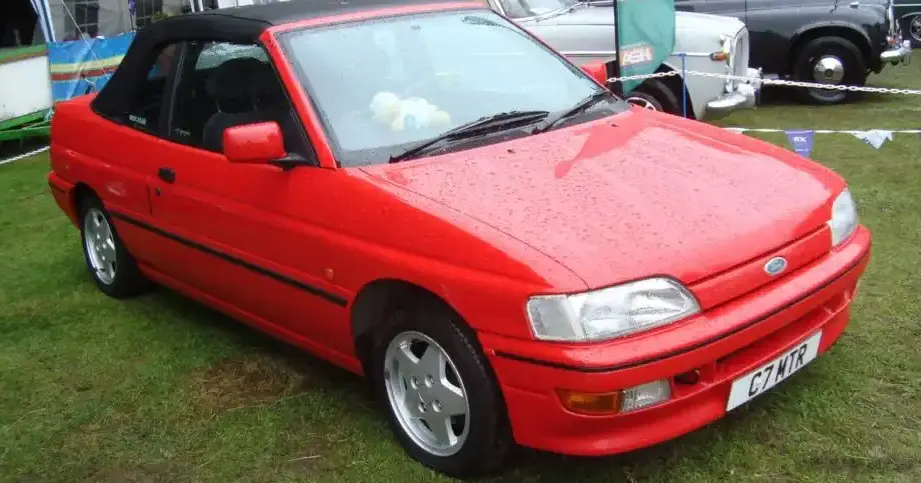
The Ford Escort V Cabrio 1.4, produced between 1990 and 1992, represented the entry point into the fifth-generation Escort Cabriolet range. Positioned as an affordable and accessible open-top motoring option, it catered to buyers seeking a stylish and practical convertible without the higher price tag of more powerful variants. This model was part of the broader Escort Mk V series (internally designated as the AFO platform), which aimed to modernize the Escort line with improved aerodynamics and a more contemporary interior. The 1.4-liter engine and five-speed manual transmission combination defined this specific trim level, offering a balance between fuel efficiency and usability.
Technical Specifications
| Brand | Ford |
| Model | Escort |
| Generation | Escort V Cabrio (ALL) |
| Type (Engine) | 1.4 (71 Hp) |
| Start of production | 1990 |
| End of production | 1992 |
| Powertrain Architecture | Internal Combustion engine |
| Body type | Cabriolet |
| Seats | 5 |
| Fuel consumption (urban) | 10 l/100 km (23.5 US mpg, 28.2 UK mpg, 10 km/l) |
| Fuel consumption (extra urban) | 5.8 l/100 km (40.6 US mpg, 48.7 UK mpg, 17.2 km/l) |
| Fuel Type | Petrol (Gasoline) |
| Acceleration 0 – 100 km/h | 13 sec |
| Acceleration 0 – 62 mph | 13 sec |
| Acceleration 0 – 60 mph | 12.4 sec |
| Maximum speed | 163 km/h (101.28 mph) |
| Weight-to-power ratio | 13.5 kg/Hp, 74 Hp/tonne |
| Power | 71 Hp @ 5600 rpm |
| Power per litre | 51 Hp/l |
| Engine Model/Code | F6F, F6G |
| Engine displacement | 1392 cm3 (84.95 cu. in.) |
| Number of cylinders | 4 |
| Number of valves per cylinder | 2 |
| Fuel injection system | Single-point injection |
| Engine aspiration | Naturally aspirated |
| Engine oil capacity | 3.5 l (3.7 US qt, 3.08 UK qt) |
| Coolant capacity | 7.6 l (8.03 US qt, 6.69 UK qt) |
| Kerb Weight | 960 kg (2116.44 lbs) |
| Fuel tank capacity | 55 l (14.53 US gal, 12.1 UK gal) |
| Drivetrain Architecture | Front wheel drive |
| Number of gears | 5 |
| Gearbox type | Manual transmission |
| Front brakes | Disc |
| Rear brakes | Drum |
| Wheel rims size | 13 inches |
Powertrain & Engine Architecture
The Escort V Cabrio 1.4 was powered by the Ford F6F or F6G engine, a 1.4-liter (1392 cc) inline-four cylinder gasoline engine. This engine featured a single overhead camshaft (SOHC) and two valves per cylinder. The fuel system employed single-point fuel injection, a relatively basic system compared to the multi-point injection found in higher-spec Escort models. This system delivered fuel into the intake manifold rather than directly into each cylinder. The engine produced 71 horsepower at 5600 rpm and approximately 88 lb-ft of torque. The five-speed manual transmission was the standard offering for this variant, providing a reasonable spread of gears for both urban driving and highway cruising. The transmission was a conventional setup, prioritizing durability and ease of maintenance over sporty performance.
Driving Characteristics
The 1.4-liter engine in the Escort V Cabrio provided adequate, but not exhilarating, performance. Acceleration from 0-60 mph took around 12.4 seconds, and top speed was approximately 101 mph. The car felt best suited to relaxed cruising rather than spirited driving. The gear ratios in the five-speed manual transmission were spaced to prioritize fuel economy and drivability. Compared to the later 1.6-liter and 1.8-liter Escort Cabriolets, the 1.4 felt noticeably slower, particularly when fully loaded with passengers and luggage. The lighter weight of the 1.4 compared to its larger-engined siblings did offer some advantage in handling, but the suspension was tuned for comfort rather than outright sportiness.
Equipment & Trim Levels
The Escort V Cabrio 1.4 typically came with a relatively basic level of equipment. Standard features generally included cloth upholstery, a basic stereo system, and manual windows and door locks. Power steering was often an optional extra. The dashboard layout was functional and straightforward, with clearly marked gauges. Optional extras included upgraded stereo systems, alloy wheels, and a more luxurious interior trim. The overall interior ambiance was practical and durable, reflecting the car’s positioning as an affordable convertible.
Chassis & Braking
The Escort V Cabriolet utilized a MacPherson strut front suspension and a twist-beam rear suspension. The front brakes were disc brakes, providing adequate stopping power, while the rear brakes were drum brakes, a cost-saving measure common in this class of vehicle. The steering was a rack-and-pinion system, offering reasonable precision. The suspension was tuned for comfort, providing a relatively smooth ride, but it wasn’t particularly sporty. Stabilizer bars were fitted to both the front and rear axles to reduce body roll during cornering, but their effectiveness was limited by the relatively soft suspension setup.
Market Reception & Comparison
The Escort V Cabrio 1.4 was generally well-received as an affordable entry into the convertible market. Critics praised its stylish design and reasonable fuel economy. However, the engine’s lack of power was a common criticism. Compared to the 1.6-liter and 1.8-liter Escort Cabriolets, the 1.4 offered significantly less performance. The 1.6-liter version, while more expensive, provided a noticeable improvement in acceleration and overall driving experience. The 1.4’s fuel economy was a strong point, achieving around 40 mpg on the highway, making it an attractive option for budget-conscious buyers. Reliability was generally good, with the 1.4-liter engine proving to be durable and relatively easy to maintain.
Legacy
The Ford Escort V Cabrio 1.4 remains a popular choice among classic car enthusiasts seeking an affordable and stylish convertible. The 1.4-liter engine, while not particularly powerful, is known for its reliability and ease of maintenance. Parts availability is generally good, making it relatively easy to keep these cars on the road. Today, these cars are often found in good condition, having been well-maintained by enthusiasts. The 1.4 variant represents a good entry point into Escort Cabrio ownership, offering a classic open-top experience without the higher costs associated with the more powerful models. The simplicity of the engine and mechanical components makes it a relatively straightforward car to work on for DIY mechanics.