
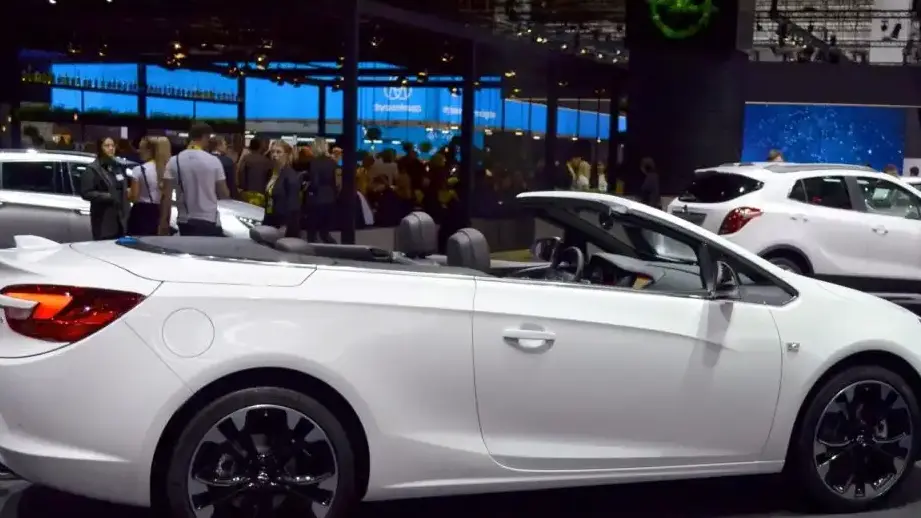
The Opel Cascada 1.4 Turbo Ecotec start/stop, produced from January 2013 to April 2018, was a mid-size convertible positioned as a stylish and relatively affordable option within Opel’s lineup. It represented Opel’s attempt to re-enter the convertible market after a hiatus, aiming to compete with vehicles like the Ford Focus Cabriolet and Volkswagen Eos. This particular variant, powered by the 1.4-liter turbocharged engine producing 140 horsepower, served as a key entry point into the Cascada range, offering a balance between fuel efficiency and acceptable performance. The Cascada itself was built on the GM Delta platform, shared with other Opel/Vauxhall and Chevrolet models.
Technical Specifications
| Brand | Opel |
| Model | Cascada |
| Generation | Cascada |
| Type (Engine) | 1.4 (140 Hp) Turbo Ecotec start/stop |
| Start of production | January, 2013 |
| End of production | April, 2018 |
| Powertrain Architecture | Internal Combustion engine |
| Body type | Cabriolet |
| Seats | 4 |
| Doors | 2 |
| Fuel consumption (urban) | 7.8-7.9 l/100 km (30.2 – 29.8 US mpg, 36.2 – 35.8 UK mpg, 12.8 – 12.7 km/l) |
| Fuel consumption (extra urban) | 5.4-5.5 l/100 km (43.6 – 42.8 US mpg, 52.3 – 51.4 UK mpg, 18.5 – 18.2 km/l) |
| Fuel consumption (combined) | 6.3 l/100 km (37.3 US mpg, 44.8 UK mpg, 15.9 km/l) |
| CO2 emissions | 148-149 g/km |
| Fuel Type | Petrol (Gasoline) |
| Acceleration 0 – 100 km/h | 10.9 sec |
| Acceleration 0 – 62 mph | 10.9 sec |
| Acceleration 0 – 60 mph | 10.4 sec |
| Maximum speed | 207 km/h (128.62 mph) |
| Emission standard | Euro 5 |
| Weight-to-power ratio | 12.2 kg/Hp, 82.3 Hp/tonne |
| Weight-to-torque ratio | 8.5 kg/Nm, 117.6 Nm/tonne |
| Power | 140 Hp @ 4900-6000 rpm |
| Power per litre | 102.8 Hp/l |
| Torque | 200 Nm @ 1850-4900 rpm (147.51 lb.-ft. @ 1850-4900 rpm) |
| Engine layout | Front, Transverse |
| Engine Model/Code | A14NET, B14NET |
| Engine displacement | 1362 cm3 (83.11 cu. in.) |
| Number of cylinders | 4 |
| Engine configuration | Inline |
| Cylinder Bore | 72.5 mm (2.85 in.) |
| Piston Stroke | 82.5 mm (3.25 in.) |
| Fuel injection system | Multi-port manifold injection |
| Engine aspiration | Turbocharger, Intercooler |
| Engine oil capacity | 4 l (4.23 US qt | 3.52 UK qt) |
| Kerb Weight | 1701-1816 kg (3750.06 – 4003.59 lbs.) |
| Max. weight | 2105-2200 kg (4640.73 – 4850.17 lbs.) |
| Max load | 384-404 kg (846.58 – 890.67 lbs.) |
| Trunk (boot) space – minimum | 280 l (9.89 cu. ft.) |
| Trunk (boot) space – maximum | 630 l (22.25 cu. ft.) |
| Fuel tank capacity | 56 l (14.79 US gal | 12.32 UK gal) |
| Permitted trailer load with brakes (12%) | 1250-1300 kg (2755.78 – 2866.01 lbs.) |
| Permitted trailer load without brakes | 750 kg (1653.47 lbs.) |
| Length | 4696 mm (184.88 in.) |
| Width | 1839 mm (72.4 in.) |
| Width including mirrors | 2020 mm (79.53 in.) |
| Height | 1443 mm (56.81 in.) |
| Wheelbase | 2695 mm (106.1 in.) |
| Front track | 1587 mm (62.48 in.) |
| Rear (Back) track | 1587 mm (62.48 in.) |
| Ride height (ground clearance) | 145 mm (5.71 in.) |
| Drag coefficient (Cd) | 0.30 |
| Minimum turning circle (turning diameter) | 12.2 m (40.03 ft.) |
| Drivetrain Architecture | The Internal combustion engine (ICE) drives the front wheels of the vehicle. |
| Drive wheel | Front wheel drive |
| Number of gears and type of gearbox | 6 gears, manual transmission |
| Front brakes | Ventilated discs |
| Rear brakes | Disc |
| Assisting systems | ABS (Anti-lock braking system) |
| Steering type | Steering rack and pinion |
| Power steering | Electric Steering |
Powertrain & Engine Architecture
The heart of this Cascada variant is the A14NET or B14NET 1.4-liter turbocharged four-cylinder engine. This engine belongs to Opel’s ‘Ecotec’ family, known for its focus on efficiency and refinement. The engine utilizes multi-point fuel injection and a single turbocharger with an intercooler to boost power output. The turbocharger helps to mitigate turbo lag, providing a relatively responsive driving experience. The engine’s timing chain design contributes to reduced maintenance compared to belt-driven engines. The 1.4L engine is paired with a six-speed manual transmission, which was the standard offering. The transmission’s gear ratios are tuned for a balance of fuel economy and acceleration, though it isn’t particularly sporty. The ‘start/stop’ system, a standard feature, automatically shuts off the engine when the vehicle is stationary to further improve fuel efficiency.
Driving Characteristics
The 140 horsepower and 200 Nm (147.51 lb-ft) of torque delivered by the 1.4 Turbo Ecotec engine provide adequate, but not exhilarating, performance. Acceleration from 0-60 mph takes around 10.4 seconds, and the top speed is 207 km/h (128.62 mph). Compared to the more powerful 1.6 Turbo or 2.0 Turbo variants, the 1.4 feels noticeably less responsive, especially during overtaking maneuvers. The six-speed manual transmission is well-matched to the engine, but the gear ratios aren’t optimized for aggressive driving. The Cascada 1.4 prioritizes comfort and fuel economy over outright performance, making it a suitable choice for relaxed cruising and everyday commuting. The steering is light and precise, contributing to a comfortable driving experience.
Equipment & Trim Levels
The Cascada 1.4 Turbo Ecotec start/stop typically came equipped with a reasonable level of standard features. These included air conditioning, electric front windows, a basic audio system with USB connectivity, and alloy wheels. Higher trim levels, such as ‘Essentia’ or ‘Sport’, added features like automatic climate control, upgraded audio systems, leather upholstery, and parking sensors. Optional extras included a panoramic sunroof, navigation system, and adaptive cruise control. Interior upholstery was typically cloth on the base models, with leather options available on higher trims. The dashboard layout was generally clean and functional, with a focus on ease of use.
Chassis & Braking
The Cascada’s chassis is comprised of independent suspension at the front (MacPherson strut) and a semi-independent torsion beam setup at the rear. This configuration provides a comfortable ride quality, although it doesn’t offer the same level of handling precision as a fully independent rear suspension. Brakes are ventilated discs at the front and solid discs at the rear. ABS (Anti-lock Braking System) is standard. The Cascada’s weight, ranging from 1701-1816 kg (3750.06 – 4003.59 lbs.), contributes to a slightly less agile feel compared to lighter competitors. Stabilizer bars are fitted front and rear to reduce body roll during cornering.
Market Reception & Comparison
The Opel Cascada 1.4 Turbo Ecotec start/stop was generally well-received by critics as a stylish and comfortable convertible. However, some reviewers noted that the 1.4-liter engine felt underpowered, particularly when the car was fully loaded. Fuel economy was praised, with combined figures around 6.3 l/100 km (37.3 US mpg). Compared to the more powerful Cascada variants, the 1.4 offered a more affordable entry point but sacrificed performance. The Volkswagen Eos, with its more refined interior and available hardtop, was often seen as a more premium alternative. The Ford Focus Cabriolet offered a sportier driving experience but lacked the Cascada’s overall sophistication.
Legacy
The Opel Cascada, while not a massive sales success, remains a relatively reliable vehicle in the used car market. The 1.4 Turbo Ecotec engine is generally considered to be durable, although regular maintenance is essential. Common issues include occasional turbocharger problems and oil leaks. The start/stop system can sometimes experience failures, but these are typically covered under warranty during the vehicle’s early years. The Cascada’s relatively simple mechanical design makes it relatively affordable to maintain and repair. Today, the Cascada 1.4 represents a reasonably priced and stylish convertible option for those seeking a comfortable and fuel-efficient open-top experience.
