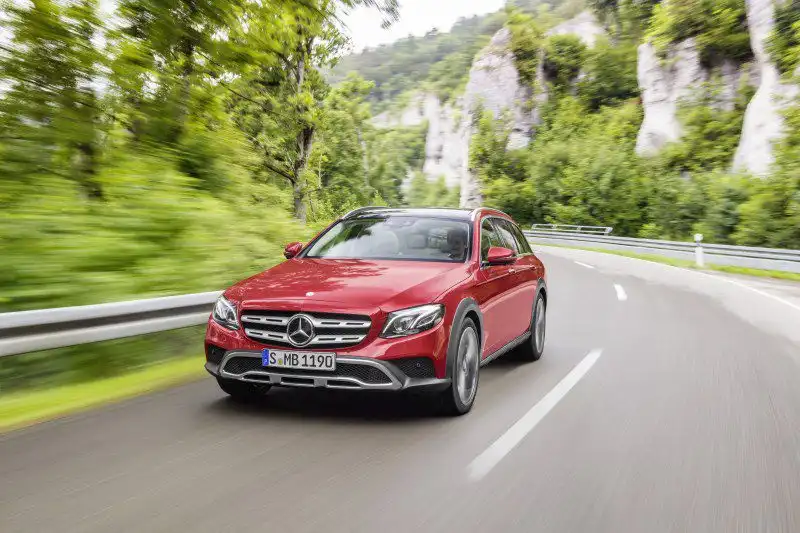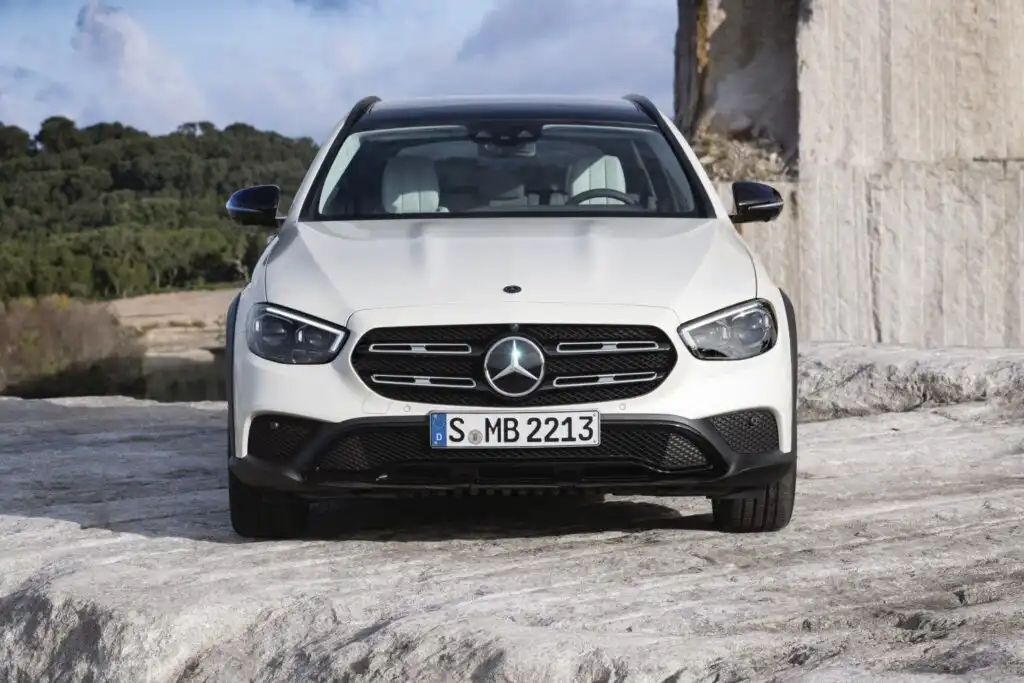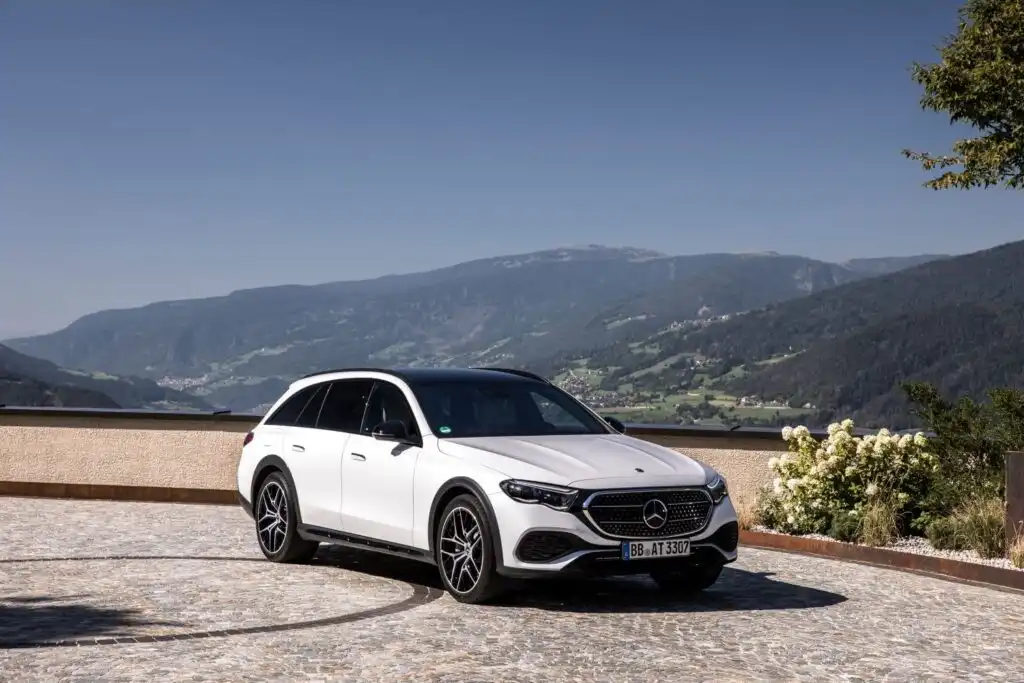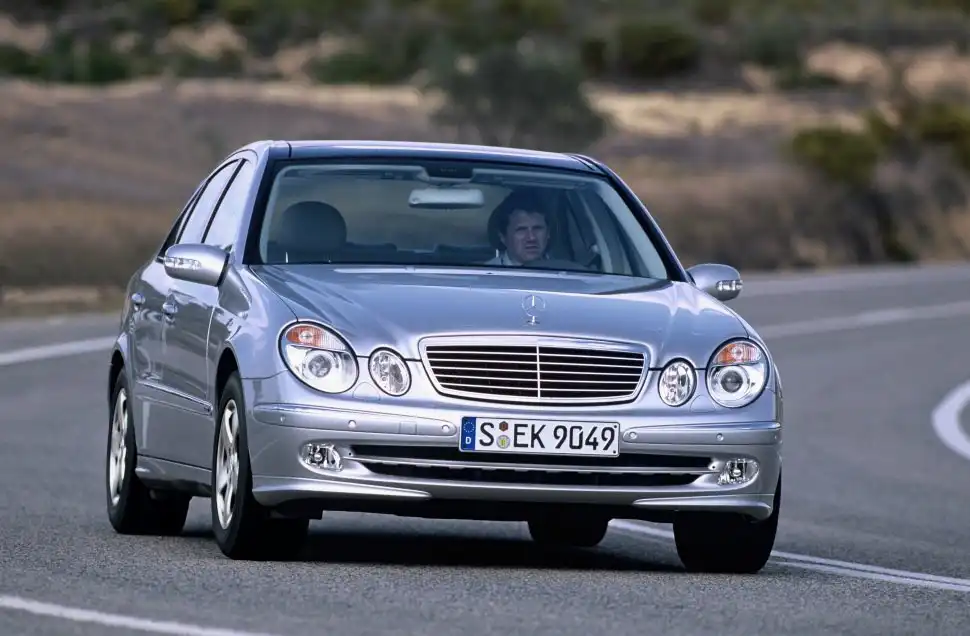
The Mercedes-Benz E 220 CDI, powered by a 2.1-liter four-cylinder diesel engine and paired with a 5G-TRONIC automatic transmission, was a significant variant within the W211 E-Class range produced between January 2002 and April 2005. Positioned as a fuel-efficient and comfortable option, it catered to buyers prioritizing economy and refinement over outright performance. This model represented a key part of Mercedes-Benz’s strategy to offer a diverse E-Class lineup, appealing to a broader customer base in the European market and beyond. The W211 generation, produced from 2002 to 2009, aimed to modernize the E-Class while maintaining its reputation for luxury and engineering excellence.
Technical Specifications
| Brand | Mercedes-Benz |
| Model | E-class |
| Generation | E-class (W211) |
| Type (Engine) | E 220 CDI (150 Hp) 5G-TRONIC |
| Start of production | January, 2002 |
| End of production | April, 2005 |
| Powertrain Architecture | Internal Combustion engine |
| Body type | Sedan |
| Seats | 5 |
| Doors | 4 |
| Fuel consumption (urban) | 9.1 l/100 km (25.8 US mpg, 31 UK mpg, 11 km/l) |
| Fuel consumption (extra urban) | 5.3 l/100 km (44.4 US mpg, 53.3 UK mpg, 18.9 km/l) |
| Fuel consumption (combined) | 6.7 l/100 km (35.1 US mpg, 42.2 UK mpg, 14.9 km/l) |
| Fuel Type | Diesel |
| Acceleration 0 – 100 km/h | 10.6 sec |
| Acceleration 0 – 62 mph | 10.6 sec |
| Acceleration 0 – 60 mph | 10.1 sec |
| Maximum speed | 214 km/h (132.97 mph) |
| Emission standard | Euro 3 |
| Weight-to-power ratio | 10.7 kg/Hp, 93.2 Hp/tonne |
| Weight-to-torque ratio | 4.7 kg/Nm, 211.2 Nm/tonne |
| Power | 150 Hp @ 4200 rpm |
| Power per litre | 69.8 Hp/l |
| Torque | 340 Nm @ 2000 rpm (250.77 lb.-ft. @ 2000 rpm) |
| Engine layout | Front, Longitudinal |
| Engine Model/Code | OM 646.961 |
| Engine displacement | 2148 cm3 (131.08 cu. in.) |
| Number of cylinders | 4 |
| Engine configuration | Inline |
| Cylinder Bore | 88 mm (3.46 in.) |
| Piston Stroke | 88.3 mm (3.48 in.) |
| Compression ratio | 18:1 |
| Number of valves per cylinder | 4 |
| Fuel injection system | Diesel Commonrail |
| Engine aspiration | Turbocharger, Intercooler |
| Valvetrain | DOHC |
| Engine oil capacity | 6.5 l (6.87 US qt | 5.72 UK qt) |
| Coolant | 10.2 l (10.78 US qt | 8.97 UK qt) |
| Kerb Weight | 1610 kg (3549.44 lbs.) |
| Max. weight | 2145 kg (4728.92 lbs.) |
| Max load | 535 kg (1179.47 lbs.) |
| Trunk (boot) space – minimum | 540 l (19.07 cu. ft.) |
| Fuel tank capacity | 65 l (17.17 US gal | 14.3 UK gal) |
| Max. roof load | 100 kg (220.46 lbs.) |
| Permitted trailer load with brakes (12%) | 1900 kg (4188.78 lbs.) |
| Permitted trailer load without brakes | 750 kg (1653.47 lbs.) |
| Length | 4818 mm (189.69 in.) |
| Width | 1822 mm (71.73 in.) |
| Width including mirrors | 1990 mm (78.35 in.) |
| Height | 1452 mm (57.17 in.) |
| Wheelbase | 2854 mm (112.36 in.) |
| Front track | 1577 mm (62.09 in.) |
| Rear (Back) track | 1570 mm (61.81 in.) |
| Front overhang | 831 mm (32.72 in.) |
| Rear overhang | 1133 mm (44.61 in.) |
| Drag coefficient (Cd) | 0.27 |
| Minimum turning circle (turning diameter) | 11.4 m (37.4 ft.) |
| Drivetrain Architecture | The Internal combustion engine (ICE) drives the rear wheels of the vehicle. |
| Drive wheel | Rear wheel drive |
| Number of gears and type of gearbox | 5 gears, automatic transmission |
| Front suspension | Double wishbone |
| Rear suspension | Independent multi-link spring suspension with stabilizer |
| Front brakes | Ventilated discs |
| Rear brakes | Disc |
| Assisting systems | ABS (Anti-lock braking system) |
| Steering type | Steering rack and pinion |
| Power steering | Hydraulic Steering |
| Tires size | 205/60 R16; 225/55 R16 |
| Wheel rims size | 7J x 16; 7.5J x 16 |
Powertrain & Engine Architecture
The heart of the E 220 CDI is the OM 646.961, a 2.1-liter inline-four cylinder diesel engine. This engine utilizes common-rail direct injection, a technology that significantly improved fuel efficiency and reduced emissions compared to earlier diesel designs. The common-rail system, supplied by Bosch, injects fuel at extremely high pressure (up to 1600 bar) directly into the combustion chamber, allowing for precise control of the combustion process. A turbocharger with an intercooler further enhances performance by forcing more air into the engine, increasing power output. The engine also features a double overhead camshaft (DOHC) valvetrain with four valves per cylinder, optimizing gas flow for improved efficiency and power. The 5G-TRONIC automatic transmission, a five-speed torque converter automatic, was specifically tuned to complement the engine’s torque characteristics. It offered smooth and refined gear changes, contributing to the overall comfortable driving experience.
Driving Characteristics
The E 220 CDI Automatic offered a comfortable and relaxed driving experience. While not a performance-oriented model, the 150 horsepower and 340 Nm (250 lb-ft) of torque provided adequate power for everyday driving and highway cruising. Acceleration from 0 to 60 mph took around 10.1 seconds, and the top speed was 133 mph. The automatic transmission, while smooth, wasn’t particularly quick to downshift, and the engine could feel somewhat strained when accelerating hard. Compared to the more powerful E 320 CDI or the E 200 Kompressor, the E 220 CDI prioritized fuel economy and refinement over outright performance. The gear ratios were optimized for fuel efficiency, resulting in a slightly less responsive feel than the manual transmission versions or higher-output models.
Equipment & Trim Levels
The E 220 CDI typically came equipped with a respectable level of standard features, including automatic climate control, power windows and mirrors, a multi-function steering wheel, and an audio system. Upholstery was generally cloth, although leather options were available. Trim levels varied depending on the market, but common options included sunroof, navigation system, heated seats, and upgraded audio systems. The interior design was typical of Mercedes-Benz at the time, emphasizing quality materials and a comfortable, ergonomic layout. Safety features such as ABS, traction control, and multiple airbags were standard.
Chassis & Braking
The W211 E-Class featured a double wishbone front suspension and an independent multi-link rear suspension, providing a comfortable and controlled ride. The E 220 CDI typically came equipped with ventilated disc brakes at the front and solid disc brakes at the rear. The hydraulic power steering offered a good balance of assistance and feedback. Stabilizer bars were fitted to both the front and rear axles to reduce body roll during cornering. The suspension was tuned for comfort, prioritizing a smooth ride over sporty handling.
Market Reception & Comparison
The E 220 CDI was well-received in the European market as a practical and economical option within the E-Class range. Critics praised its fuel efficiency and comfortable ride, but some noted its lack of outright performance compared to other models. Compared to the E 320 CDI, the E 220 CDI offered significantly better fuel economy but lacked the higher engine output. Against the petrol-powered E 200 Kompressor, the E 220 CDI provided superior torque and fuel efficiency, making it a more suitable choice for long-distance driving. Reliability was generally good, although some owners reported issues with the diesel particulate filter (DPF) and the common-rail injection system.
Legacy
The OM 646 engine, as used in the E 220 CDI, proved to be a durable and reliable powerplant when properly maintained. While the 5G-TRONIC transmission could experience issues with valve body wear over time, it was generally considered a robust unit. Today, well-maintained E 220 CDI models can still be found on the used car market, offering a relatively affordable entry point into Mercedes-Benz ownership. Their fuel efficiency and comfortable ride continue to appeal to buyers seeking a practical and refined sedan. However, potential buyers should be aware of the potential for DPF issues and the importance of regular maintenance to ensure long-term reliability.