
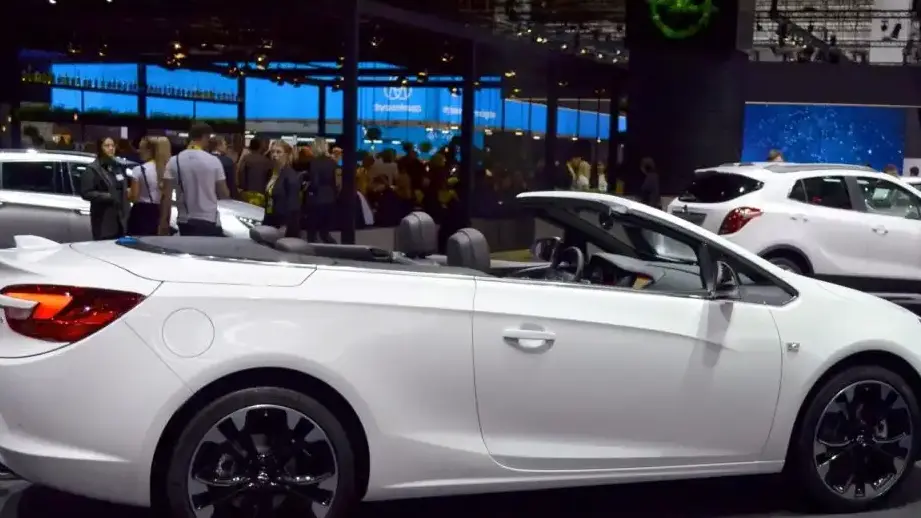
The Opel Cascada 1.6 (136 hp) Start/Stop was a front-wheel-drive, four-seater cabriolet produced between April 2018 and April 2019. Positioned as a mid-range offering within the Cascada lineup, it aimed to provide a balance between fuel efficiency and acceptable performance for open-top motoring. The Cascada itself was Opel’s attempt to re-enter the medium-sized convertible market, competing with vehicles like the Ford Mustang Convertible and Volkswagen Eos. This particular variant, powered by the A16XSH engine, represented a more economical alternative to the higher-powered versions available, targeting buyers prioritizing lower running costs over outright speed.
Technical Specifications
| Brand | Opel |
| Model | Cascada |
| Generation | Cascada |
| Type (Engine) | 1.6 (136 Hp) Start/Stop |
| Start of production | April, 2018 |
| End of production | April, 2019 |
| Powertrain Architecture | Internal Combustion engine |
| Body type | Cabriolet |
| Seats | 4 |
| Doors | 2 |
| Fuel consumption (urban) | 9 l/100 km (26.1 US mpg, 31.4 UK mpg, 11.1 km/l) |
| Fuel consumption (extra urban) | 6.1 l/100 km (38.6 US mpg, 46.3 UK mpg, 16.4 km/l) |
| Fuel consumption (combined) | 7.2 l/100 km (32.7 US mpg, 39.2 UK mpg, 13.9 km/l) |
| CO2 emissions | 164 g/km |
| Fuel Type | Petrol (Gasoline) |
| Acceleration 0 – 100 km/h | 11.4 sec |
| Acceleration 0 – 62 mph | 11.4 sec |
| Acceleration 0 – 60 mph | 10.8 sec |
| Maximum speed | 205 km/h (127.38 mph) |
| Emission standard | Euro 6d |
| Weight-to-power ratio | 12.7 kg/Hp, 78.5 Hp/tonne |
| Weight-to-torque ratio | 7.2 kg/Nm, 138.5 Nm/tonne |
| Power | 136 Hp @ 4000-6000 rpm |
| Power per litre | 85.1 Hp/l |
| Torque | 240 Nm @ 1650-3500 rpm (177.01 lb.-ft. @ 1650-3500 rpm) |
| Engine layout | Front, Transverse |
| Engine Model/Code | D16SHJ |
| Engine displacement | 1598 cm3 (97.52 cu. in.) |
| Number of cylinders | 4 |
| Engine configuration | Inline |
| Cylinder Bore | 79 mm (3.11 in.) |
| Piston Stroke | 81.5 mm (3.21 in.) |
| Compression ratio | 10.5:1 |
| Number of valves per cylinder | 4 |
| Fuel injection system | Direct injection |
| Engine aspiration | Turbocharger, Intercooler |
| Engine oil capacity | 5.5 l (5.81 US qt | 4.84 UK qt) |
| Kerb Weight | 1733 kg (3820.61 lbs.) |
| Max. weight | 2150 kg (4739.94 lbs.) |
| Max load | 417 kg (919.33 lbs.) |
| Trunk (boot) space – minimum | 380 l (13.42 cu. ft.) |
| Trunk (boot) space – maximum | 750 l (26.49 cu. ft.) |
| Fuel tank capacity | 56 l (14.79 US gal | 12.32 UK gal) |
| Permitted trailer load with brakes (12%) | 1300 kg (2866.01 lbs.) |
| Permitted trailer load without brakes | 750 kg (1653.47 lbs.) |
| Length | 4696 mm (184.88 in.) |
| Width | 1839 mm (72.4 in.) |
| Width including mirrors | 2020 mm (79.53 in.) |
| Height | 1443 mm (56.81 in.) |
| Wheelbase | 2695 mm (106.1 in.) |
| Front track | 1587 mm (62.48 in.) |
| Rear (Back) track | 1587 mm (62.48 in.) |
| Minimum turning circle | 12.2 m (40.03 ft.) |
| Drivetrain Architecture | The Internal combustion engine (ICE) drives the front wheels of the vehicle. |
| Drive wheel | Front wheel drive |
| Number of gears and type of gearbox | 6 gears, manual transmission |
| Front brakes | Ventilated discs |
| Rear brakes | Ventilated discs |
| Assisting systems | ABS (Anti-lock braking system) |
| Steering type | Steering rack and pinion |
| Power steering | Electric Steering |
| Tires size | 225/55 R17 |
| Wheel rims size | 7J x 17 |
Powertrain & Engine Architecture
The Cascada 1.6 Start/Stop utilized the Opel/Vauxhall A16XSH engine, a 1.6-liter turbocharged inline-four cylinder petrol engine. This engine was part of Opel’s ‘Small Diesel/Petrol’ family, known for its compact dimensions and efficiency. The A16XSH featured direct fuel injection, a single scroll turbocharger, and an intercooler to enhance performance. The engine’s Start/Stop system automatically shut off the engine when the vehicle came to a halt, improving fuel economy in urban driving conditions. The engine produced 136 horsepower at 4,000-6,000 rpm and 240 Nm (177 lb-ft) of torque between 1,650 and 3,500 rpm. This power was delivered to the front wheels through a six-speed manual transmission. While an automatic transmission was offered on other Cascada variants, the 1.6L engine was exclusively paired with the manual gearbox.
Driving Characteristics
The 1.6-liter engine, coupled with the manual transmission, provided adequate, but not exhilarating, performance. Acceleration from 0-60 mph took around 10.8 seconds, and the top speed was 127.38 mph. Compared to the more powerful 2.0-liter turbo variants, the 1.6L felt noticeably less responsive, particularly during overtaking maneuvers. The six-speed manual transmission was well-matched to the engine’s characteristics, offering a reasonable spread of gears for both city and highway driving. The turbocharger did provide a noticeable boost in power at lower engine speeds, helping to compensate for the engine’s relatively small displacement. However, the power delivery wasn’t as linear as in naturally aspirated engines. The Cascada’s weight of approximately 3,820 lbs did impact its agility, making it feel less nimble than some of its competitors.
Equipment & Trim Levels
The Cascada 1.6 Start/Stop typically came with a respectable level of standard equipment. This included air conditioning, a touchscreen infotainment system with Bluetooth connectivity, alloy wheels, and electric windows and mirrors. Safety features such as ABS, ESP (Electronic Stability Program), and multiple airbags were also standard. Higher trim levels offered options like leather upholstery, heated seats, a premium sound system, and advanced driver-assistance systems such as lane departure warning and adaptive cruise control. Interior upholstery was generally cloth, with options for partial leather upgrades. The dashboard layout was relatively straightforward and functional, prioritizing ease of use over outright luxury.
Chassis & Braking
The Cascada utilized a MacPherson strut front suspension and a multi-link rear suspension, providing a comfortable ride quality. The suspension was tuned to prioritize comfort over sporty handling. The braking system consisted of ventilated discs on all four wheels, providing adequate stopping power for the vehicle’s weight and performance. ABS (Anti-lock Braking System) was standard, enhancing braking performance in emergency situations. The steering was electrically assisted, offering a light and precise feel. Stabilizer bars were fitted to both the front and rear axles to reduce body roll during cornering.
Market Reception & Comparison
The Opel Cascada 1.6 Start/Stop was generally well-received by critics as a practical and fuel-efficient convertible. However, it was often criticized for its lack of outright performance compared to some of its rivals. Fuel economy figures of around 32.7 US mpg combined were competitive for the segment. Reliability reports were generally positive, with few major issues reported with the A16XSH engine. Compared to the higher-powered 2.0-liter turbo variants, the 1.6L offered a more affordable entry point into Cascada ownership, but at the expense of performance. The 1.6L appealed to buyers who prioritized fuel efficiency and everyday usability over sporty driving dynamics.
Legacy
The Opel Cascada, and specifically the 1.6L Start/Stop variant, has established a modest following in the used car market. The A16XSH engine is generally considered to be a reliable unit, provided it has been properly maintained. Parts availability is generally good, and maintenance costs are relatively reasonable. While not a particularly sought-after model, the Cascada 1.6 offers a relatively affordable and practical way to experience open-top motoring. Its blend of fuel efficiency, comfort, and practicality continues to appeal to a niche segment of buyers looking for a stylish and economical convertible.
