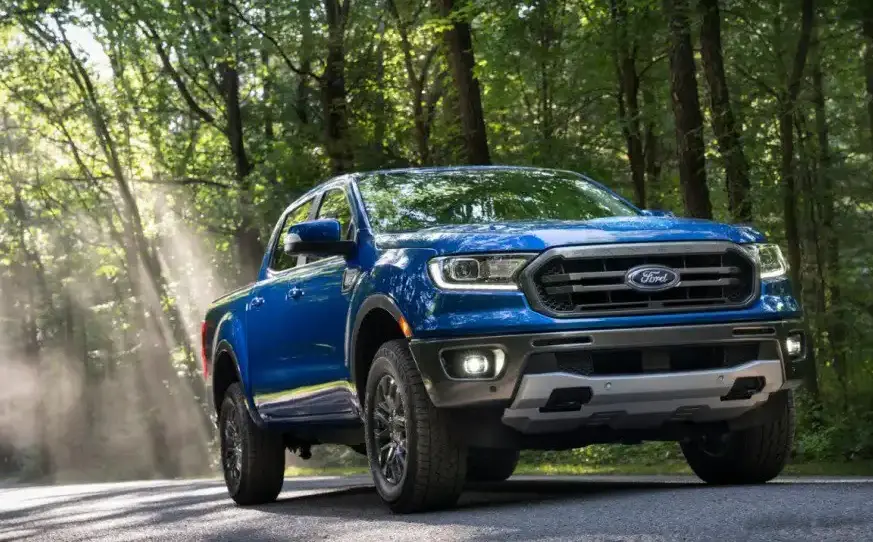
The Ford Ranger III Double Cab, specifically the facelifted version introduced in January 2019 and produced through 2022, represented a significant evolution of Ford’s mid-size pickup truck for the global market. While the Ranger had been a mainstay in markets like Europe, Australia, and South Africa for decades, the 2019 facelift brought updated styling, enhanced technology, and a new engine option: the 2.0 EcoBlue turbocharged diesel. This particular variant, producing 213 horsepower and paired with a 10-speed automatic transmission and four-wheel drive (4×4), occupied a sweet spot in the Ranger lineup, offering a balance of performance, capability, and refinement. It aimed to appeal to buyers needing a versatile vehicle for both work and family duties.
Technical Specifications
| Brand | Ford |
| Model | Ranger |
| Generation | Ranger III Double Cab (facelift 2019) |
| Type (Engine) | 2.0 EcoBlue (213 Hp) 4×4 Automatic |
| Start of production | January, 2019 |
| End of production | 2022 |
| Powertrain Architecture | Internal Combustion engine |
| Body type | Pick-up |
| Seats | 5 |
| Doors | 4 |
| Fuel consumption (combined) | 7.7-7.8 l/100 km (30.5 – 30.2 US mpg, 36.7 – 36.2 UK mpg, 13 – 12.8 km/l) |
| CO2 emissions | 201-204 g/km |
| Fuel Type | Diesel |
| Acceleration 0 – 100 km/h | 9 sec |
| Acceleration 0 – 62 mph | 9 sec |
| Acceleration 0 – 60 mph | 8.6 sec |
| Maximum speed | 180 km/h (111.85 mph) |
| Emission standard | Euro 6d-TEMP |
| Weight-to-power ratio | 10.5 kg/Hp, 95.3 Hp/tonne |
| Weight-to-torque ratio | 4.5 kg/Nm, 223.8 Nm/tonne |
| Power | 213 Hp |
| Power per litre | 106.7 Hp/l |
| Torque | 500 Nm (368.78 lb.-ft.) |
| Engine displacement | 1997 cm3 (121.86 cu. in.) |
| Number of cylinders | 4 |
| Engine configuration | Inline |
| Number of valves per cylinder | 4 |
| Fuel injection system | Diesel Commonrail |
| Engine aspiration | BiTurbo, Intercooler |
| Engine oil capacity | 8.1 l (8.56 US qt | 7.13 UK qt) |
| Coolant | 12.6 l (13.31 US qt | 11.09 UK qt) |
| Kerb Weight | 2234-2246 kg (4925.13 – 4951.58 lbs.) |
| Max. weight | 3270 kg (7209.12 lbs.) |
| Max load | 1024-1036 kg (2257.53 – 2283.99 lbs.) |
| Fuel tank capacity | 80 l (21.13 US gal | 17.6 UK gal) |
| AdBlue tank | 20 l (5.28 US gal | 4.4 UK gal) |
| Permitted trailer load with brakes (12%) | 3500 kg (7716.18 lbs.) |
| Permitted trailer load without brakes | 750 kg (1653.47 lbs.) |
| Length | 5359 mm (210.98 in.) |
| Width | 1867 mm (73.5 in.) |
| Width with mirrors folded | 1977 mm (77.83 in.) |
| Width including mirrors | 2163 mm (85.16 in.) |
| Height | 1821-1848 mm (71.69 – 72.76 in.) |
| Wheelbase | 3220 mm (126.77 in.) |
| Front track | 1560 mm (61.42 in.) |
| Rear (Back) track | 1560 mm (61.42 in.) |
| Ride height (ground clearance) | 237 mm (9.33 in.) |
| Minimum turning circle | 12.7 m (41.67 ft.) |
| Approach angle | 29.0° |
| Departure angle | 27.0° |
| Ramp-over angle | 25.0° |
| Climb angle | 35.0° |
| Wading depth | 800 mm (31.5 in.) |
| Drive wheel | All wheel drive (4×4) |
| Number of gears and type of gearbox | 10 gears, automatic transmission |
| Front brakes | Disc |
| Rear brakes | Drum |
| Assisting systems | ABS (Anti-lock braking system) |
| Tires size | 265/65 R17; 265/60 R18 |
| Wheel rims size | 8J x 17; 8J x 18 |
Powertrain & Engine Architecture
The heart of this Ranger variant is the 2.0 EcoBlue diesel engine. This engine is part of Ford’s EcoBlue family, known for its focus on efficiency and reduced emissions. The 2.0-liter inline-four cylinder engine utilizes a sophisticated bi-turbocharger setup – a low-inertia turbocharger for responsiveness and a larger turbocharger for peak power. This configuration helps to minimize turbo lag and deliver a broad torque curve. The engine employs a common-rail direct fuel injection system, operating at extremely high pressures to atomize the fuel for cleaner and more complete combustion. The engine code is typically associated with the Puma engine family. The 10-speed automatic transmission, co-developed with General Motors, is a key component. Its wide gear ratio spread allows the engine to operate in its most efficient range more often, contributing to improved fuel economy and refined cruising. The transmission features sophisticated shift logic and is designed to handle the engine’s substantial torque output.
Driving Characteristics
The 213 horsepower and 500 Nm (368 lb-ft) of torque provided by the 2.0 EcoBlue engine, when coupled with the 10-speed automatic, resulted in a capable and relatively refined driving experience. While not as overtly powerful as some of the larger displacement engines offered in the Ranger lineup (like the 3.2-liter five-cylinder), this combination offered ample power for everyday driving and towing. The 10-speed transmission kept the engine in its optimal power band, providing smooth and decisive shifts. Compared to the six-speed manual transmission available on other Ranger models, the automatic prioritized comfort and ease of use over outright driver engagement. Acceleration from 0-60 mph was around 8.6 seconds, respectable for a mid-size pickup. The 4×4 system provided good traction in various conditions, making it suitable for both on-road and light off-road use.
Equipment & Trim Levels
The 2.0 EcoBlue 4×4 Automatic typically came in mid-to-high trim levels, such as the Limited or Wildtrack, depending on the specific market. Standard equipment often included air conditioning, power windows and locks, a touchscreen infotainment system with Apple CarPlay and Android Auto compatibility, and a suite of safety features like ABS, electronic stability control, and multiple airbags. Higher trims added features like leather upholstery, heated front seats, a premium sound system, and advanced driver-assistance systems such as adaptive cruise control and lane-keeping assist. Optional extras could include a tow package, a bed liner, and various styling accessories.
Chassis & Braking
The Ranger III Double Cab utilized a robust ladder-frame chassis, providing a solid foundation for both on-road and off-road capability. The front suspension consisted of independent double wishbones with coil springs and stabilizer bar, while the rear suspension employed leaf springs. This setup prioritized load-carrying capacity and durability. Braking duties were handled by disc brakes at the front and drum brakes at the rear. While the drum brakes were adequate for most applications, some critics noted that larger disc brakes at the rear would have provided improved stopping power, especially when towing or carrying heavy loads. A stabilizer bar was fitted to both the front and rear axles to reduce body roll during cornering.
Market Reception & Comparison
The 2.0 EcoBlue 4×4 Automatic Ranger was generally well-received by automotive critics. It was praised for its fuel efficiency, comfortable ride, and capable performance. Compared to the older 3.2-liter engine, the 2.0 EcoBlue offered improved fuel economy and comparable power, albeit with a slightly different character. The 10-speed automatic transmission was also lauded for its smoothness and responsiveness. However, some reviewers felt that the engine could be a bit noisy under heavy acceleration. Compared to the manual transmission versions, the automatic was seen as more convenient for everyday driving, but less engaging for enthusiasts.
Legacy
The 2.0 EcoBlue engine and 10-speed automatic transmission combination proved to be a reliable powertrain in the Ranger III. While some early examples experienced minor software glitches, these were generally addressed through software updates. Today, used examples of this Ranger variant are relatively common and generally hold their value well. The engine is known for its durability and relatively low running costs, making it a popular choice for buyers seeking a practical and capable mid-size pickup truck. The Ranger III, and this specific variant, helped solidify Ford’s position as a leading player in the global pickup truck market.