Technical Specifications
| Brand | Ford |
| Model | Ranger |
| Generation | Ranger III Double Cab (facelift 2019) |
| Type (Engine) | 3.2 Duratorq TDCi (200 Hp) 4×4 Automatic |
| Start of production | January, 2019 |
| End of production | 2022 |
| Powertrain Architecture | Internal Combustion engine |
| Body type | Pick-up |
| Seats | 5 |
| Doors | 4 |
| Fuel consumption (combined) | 9.5 l/100 km (24.8 US mpg, 29.7 UK mpg, 10.5 km/l) |
| CO2 emissions | 248 g/km |
| Fuel Type | Diesel |
| Acceleration 0 – 100 km/h | 10.6 sec |
| Acceleration 0 – 62 mph | 10.6 sec |
| Acceleration 0 – 60 mph | 10.1 sec |
| Maximum speed | 175 km/h (108.74 mph) |
| Emission standard | Euro 6d-TEMP |
| Weight-to-power ratio | 11.2 kg/Hp, 89 Hp/tonne |
| Weight-to-torque ratio | 4.8 kg/Nm, 209.3 Nm/tonne |
| Power | 200 Hp |
| Power per litre | 62.5 Hp/l |
| Torque | 470 Nm (346.65 lb.-ft.) |
| Engine displacement | 3198 cm3 (195.15 cu. in.) |
| Number of cylinders | 5 |
| Engine configuration | Inline |
| Number of valves per cylinder | 4 |
| Fuel injection system | Diesel Commonrail |
| Engine aspiration | Turbocharger, Intercooler |
| Engine oil capacity | 8.9 l (9.4 US qt | 7.83 UK qt) |
| Coolant | 11 l (11.62 US qt | 9.68 UK qt) |
| Kerb Weight | 2246 kg (4951.58 lbs.) |
| Max. weight | 3270 kg (7209.12 lbs.) |
| Max load | 1024 kg (2257.53 lbs.) |
| Fuel tank capacity | 80 l (21.13 US gal | 17.6 UK gal) |
| AdBlue tank | 20 l (5.28 US gal | 4.4 UK gal) |
| Permitted trailer load with brakes (12%) | 3500 kg (7716.18 lbs.) |
| Permitted trailer load without brakes | 750 kg (1653.47 lbs.) |
| Length | 5359 mm (210.98 in.) |
| Width | 1867 mm (73.5 in.) |
| Width with mirrors folded | 1977 mm (77.83 in.) |
| Width including mirrors | 2163 mm (85.16 in.) |
| Height | 1848 mm (72.76 in.) |
| Wheelbase | 3220 mm (126.77 in.) |
| Front track | 1560 mm (61.42 in.) |
| Rear (Back) track | 1560 mm (61.42 in.) |
| Ride height (ground clearance) | 237 mm (9.33 in.) |
| Minimum turning circle | 12.7 m (41.67 ft.) |
| Approach angle | 29.0° |
| Departure angle | 27.0° |
| Ramp-over angle | 25.0° |
| Climb angle | 35.0° |
| Wading depth | 800 mm (31.5 in.) |
| Drive wheel | All wheel drive (4×4) |
| Number of gears and type of gearbox | 6 gears, automatic transmission |
| Front brakes | Disc |
| Rear brakes | Drum |
| Assisting systems | ABS (Anti-lock braking system) |
| Tires size | 265/60 R18 |
| Wheel rims size | 8J x 18 |
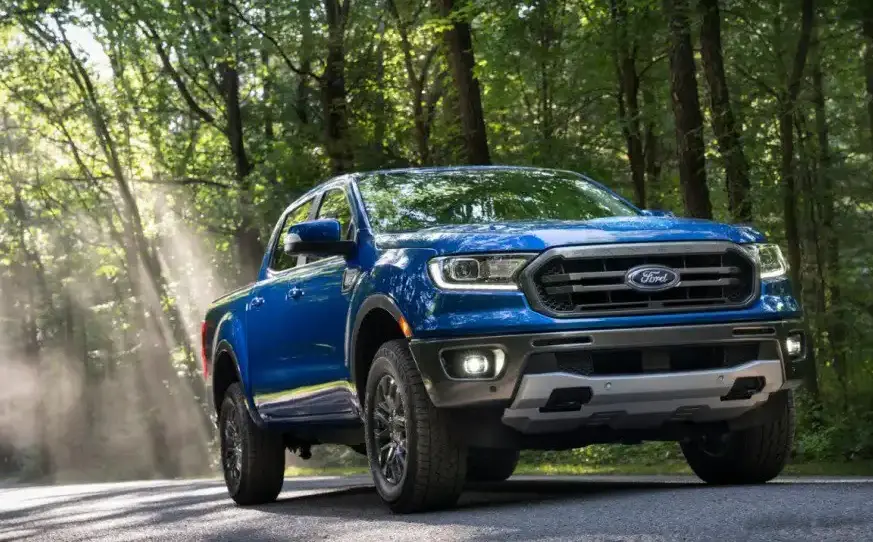
The 2019-2022 Ford Ranger III Double Cab 3.2 Duratorq TDCi 4×4 Automatic was a significant offering in the global Ford Ranger lineup. Positioned as a mid-range to upper-mid-range trim, it slotted in above the base model Rangers with smaller engines and manual transmissions, but below potential high-performance or luxury-focused variants (depending on regional availability). Built on the T6 platform, the Ranger Double Cab provided a practical and robust solution for families and businesses needing both passenger space and cargo-carrying capability. The facelift introduced in 2019 brought updated styling, improved technology, and refinements to the 3.2-liter engine to meet stricter emissions standards.
Powertrain & Engine Architecture
At the heart of this Ranger variant lies the 3.2-liter Duratorq TDCi inline five-cylinder diesel engine. This engine, designated with various codes depending on the market (often Puma 3.2), was known for its robust construction and relatively smooth operation for a diesel. It featured a common-rail direct fuel injection system, delivering fuel at extremely high pressure for optimized combustion. A variable geometry turbocharger (VGT) with an intercooler was employed to boost power and torque across a wide RPM range. The engine produced 200 horsepower and a substantial 470 Nm (346.65 lb.-ft.) of torque. The six-speed automatic transmission, sourced from various suppliers depending on the region, was chosen for its balance of efficiency and ease of use. While not the sportiest transmission, it provided smooth shifts and allowed drivers to focus on navigating various terrains.
Driving Characteristics
The 3.2L Duratorq with the automatic transmission delivered a competent, if not exhilarating, driving experience. Acceleration from 0-60 mph took around 10.1 seconds, which was adequate for everyday driving and towing. The automatic transmission, while smooth, did exhibit some hunting for the right gear, particularly when under load. The 4×4 system, typically featuring an electronically selectable transfer case, provided excellent traction in off-road conditions. The Ranger’s suspension, tuned for both on-road comfort and off-road capability, offered a reasonable ride quality, although it could feel somewhat firm when unladen. Compared to the manual transmission versions of the 3.2L, the automatic offered greater convenience, especially in urban environments, but at the expense of some fuel efficiency and a slightly less engaging driving experience. Higher output variants, if available in certain markets, would offer quicker acceleration, but the 3.2L automatic struck a good balance for many users.
Equipment & Trim Levels
The 2019-2022 Ranger III Double Cab 3.2 Duratorq 4×4 Automatic typically came well-equipped, though specific features varied by region and optional packages. Standard equipment generally included air conditioning, power windows and locks, a basic audio system with Bluetooth connectivity, and alloy wheels. Higher trim levels added features such as leather upholstery, a more advanced infotainment system with navigation, a rearview camera, parking sensors, and automatic climate control. Safety features typically included ABS, electronic stability control, and multiple airbags. Optional extras could include a tow package, bed liner, and various styling enhancements.
Chassis & Braking
The Ranger Double Cab utilized a body-on-frame construction, providing a robust and durable platform. The front suspension featured independent double wishbones with coil springs and stabilizer bar, while the rear suspension employed leaf springs. This configuration allowed for a good balance of ride comfort and load-carrying capacity. The braking system consisted of front disc brakes and rear drum brakes, with ABS as standard. The drum brakes on the rear were a cost-saving measure, and while adequate for most applications, they didn’t offer the same stopping power as disc brakes on all four wheels. Stabilizer bars were fitted front and rear to reduce body roll during cornering.
Market Reception & Comparison
The Ford Ranger III Double Cab 3.2 Duratorq 4×4 Automatic was generally well-received by automotive critics. It was praised for its practicality, durability, and off-road capability. However, some reviewers noted that the automatic transmission could be hesitant at times, and the fuel economy wasn’t class-leading. Compared to other trims in the Ranger lineup, the 3.2L automatic offered a good compromise between performance and convenience. The smaller engine options were more fuel-efficient but lacked the towing capacity and overall power of the 3.2L. The higher-output variants, if available, provided more performance but came at a higher price point.
Legacy
The 3.2-liter Duratorq TDCi engine, in general, has proven to be a relatively reliable powertrain when properly maintained. Common issues include turbocharger wear, injector problems, and occasional issues with the fuel injection pump. The six-speed automatic transmission is also generally reliable, but regular fluid changes are crucial for longevity. In the used car market, the 2019-2022 Ranger III Double Cab 3.2 Duratorq 4×4 Automatic remains a popular choice for those seeking a capable and versatile pickup truck. Its robust construction and proven powertrain make it a good value proposition, particularly for buyers who need a vehicle for work or outdoor adventures. However, potential buyers should be aware of the potential maintenance costs associated with a diesel engine and ensure that the vehicle has been well-maintained.