
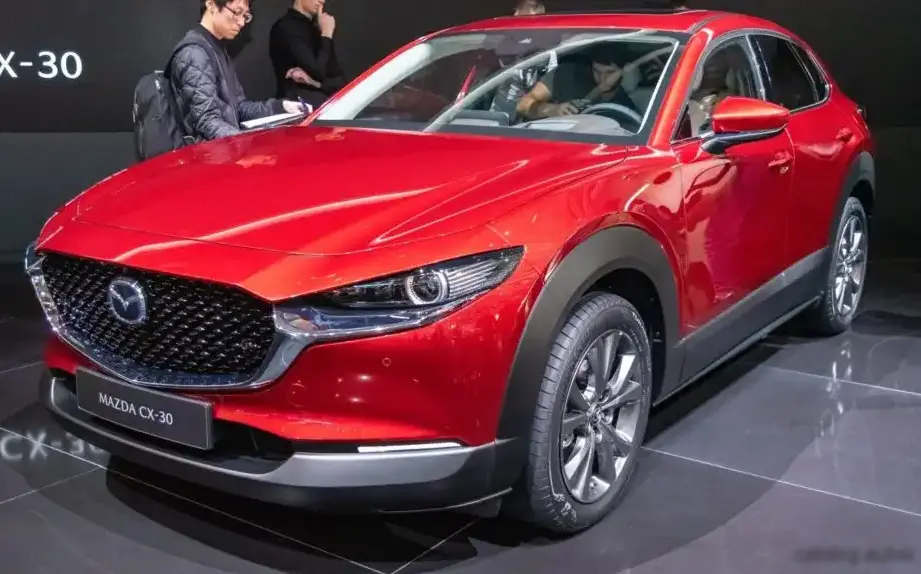
The Mazda CX-30 2.0 e-Skyactiv G, producing 150 horsepower, represents a key variant within the first generation (DM) of the CX-30, launched in January 2020. Positioned as a compact crossover SUV, the CX-30 aimed to bridge the gap between the Mazda CX-5 and the Mazda3, offering a more stylish and accessible entry point into the Mazda SUV lineup. This particular engine and transmission combination was widely available across many global markets, including Europe and Asia, and was introduced to the US market shortly after the initial launch. It served as a core offering, balancing fuel efficiency with adequate performance for everyday driving.
Technical Specifications
| Brand | Mazda |
| Model | CX-30 |
| Generation | CX-30 |
| Type (Engine) | 2.0 e-Skyactiv G (150 Hp) |
| Start of production | January, 2020 |
| Powertrain Architecture | MHEV (Mild Hybrid Electric Vehicle) |
| Body type | SUV |
| Seats | 5 |
| Doors | 5 |
| Combined fuel consumption (WLTP) | 5.9 l/100 km (39.9 US mpg) |
| CO2 emissions (WLTP) | 134 g/km |
| Fuel Type | Petrol (Gasoline) |
| Acceleration 0 – 100 km/h | 8.8 sec |
| Acceleration 0 – 62 mph | 8.8 sec |
| Acceleration 0 – 60 mph | 8.4 sec |
| Maximum speed | 198 km/h (123.03 mph) |
| Emission standard | Euro 6d-ISC-FCM |
| Weight-to-power ratio | 8.8 kg/Hp |
| Weight-to-torque ratio | 6.2 kg/Nm |
| Power | 150 Hp @ 6000 rpm |
| Torque | 213 Nm @ 4000 rpm (157.1 lb.-ft. @ 4000 rpm) |
| Engine layout | Front, Transverse |
| Engine Model/Code | PE |
| Engine displacement | 1998 cm3 (121.93 cu. in.) |
| Number of cylinders | 4 |
| Engine configuration | Inline |
| Cylinder Bore | 83.5 mm (3.29 in.) |
| Piston Stroke | 91.2 mm (3.59 in.) |
| Compression ratio | 13:1 |
| Number of valves per cylinder | 4 |
| Fuel injection system | Direct injection |
| Engine oil capacity | 4.2 l (4.44 US qt | 3.7 UK qt) |
| Coolant capacity | 6.3 l (6.66 US qt | 5.54 UK qt) |
| Kerb Weight | 1320-1407 kg (2910.1 – 3101.9 lbs.) |
| Max. weight | 1927 kg (4248.31 lbs.) |
| Trunk (boot) space – minimum | 430 l (15.19 cu. ft.) |
| Trunk (boot) space – maximum | 1406 l (49.65 cu. ft.) |
| Fuel tank capacity | 51 l (13.47 US gal | 11.22 UK gal) |
| Drive wheel | Front wheel drive |
| Number of gears and type of gearbox | 6 gears, manual transmission |
Powertrain & Engine Architecture
The CX-30 2.0 e-Skyactiv G utilizes Mazda’s PE engine code, a 1.998-liter naturally aspirated inline-four cylinder gasoline engine. This engine is a cornerstone of Mazda’s Skyactiv technology, emphasizing high compression (13:1) for improved thermal efficiency. The engine employs direct fuel injection, optimizing fuel delivery and combustion. The e-Skyactiv G designation indicates the inclusion of a 24V mild-hybrid system. This system uses a small electric motor and battery to provide a power assist during acceleration and enable extended engine stop-start functionality, improving fuel economy. The engine’s valvetrain features dual overhead camshafts (DOHC) and four valves per cylinder, contributing to its responsive nature. The 6-speed manual transmission was a common pairing, offering precise shifts and driver engagement.
Driving Characteristics
The 150 hp and 157 lb-ft of torque delivered by the 2.0-liter engine, coupled with the 6-speed manual transmission, provides adequate performance for daily commuting and highway driving. Acceleration from 0-60 mph takes approximately 8.4 seconds. While not a performance-oriented setup, the engine is characterized by its smooth power delivery and willingness to rev. The manual transmission’s gear ratios are well-matched to the engine’s torque curve, providing usable power across a broad range of engine speeds. Compared to higher-output variants (like those with larger displacement engines), this configuration prioritizes fuel efficiency and a more relaxed driving experience. The mild-hybrid system provides a subtle boost during acceleration, but its primary benefit is in reducing fuel consumption in stop-and-go traffic.
Equipment & Trim Levels
The CX-30 2.0 e-Skyactiv G was typically offered in several trim levels, varying by market. Base models generally included features such as LED headlights, a 8.8-inch infotainment display with Mazda Connect, Bluetooth connectivity, and a suite of safety features including Mazda’s i-Activsense safety technologies (such as lane departure warning, lane-keep assist, and automatic emergency braking). Higher trim levels added features like leather upholstery, a power-adjustable driver’s seat, a premium sound system, and a sunroof. Interior upholstery typically consisted of cloth on base models, with leatherette or full leather options available on higher trims. Dashboard configurations were consistent across trims, featuring a minimalist design with a focus on ergonomics.
Chassis & Braking
The CX-30 utilizes a front-wheel-drive platform with independent suspension in the front (MacPherson strut) and a torsion beam setup in the rear. The suspension is tuned for a balance between comfort and handling. Braking systems typically consisted of ventilated discs on the front wheels and solid discs on the rear. Anti-lock Braking System (ABS) and Electronic Brakeforce Distribution (EBD) were standard features. Stabilizer bars were included on both axles to reduce body roll during cornering. The chassis was designed to be lightweight, contributing to the vehicle’s overall agility and fuel efficiency.
Market Reception & Comparison
The Mazda CX-30 2.0 e-Skyactiv G was generally well-received by automotive critics. It was praised for its stylish design, comfortable interior, and engaging driving dynamics. The fuel economy of around 39.9 US mpg (combined) was considered competitive within its segment. Compared to other trims in the CX-30 lineup, this variant offered a more affordable entry point, making it attractive to budget-conscious buyers. However, some reviewers noted that the 150 hp engine could feel underpowered when fully loaded or during aggressive driving. Compared to diesel variants, the gasoline engine offered a smoother and quieter driving experience, but with slightly lower fuel economy.
Legacy
The Mazda CX-30 2.0 e-Skyactiv G has proven to be a reliable powertrain combination. The Skyactiv engine is known for its durability and relatively low maintenance costs. On the used car market, these models hold their value reasonably well, due to Mazda’s reputation for quality and reliability. The mild-hybrid system has also proven to be robust, with few reported issues. The CX-30, in general, has established itself as a popular choice in the compact crossover segment, and the 2.0-liter variant continues to be a viable option for buyers seeking a stylish, efficient, and reliable vehicle.
