
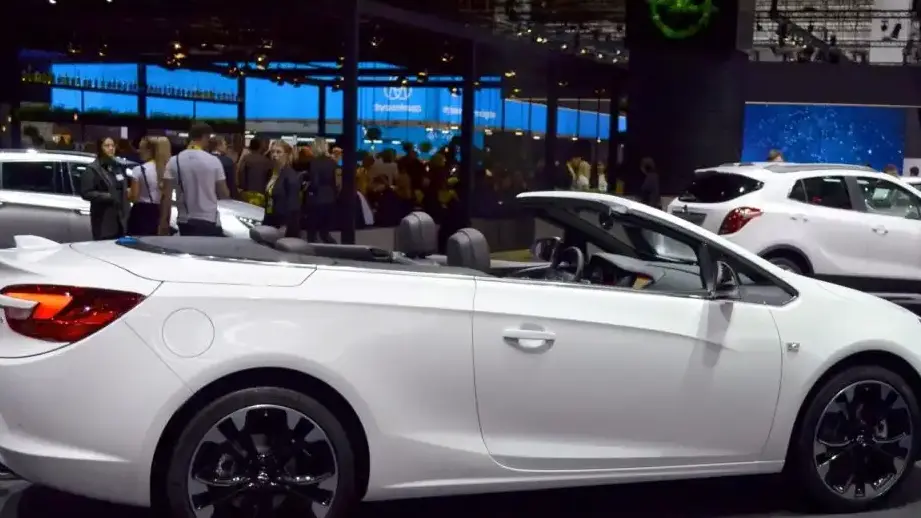
The Opel Cascada 2.0 CDTI (170 hp) Start/Stop, produced from September 2015 to April 2018, represents a mid-cycle offering within the Cascada range. Positioned as a more efficient and refined option, it aimed to appeal to buyers seeking a comfortable, open-top driving experience with reduced running costs. The Cascada itself was Opel’s entry into the mid-size convertible market, competing with vehicles like the Ford Mustang Convertible and Volkswagen Eos. This variant, equipped with the 2.0-liter turbocharged diesel engine and a six-speed manual transmission, occupied a middle ground in the Cascada lineup, offering a balance between performance and economy.
Technical Specifications
| Brand | Opel |
| Model | Cascada |
| Generation | Cascada |
| Type (Engine) | 2.0 CDTI (170 Hp) Start/Stop |
| Start of production | September, 2015 |
| End of production | April, 2018 |
| Powertrain Architecture | Internal Combustion engine |
| Body type | Cabriolet |
| Seats | 4 |
| Doors | 2 |
| Fuel consumption (urban) | 6 l/100 km (39.2 US mpg, 47.1 UK mpg, 16.7 km/l) |
| Fuel consumption (extra urban) | 4.2 l/100 km (56 US mpg, 67.3 UK mpg, 23.8 km/l) |
| Fuel consumption (combined) | 4.9 l/100 km (48 US mpg, 57.6 UK mpg, 20.4 km/l) |
| CO2 emissions | 129 g/km |
| Fuel Type | Diesel |
| Acceleration 0 – 100 km/h | 10.3 sec |
| Acceleration 0 – 62 mph | 10.3 sec |
| Acceleration 0 – 60 mph | 9.8 sec |
| Maximum speed | 218 km/h (135.46 mph) |
| Emission standard | Euro 6 |
| Weight-to-power ratio | 10 kg/Hp, 99.9 Hp/tonne |
| Weight-to-torque ratio | 4.3 kg/Nm, 235.2 Nm/tonne |
| Power | 170 Hp @ 3750 rpm |
| Power per litre | 86.9 Hp/l |
| Torque | 400 Nm @ 1750-2500 rpm (295.02 lb.-ft. @ 1750-2500 rpm) |
| Engine layout | Front, Transverse |
| Engine Model/Code | B20DTH |
| Engine displacement | 1956 cm3 (119.36 cu. in.) |
| Number of cylinders | 4 |
| Engine configuration | Inline |
| Cylinder Bore | 83 mm (3.27 in.) |
| Piston Stroke | 90.4 mm (3.56 in.) |
| Compression ratio | 16.5:1 |
| Fuel injection system | Diesel Commonrail |
| Engine aspiration | Turbocharger, Intercooler |
| Engine oil capacity | 4.9 l (5.18 US qt | 4.31 UK qt) |
| Kerb Weight | 1701-1816 kg (3750.06 – 4003.59 lbs.) |
| Max. weight | 2105-2200 kg (4640.73 – 4850.17 lbs.) |
| Max load | 384-404 kg (846.58 – 890.67 lbs.) |
| Fuel tank capacity | 56 l (14.79 US gal | 12.32 UK gal) |
| Permitted trailer load with brakes (12%) | 1250-1300 kg (2755.78 – 2866.01 lbs.) |
| Permitted trailer load without brakes | 750 kg (1653.47 lbs.) |
| Length | 4696 mm (184.88 in.) |
| Width | 1839 mm (72.4 in.) |
| Width including mirrors | 2020 mm (79.53 in.) |
| Height | 1443 mm (56.81 in.) |
| Wheelbase | 2695 mm (106.1 in.) |
| Front track | 1587 mm (62.48 in.) |
| Rear (Back) track | 1587 mm (62.48 in.) |
| Ride height (ground clearance) | 145 mm (5.71 in.) |
| Drag coefficient (Cd) | 0.30 |
| Minimum turning circle (turning diameter) | 12.2 m (40.03 ft.) |
| Drivetrain Architecture | The Internal combustion engine (ICE) drives the front wheels of the vehicle. |
| Drive wheel | Front wheel drive |
| Number of gears and type of gearbox | 6 gears, manual transmission |
| Front brakes | Ventilated discs |
| Rear brakes | Disc |
| Assisting systems | ABS (Anti-lock braking system) |
| Steering type | Steering rack and pinion |
| Power steering | Electric Steering |
| Tires size | 235/55 R17 |
| Wheel rims size | 7J x 17 |
Powertrain & Engine Architecture
At the heart of the Cascada 2.0 CDTI lies the B20DTH engine, a 1.956-liter inline-four cylinder diesel. This engine is a member of Opel/Vauxhall’s family of common-rail direct injection diesel engines. The B20DTH utilizes a turbocharger with an intercooler to boost power and efficiency. The common-rail direct injection system, operating at very high pressures, ensures precise fuel delivery and optimized combustion. The engine features a 16.5:1 compression ratio, contributing to its thermal efficiency. The six-speed manual transmission was the standard offering for this variant, providing drivers with full control over gear selection. The Start/Stop system, a key feature, automatically shuts off the engine when the vehicle is stationary (e.g., at traffic lights) to reduce fuel consumption and emissions.
Driving Characteristics
The 170 hp and 400 Nm (295 lb-ft) of torque delivered by the 2.0 CDTI engine provided the Cascada with respectable, though not particularly sporty, performance. Acceleration from 0 to 60 mph took around 9.8 seconds, and the top speed was 135.46 mph. The engine’s torque peak, available from 1750-2500 rpm, meant that the Cascada offered good in-gear acceleration and effortless cruising. Compared to the more powerful petrol variants, the 2.0 CDTI prioritized fuel economy and relaxed driving. The manual transmission, while engaging, didn’t offer the same level of responsiveness as some competitors’ gearboxes. The Cascada’s weight, ranging from 3750 to 4003 pounds, was noticeable, particularly during spirited driving.
Equipment & Trim Levels
The Cascada 2.0 CDTI typically came equipped with a reasonable level of standard features. These included air conditioning, electric front windows, a CD/MP3 stereo system, and alloy wheels. Higher trim levels, such as the Cosmo, added features like leather upholstery, heated front seats, a touchscreen infotainment system, and parking sensors. Optional extras included a panoramic sunroof, adaptive cruise control, and a premium sound system. Interior upholstery was typically cloth on base models, with leather available as an upgrade. The dashboard layout was generally straightforward and functional, prioritizing ease of use.
Chassis & Braking
The Cascada utilized a MacPherson strut front suspension and a multi-link rear suspension, providing a comfortable ride quality. The front brakes were ventilated discs, while the rear brakes were solid discs. ABS (Anti-lock Braking System) was standard. The steering was electrically assisted, offering a light and precise feel. Stabilizer bars were fitted to both the front and rear axles to reduce body roll during cornering. The suspension tuning was geared towards comfort rather than outright handling prowess, making the Cascada a pleasant cruiser.
Market Reception & Comparison
The Opel Cascada 2.0 CDTI was generally well-received by critics as a comfortable and refined convertible. The diesel engine was praised for its fuel efficiency and torque delivery. However, some reviewers found the handling to be somewhat lacking in engagement compared to rivals. Fuel economy figures of around 48 US mpg combined were competitive for the segment. Reliability was generally good, although, like all diesel engines, the Cascada’s diesel particulate filter (DPF) required periodic maintenance. Compared to the petrol-powered Cascada variants, the 2.0 CDTI appealed to buyers prioritizing fuel economy and long-distance comfort.
Legacy
The Opel Cascada, and specifically the 2.0 CDTI variant, has established a reputation as a reliable and relatively affordable convertible in the used car market. The B20DTH engine is known for its durability, provided it has been properly maintained. The Start/Stop system, while contributing to fuel savings, can be a potential source of issues if not functioning correctly. Today, the Cascada 2.0 CDTI represents a good value proposition for buyers seeking an open-top driving experience without breaking the bank. Its blend of comfort, fuel efficiency, and practicality continues to appeal to a wide range of drivers.
