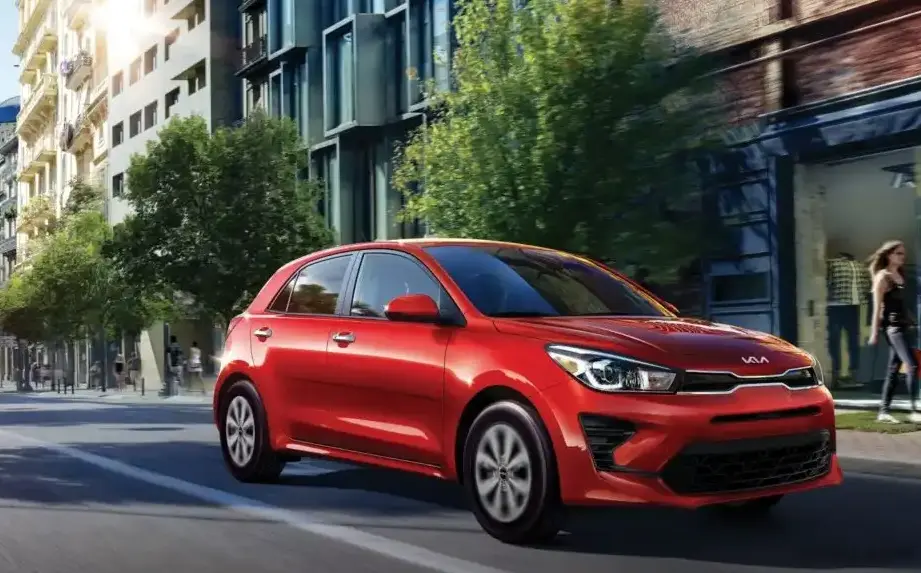
The Kia Rio IV Hatchback, specifically the YB facelift model produced from August 2020 onwards, represents a significant evolution in Kia’s subcompact offering. The 1.0 T-GDI (101 horsepower) variant equipped with a 7-speed Dual Clutch Transmission (DCT) was positioned as a mid-range option, bridging the gap between the base engine and potentially higher-trim, larger-displacement alternatives depending on regional availability. This configuration aimed to deliver a balance of fuel efficiency, modern technology, and acceptable performance for urban and highway driving. The Rio IV, built on the Kia/Hyundai B-platform, was designed to compete directly with established players like the Volkswagen Polo, Ford Fiesta, and Toyota Yaris in the European and global markets.
Technical Specifications
| Brand | Kia |
| Model | Rio |
| Generation | Rio IV Hatchback (YB, facelift 2020) |
| Type (Engine) | 1.0 T-GDI (101 Hp) DCT |
| Start of production | August, 2020 |
| Powertrain Architecture | Internal Combustion engine |
| Body type | Hatchback |
| Seats | 5 |
| Doors | 5 |
| Fuel consumption (urban) | 5.7 l/100 km (41.3 US mpg, 49.6 UK mpg, 17.5 km/l) |
| Fuel consumption (extra urban) | 4.4 l/100 km (53.5 US mpg, 64.2 UK mpg, 22.7 km/l) |
| Fuel consumption (combined) | 4.8 l/100 km (49 US mpg, 58.9 UK mpg, 20.8 km/l) |
| CO2 emissions | 110 g/km |
| Fuel Type | Petrol (Gasoline) |
| Acceleration 0 – 100 km/h | 11.4 sec |
| Acceleration 0 – 62 mph | 11.4 sec |
| Acceleration 0 – 60 mph | 10.8 sec |
| Maximum speed | 185 km/h (114.95 mph) |
| Emission standard | Euro 6d-ISC-FCM |
| Weight-to-power ratio | 11.1 kg/Hp, 89.8 Hp/tonne |
| Weight-to-torque ratio | 6.5 kg/Nm, 152.9 Nm/tonne |
| Power | 101 Hp @ 4500-6000 rpm |
| Power per litre | 101.2 Hp/l |
| Torque | 172 Nm @ 1500-4000 rpm (126.86 lb.-ft. @ 1500-4000 rpm) |
| Engine layout | Front, Transverse |
| Engine Model/Code | G3LE |
| Engine displacement | 998 cm3 (60.9 cu. in.) |
| Number of cylinders | 3 |
| Engine configuration | Inline |
| Cylinder Bore | 71 mm (2.8 in.) |
| Piston Stroke | 84 mm (3.31 in.) |
| Compression ratio | 10.5:1 |
| Number of valves per cylinder | 4 |
| Fuel injection system | Direct injection |
| Engine aspiration | Turbocharger, Intercooler |
| Engine oil capacity | 3.6 l (3.8 US qt | 3.17 UK qt) |
| Coolant capacity | 5.9 l (6.23 US qt | 5.19 UK qt) |
| Kerb Weight | 1125-1223 kg (2480.2 – 2696.25 lbs.) |
| Max. weight | 1650 kg (3637.63 lbs.) |
| Max load | 427-525 kg (941.37 – 1157.43 lbs.) |
| Trunk (boot) space – minimum | 325 l (11.48 cu. ft.) |
| Trunk (boot) space – maximum | 1103 l (38.95 cu. ft.) |
| Fuel tank capacity | 45 l (11.89 US gal | 9.9 UK gal) |
| Max. roof load | 70 kg (154.32 lbs.) |
| Permitted trailer load with brakes (12%) | 900 kg (1984.16 lbs.) |
| Permitted trailer load without brakes | 450 kg (992.08 lbs.) |
| Permitted towbar download | 75 kg (165.35 lbs.) |
| Length | 4065 mm (160.04 in.) |
| Width | 1725 mm (67.91 in.) |
| Width including mirrors | 1993 mm (78.46 in.) |
| Height | 1450 mm (57.09 in.) |
| Wheelbase | 2580 mm (101.57 in.) |
| Front track | 1512 mm (59.53 in.) |
| Rear (Back) track | 1518 mm (59.76 in.) |
| Minimum turning circle | 10.2 m (33.46 ft.) |
| Drivetrain Architecture | Front wheel drive |
| Number of gears and type of gearbox | 7 gears, automatic transmission DCT |
| Front suspension | Independent, type McPherson with coil spring and anti-roll bar |
| Rear suspension | Coil spring, Elastic beam |
| Front brakes | Ventilated discs, 280 mm |
| Rear brakes | Disc, 262 mm |
| Assisting systems | ABS (Anti-lock braking system) |
| Steering type | Steering rack and pinion |
| Power steering | Electric Steering |
| Tires size | 195/55 R16 87H |
| Wheel rims size | 6.0J x 16 |
Powertrain & Engine Architecture
The heart of this Rio variant is the G3LE, a 1.0-liter turbocharged three-cylinder engine. This engine utilizes direct fuel injection and a single scroll turbocharger with an intercooler to maximize efficiency and power output. The engine code ‘G3LE’ signifies a specific iteration of Hyundai-Kia’s ‘Kappa’ engine family. The Kappa engines are known for their lightweight construction and focus on fuel economy. The 1.0 T-GDI employs a timing chain for durability, and features a relatively high compression ratio of 10.5:1. The 7-speed Dual Clutch Transmission (DCT) is a crucial component, offering quicker and smoother gear changes compared to a traditional automatic transmission. This DCT is designed to enhance both performance and fuel efficiency by minimizing power loss during shifts.
Driving Characteristics
The 101 horsepower and 172 Nm (126.86 lb-ft) of torque delivered by the 1.0 T-GDI engine, coupled with the 7-speed DCT, provides adequate performance for everyday driving. Acceleration from 0-60 mph takes around 10.8 seconds, and the top speed is 185 km/h (114.95 mph). While not a particularly sporty setup, the turbocharger provides a noticeable boost in power during acceleration, making overtaking maneuvers manageable. The DCT contributes to a more engaging driving experience than a conventional automatic, although some drivers may notice slight hesitation at low speeds. The gear ratios are tuned for fuel efficiency, meaning the engine can feel slightly strained when climbing hills or carrying a full load. Compared to higher-output versions of the Rio (if available in certain markets), this variant prioritizes economy over outright performance.
Equipment & Trim Levels
The 1.0 T-GDI DCT trim typically included standard features such as air conditioning, a touchscreen infotainment system with Apple CarPlay and Android Auto compatibility, Bluetooth connectivity, and power windows. Safety features generally included ABS, Electronic Stability Control (ESC), and multiple airbags. Higher trim levels offered additional features like alloy wheels, a rear-view camera, parking sensors, and a more sophisticated infotainment system. Interior upholstery was typically cloth, with options for upgraded materials on higher trims. The dashboard layout was functional and modern, with a focus on ease of use.
Chassis & Braking
The Rio IV utilizes a McPherson strut front suspension and a torsion beam rear suspension. This setup provides a comfortable ride quality, although it’s not particularly sporty. The front brakes are ventilated discs, while the rear brakes are solid discs. ABS (Anti-lock Braking System) is standard, providing enhanced braking performance in emergency situations. The steering is electrically assisted, offering light and precise control. The suspension tuning is geared towards comfort and stability, rather than aggressive handling.
Market Reception & Comparison
The 1.0 T-GDI DCT Rio was generally well-received by automotive critics for its fuel efficiency and modern features. However, some reviewers noted that the engine could feel underpowered at times, particularly when fully loaded. Compared to the base engine options, the 1.0 T-GDI offered a significant improvement in performance. In terms of fuel economy, it was competitive with other subcompact hatchbacks in its class. Reliability reports have been generally positive, with few major issues reported with the engine or transmission.
Legacy
The Kia Rio IV 1.0 T-GDI DCT has established itself as a reliable and economical subcompact hatchback in the used car market. The G3LE engine, while not known for exceptional power, has proven to be durable and relatively easy to maintain. The DCT transmission, if properly maintained (regular fluid changes are crucial), is also generally reliable. As a result, these Rios continue to be a popular choice for budget-conscious buyers seeking a practical and fuel-efficient vehicle.