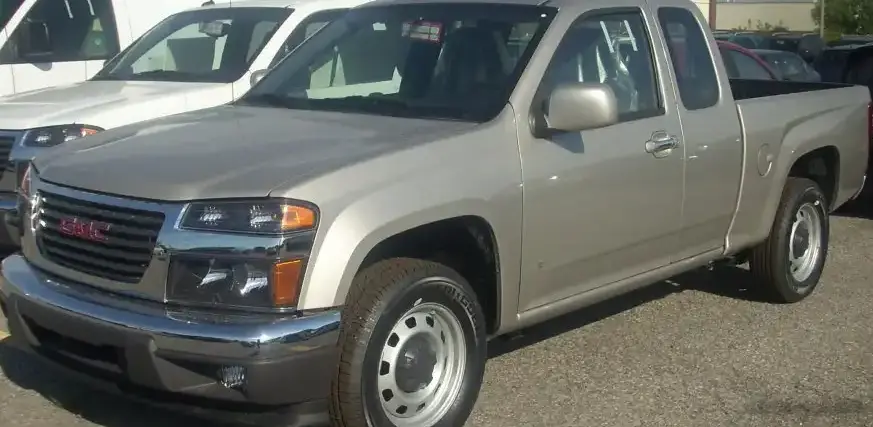
The GMC Canyon I Extended Cab, specifically the variant equipped with the 2.9-liter inline-four engine producing 185 horsepower and paired with a four-wheel-drive system, was a mid-size pickup truck sold in North America from 2007 to 2012. It represented GMC’s entry into the increasingly popular mid-size truck segment, offering a more manageable size compared to full-size offerings like the Sierra while still providing respectable capability. This particular configuration occupied a position in the Canyon lineup as a balance between affordability and functionality, appealing to buyers who didn’t require the power of the V6 options but still desired the added traction of 4WD. It was built on the GMT900 platform, shared with the Chevrolet Colorado.
Technical Specifications
| Brand | GMC |
| Model | Canyon |
| Generation | Canyon I Extended Cab |
| Type (Engine) | 2.9 (185 Hp) 4WD |
| Start of production | 2007 |
| End of production | 2012 |
| Powertrain Architecture | Internal Combustion engine |
| Body type | Pick-up |
| Seats | 4-5 |
| Doors | 4 |
| Fuel consumption (urban) | 13 l/100 km (18.1 US mpg, 21.7 UK mpg) |
| Fuel consumption (extra urban) | 9.8 l/100 km (24 US mpg, 28.8 UK mpg) |
| Fuel Type | Petrol (Gasoline) |
| Weight-to-power ratio | 9.2 kg/Hp, 108.2 Hp/tonne |
| Weight-to-torque ratio | 6.6 kg/Nm, 150.9 Nm/tonne |
| Power | 185 Hp @ 5600 rpm |
| Power per litre | 63.3 Hp/l |
| Torque | 258 Nm @ 2800 rpm (190.29 lb.-ft. @ 2800 rpm) |
| Maximum engine speed | 6300 rpm |
| Engine layout | Front, Transverse |
| Engine Model/Code | LLV |
| Engine displacement | 2921 cm3 (178.25 cu. in.) |
| Number of cylinders | 4 |
| Engine configuration | Inline |
| Cylinder Bore | 95.5 mm (3.76 in.) |
| Piston Stroke | 102 mm (4.02 in.) |
| Compression ratio | 10:1 |
| Number of valves per cylinder | 4 |
| Fuel injection system | Multi-port manifold injection |
| Engine aspiration | Naturally aspirated engine |
| Valvetrain | DOHC, CVVT |
| Engine oil capacity | 4.7 l (4.97 US qt | 4.14 UK qt) |
| Coolant | 9.8 l (10.36 US qt | 8.62 UK qt) |
| Kerb Weight | 1710 kg (3769.9 lbs.) |
| Max. weight | 2404 kg (5299.91 lbs.) |
| Max load | 694 kg (1530.01 lbs.) |
| Trunk (boot) space – minimum | 1245 l (43.97 cu. ft.) |
| Fuel tank capacity | 74.2 l (19.6 US gal | 16.32 UK gal) |
| Length | 5260 mm (207.09 in.) |
| Width | 1742 mm (68.58 in.) |
| Height | 1718 mm (67.64 in.) |
| Wheelbase | 3200 mm (125.98 in.) |
| Front track | 1515 mm (59.65 in.) |
| Rear (Back) track | 1520 mm (59.84 in.) |
| Ride height (ground clearance) | 191.4 mm (7.54 in.) |
| Minimum turning circle (turning diameter) | 13.5 m (44.29 ft.) |
| Drive wheel | All wheel drive (4×4) |
| Number of gears and type of gearbox | 5 gears, manual transmission |
| Front suspension | Independent coil spring |
| Rear suspension | Leaf spring |
| Front brakes | Ventilated discs |
| Rear brakes | Drum |
| Assisting systems | ABS (Anti-lock braking system) |
| Steering type | Steering rack and pinion |
| Power steering | Hydraulic Steering |
| Tires size | 225/70 R15; 235/75 R15 |
| Wheel rims size | 6.5J x 15 |
Powertrain & Engine Architecture
The heart of this Canyon variant was the LLV 2.9-liter inline-four cylinder engine. This engine, a product of General Motors’ design, featured a cast iron block and an aluminum cylinder head. It utilized multi-port fuel injection and a double overhead camshaft (DOHC) valvetrain with variable valve timing (CVVT) to optimize performance and efficiency. The LLV engine was known for its relative simplicity and durability, though it wasn’t known for being particularly refined or powerful. The 185 horsepower and 190 lb-ft of torque were adequate for everyday driving and light hauling, but it was noticeably less potent than the available 3.7L V6 and 2.8L Duramax Diesel options. The engine was transversely mounted, driving all four wheels through a five-speed manual transmission. While an automatic transmission was available on other Canyon trims, the 2.9L engine was only offered with the manual in the 4WD configuration.
Driving Characteristics
The 2.9-liter engine and five-speed manual transmission combination in the 4WD Canyon offered a reasonably engaging driving experience, though it required frequent shifting to maintain momentum, especially when loaded or climbing hills. The gear ratios were tuned for fuel economy and everyday usability rather than outright performance. Acceleration was adequate, but not brisk. The 4WD system provided enhanced traction in slippery conditions, making it suitable for light off-road use and inclement weather. Compared to the V6 models, the 2.9L felt significantly slower, particularly in highway passing situations. The manual transmission provided more driver control than the available automatic in other trims, but it also demanded more effort from the driver in stop-and-go traffic.
Equipment & Trim Levels
The Extended Cab configuration offered a small rear seat suitable for occasional passengers. Standard features on the 2.9L 4WD Canyon typically included air conditioning, a basic audio system, and power windows and locks. The interior materials were generally utilitarian, reflecting the truck’s work-oriented nature. Optional extras included upgraded audio systems, cruise control, and a towing package. The trim level was generally considered a base or mid-range offering, positioned below the SLT and Z71 trims which featured more luxurious appointments and off-road enhancements.
Chassis & Braking
The Canyon I utilized a body-on-frame construction, providing a robust and durable platform. The front suspension consisted of independent coil springs, while the rear suspension employed leaf springs. This setup prioritized load-carrying capacity and durability over ride comfort. Braking duties were handled by ventilated discs at the front and drum brakes at the rear. ABS (Anti-lock Braking System) was standard. The steering was rack-and-pinion with hydraulic power assist. The suspension tuning was geared towards providing a stable and controlled ride, even when hauling or towing.
Market Reception & Comparison
The 2.9-liter Canyon 4WD was generally viewed as a practical and affordable option for buyers seeking a mid-size pickup with four-wheel drive. Critics noted its adequate performance and fuel economy, but also pointed out its lack of refinement and relatively low power output compared to competitors and higher-trim Canyon models. The V6-equipped Canyons offered significantly more power and a smoother driving experience, but at a higher price point. The 2.8L Duramax Diesel offered superior fuel economy and torque, but also carried a premium. Compared to competitors like the Toyota Tacoma and Nissan Frontier, the Canyon 2.9L 4WD offered a competitive price but often lagged behind in terms of perceived reliability and resale value.
Legacy
The LLV 2.9-liter engine, while not a powerhouse, proved to be reasonably reliable in the Canyon. Common issues included oil leaks and occasional sensor failures, but major engine failures were relatively rare. Today, these Canyons are often found as affordable work trucks or entry-level pickups. Their relatively simple mechanical design makes them easier and less expensive to maintain than more modern vehicles. However, their age and mileage mean that finding well-maintained examples can be challenging. The 2.9L 4WD Canyon represents a solid, if unspectacular, offering from GMC’s early foray into the mid-size truck market.