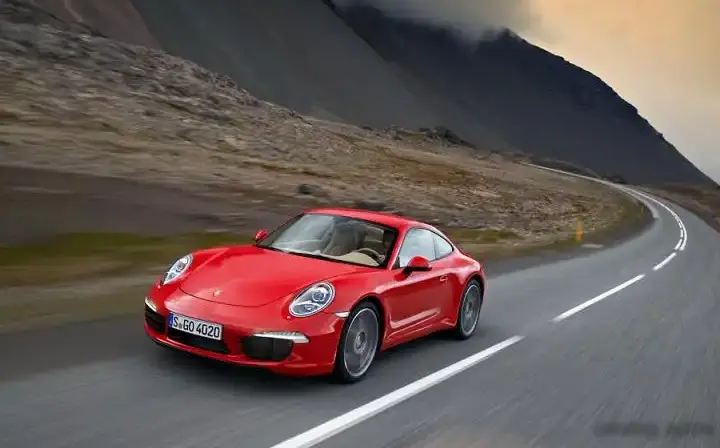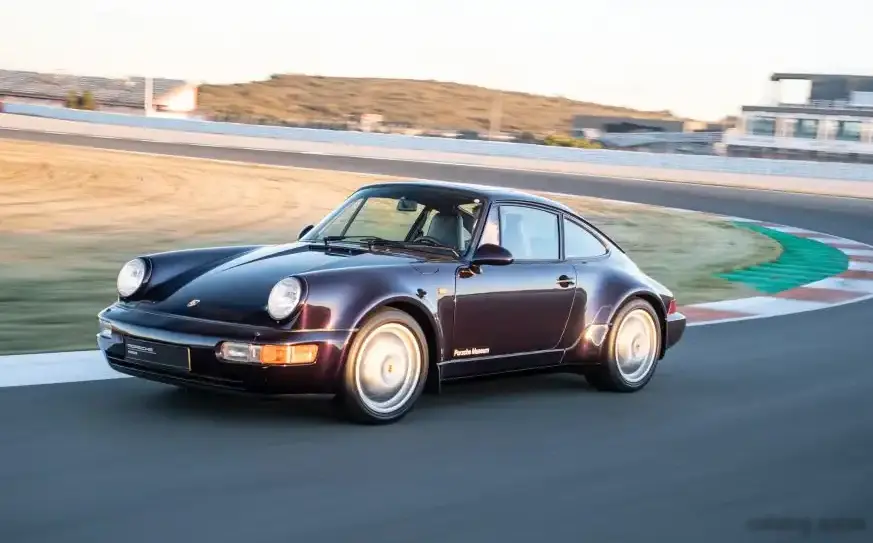
The Porsche 911 (964) Turbo S 3.3, produced from 1992 to 1993, represented the pinnacle of the 964 generation’s performance capabilities. Positioned as the ultimate, limited-production variant of the 964 Turbo, it was designed for discerning enthusiasts seeking the most exhilarating driving experience. Built on the 964 platform – a significant evolution of the iconic 911 silhouette – the Turbo S 3.3 offered substantial upgrades over the standard 964 Turbo, cementing its status as a collector’s item and a benchmark for performance in its era. Approximately 78 units were produced, making it a rare and highly sought-after vehicle.
Technical Specifications
| Brand | Porsche |
| Model | 911 |
| Generation | 911 (964) |
| Type (Engine) | Turbo S 3.3 (381 Hp) |
| Start of production | 1992 |
| End of production | 1993 |
| Powertrain Architecture | Internal Combustion engine |
| Body type | Coupe |
| Seats | 4 |
| Doors | 2 |
| Fuel Type | Petrol (Gasoline) |
| Power | 381 Hp @ 5750 rpm |
| Power per litre | 115.5 Hp/l |
| Torque | 508 Nm @ 5000 rpm |
| Torque (lb-ft) | 374.68 lb.-ft. @ 5000 rpm |
| Engine layout | Rear, Longitudinal |
| Engine Model/Code | M30.69 |
| Engine displacement | 3299 cm3 |
| Engine displacement (cu. in.) | 201.32 cu. in. |
| Number of cylinders | 6 |
| Engine configuration | Boxer |
| Cylinder Bore | 97 mm |
| Cylinder Bore (in.) | 3.82 in. |
| Piston Stroke | 74.4 mm |
| Piston Stroke (in.) | 2.93 in. |
| Number of valves per cylinder | 2 |
| Fuel injection system | Multi-port manifold injection |
| Engine aspiration | Turbocharger |
| Engine oil capacity | 10 l |
| Engine oil capacity (US qt) | 10.57 US qt |
| Engine oil capacity (UK qt) | 8.8 UK qt |
| Length | 4250 mm |
| Length (in.) | 167.32 in. |
| Width | 1775 mm |
| Width (in.) | 69.88 in. |
| Wheelbase | 2272 mm |
| Wheelbase (in.) | 89.45 in. |
| Front track | 1434 mm |
| Front track (in.) | 56.46 in. |
| Rear track | 1493 mm |
| Rear track (in.) | 58.78 in. |
| Minimum turning circle | 11.45 m |
| Minimum turning circle (ft) | 37.57 ft |
| Drivetrain Architecture | Rear wheel drive |
| Number of gears | 5 |
| Type of gearbox | Manual transmission |
| Front suspension | Independent type McPherson |
| Rear suspension | Independent coil spring |
| Front brakes | Ventilated discs |
| Rear brakes | Ventilated discs |
| Assisting systems | ABS (Anti-lock braking system) |
| Steering type | Steering rack and pinion |
| Power steering | Hydraulic Steering |
Powertrain & Engine Architecture
The heart of the 964 Turbo S 3.3 is its 3.3-liter, twin-turbocharged flat-six engine, designated M30.69. This engine built upon the foundation of the standard 964 Turbo’s engine, but with significant enhancements. Key upgrades included larger turbochargers and intercoolers, revised engine management software, and strengthened internal components. The engine utilized a Bosch Motronic engine management system, controlling multi-port fuel injection. The boxer configuration, with its horizontally opposed cylinders, contributed to a lower center of gravity, enhancing handling. The engine produced 381 horsepower at 5750 rpm and 374.68 lb-ft of torque at 5000 rpm. Power was delivered to the rear wheels via a robust 5-speed manual transmission, specifically chosen for its durability and ability to handle the increased power output. The transmission featured revised gear ratios optimized for acceleration and high-speed stability.
Driving Characteristics
The 964 Turbo S 3.3 offered a dramatically different driving experience compared to the standard 964 models. The increased power and torque, combined with the optimized transmission, resulted in blistering acceleration. The car could sprint from 0 to 60 mph in approximately 3.7 seconds, and achieve a top speed exceeding 170 mph. The twin-turbochargers provided a broad powerband, but with a noticeable surge of power as the turbos spooled up. The suspension, while retaining the basic McPherson strut front and independent coil spring rear setup of the 964, was further refined with stiffer springs and dampers to manage the increased performance. The car demanded respect and skill from the driver, as its rear-wheel-drive configuration and powerful engine could easily overwhelm less experienced drivers. The steering was precise and communicative, providing excellent feedback from the road.
Equipment & Trim Levels
As the flagship of the 964 Turbo range, the S 3.3 came exceptionally well-equipped. Standard features included a leather interior, power windows, power steering, and an upgraded audio system. The interior trim was typically finished in supple leather, with options for various color combinations. The Turbo S 3.3 also featured unique exterior styling cues, including wider rear wheel arches, a distinctive rear wing, and special “Turbo S” badging. Optional extras included a limited-slip differential, sport seats, and a sunroof. The focus was on providing a luxurious yet performance-oriented driving environment.
Chassis & Braking
The chassis of the 964 Turbo S 3.3 was largely based on the standard 964, but with several key modifications. The most significant change was the wider rear track, necessitated by the larger tires and wheel arches. The suspension was upgraded with stiffer springs and dampers, as mentioned previously, to improve handling and reduce body roll. Braking duties were handled by ventilated disc brakes on all four wheels, providing ample stopping power. An ABS anti-lock braking system was standard, enhancing safety and control. The car’s weight distribution was carefully balanced to optimize handling characteristics.
Market Reception & Comparison
The 964 Turbo S 3.3 was universally praised by automotive journalists for its exceptional performance and driving dynamics. Critics lauded its powerful engine, precise handling, and luxurious interior. Compared to the standard 964 Turbo, the S 3.3 offered a significant performance advantage, but at a substantial price premium. It was also more demanding to drive, requiring a higher level of skill and experience. Compared to contemporary supercars from Ferrari and Lamborghini, the 964 Turbo S 3.3 offered a unique blend of performance, practicality, and everyday usability. Its relative reliability, compared to some of its Italian rivals, was also a significant selling point.
Legacy
The Porsche 911 (964) Turbo S 3.3 remains a highly collectible and sought-after vehicle today. Its limited production numbers and exceptional performance have ensured its status as a modern classic. The M30.69 engine, while complex, has proven to be relatively durable when properly maintained. However, the car’s age and complexity require regular servicing by a qualified Porsche technician. Values for well-maintained examples have steadily increased in recent years, reflecting the growing demand for classic Porsche models. The 964 Turbo S 3.3 represents a high point in the evolution of the 911, and a testament to Porsche’s engineering prowess.