
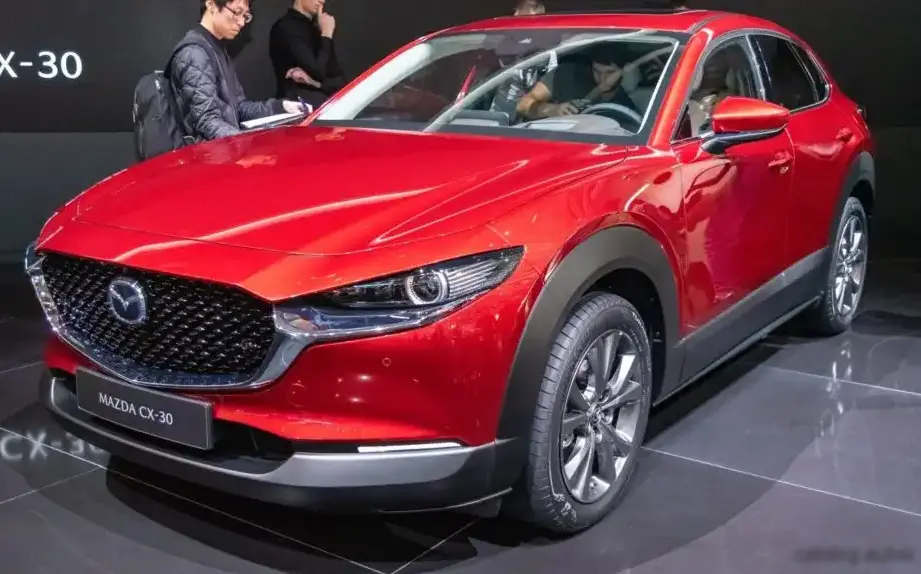
The Mazda CX-30 2.0 e-Skyactiv G (150 Hp) Skyactiv-Drive is a compact crossover SUV introduced by Mazda in January 2020. Positioned as a mainstream offering within the CX-30 lineup, it represents a balance between efficiency and performance, targeting buyers seeking a stylish and practical vehicle. This variant utilizes Mazda’s Skyactiv-G gasoline engine paired with a Skyactiv-Drive automatic transmission and a mild-hybrid system, making it a key component of Mazda’s strategy to offer a diverse range of powertrain options in the popular subcompact SUV segment. It slots in as the entry to mid-range option, below the more powerful turbocharged variants.
Technical Specifications
| Brand | Mazda |
| Model | CX-30 |
| Type (Engine) | 2.0 e-Skyactiv G (150 Hp) Skyactiv-Drive |
| Start of production | January, 2020 |
| Powertrain Architecture | MHEV (Mild Hybrid Electric Vehicle) |
| Body type | SUV |
| Seats | 5 |
| Doors | 5 |
| Combined fuel consumption (WLTP) | 6.3-6.4 l/100 km (37.3 – 36.8 US mpg) |
| CO2 emissions (WLTP) | 143-144 g/km |
| Fuel consumption (urban) | 7.1 l/100 km (33.1 US mpg) |
| Fuel consumption (extra urban) | 4.7 l/100 km (50 US mpg) |
| Fuel consumption (combined) | 5.6 l/100 km (42 US mpg) |
| CO2 emissions (NEDC) | 126 g/km |
| Fuel Type | Petrol (Gasoline) |
| Acceleration 0 – 100 km/h | 10 sec |
| Acceleration 0 – 62 mph | 10 sec |
| Acceleration 0 – 60 mph | 9.5 sec |
| Maximum speed | 194 km/h (120.55 mph) |
| Emission standard | Euro 6d-ISC-FCM |
| Weight-to-power ratio | 9 kg/Hp |
| Weight-to-torque ratio | 6.3 kg/Nm |
| Power | 150 Hp @ 6000 rpm |
| Torque | 213 Nm @ 4000 rpm (157.1 lb.-ft. @ 4000 rpm) |
| Engine layout | Front, Transverse |
| Engine Model/Code | PE |
| Engine displacement | 1998 cm3 (121.93 cu. in.) |
| Number of cylinders | 4 |
| Engine configuration | Inline |
| Cylinder Bore | 83.5 mm (3.29 in.) |
| Piston Stroke | 91.2 mm (3.59 in.) |
| Compression ratio | 13:1 |
| Number of valves per cylinder | 4 |
| Fuel injection system | Direct injection |
| Engine aspiration | Naturally aspirated |
| Engine oil capacity | 4.2 l (4.44 US qt | 3.7 UK qt) |
| Coolant capacity | 6.5 l (6.87 US qt | 5.72 UK qt) |
| Kerb Weight | 1347-1435 kg (2969.63 – 3163.63 lbs.) |
| Max. weight | 1957 kg (4314.45 lbs.) |
| Max load | 522-610 kg (1150.81 – 1344.82 lbs.) |
| Trunk (boot) space – minimum | 430 l (15.19 cu. ft.) |
| Trunk (boot) space – maximum | 1406 l (49.65 cu. ft.) |
| Fuel tank capacity | 51 l (13.47 US gal | 11.22 UK gal) |
| Max. roof load | 75 kg (165.35 lbs.) |
| Permitted trailer load (brakes 8%) | 1300 kg (2866.01 lbs.) |
| Permitted trailer load (brakes 12%) | 1300 kg (2866.01 lbs.) |
| Permitted trailer load (no brakes) | 600 kg (1322.77 lbs.) |
| Permitted towbar download | 75 kg (165.35 lbs.) |
| Length | 4395 mm (173.03 in.) |
| Width | 1795 mm (70.67 in.) |
| Width including mirrors | 2040 mm (80.31 in.) |
| Height | 1540 mm (60.63 in.) |
| Wheelbase | 2655 mm (104.53 in.) |
| Ride height (ground clearance) | 175 mm (6.89 in.) |
| Minimum turning circle | 10.6 m (34.78 ft.) |
| Drivetrain Architecture | Front wheel drive, MHEV |
| Drive wheel | Front wheel drive |
| Number of gears | 6 |
| Gearbox type | Automatic transmission |
| Front brakes | Ventilated discs |
| Rear brakes | Disc |
| Tires size | 215/65 R16 98H; 215/55 R18 95H |
| Wheel rims size | 6.5J x 16 ET45; 7J x 18 ET45 |
INTRODUCTION
The Mazda CX-30 2.0 e-Skyactiv G (150 Hp) Skyactiv-Drive, launched in 2020, is a five-seat, five-door compact SUV built on Mazda’s 1HX0 platform, shared with the Mazda3. It was designed to appeal to a younger demographic seeking a stylish and engaging driving experience in a smaller package than the CX-5. The “e-Skyactiv G” designation indicates the inclusion of Mazda’s mild-hybrid technology, aimed at improving fuel efficiency and reducing emissions. This variant serves as a core offering in the CX-30 range, providing a balance of affordability and features.
Powertrain & Engine Architecture
At the heart of the CX-30 2.0 e-Skyactiv G is Mazda’s PE engine, a 1.998-liter (2.0L) inline-four cylinder gasoline engine. This engine is characterized by its high compression ratio of 13:1, achieved through careful engineering and optimized combustion chamber design. It utilizes direct fuel injection for precise fuel delivery and improved efficiency. The engine employs a conventional valvetrain with four valves per cylinder. The mild-hybrid system consists of a 24V electric motor integrated with the powertrain, providing a small amount of electric assistance during acceleration and enabling an extended start-stop range. The Skyactiv-Drive automatic transmission is a six-speed unit with a torque converter. It’s programmed for smooth and efficient shifts, prioritizing fuel economy over outright performance. Unlike some dual-clutch transmissions, the Skyactiv-Drive offers a more traditional automatic feel.
Driving Characteristics
The 150 hp and 157 lb-ft of torque produced by this powertrain configuration delivers adequate, but not exhilarating, performance. Acceleration from 0-60 mph takes approximately 9.5 seconds, and the car has a top speed of 120.55 mph. The Skyactiv-Drive transmission is tuned for efficiency, meaning gear changes are generally smooth but not particularly quick. The mild-hybrid system provides a subtle boost during initial acceleration, helping to mitigate some of the engine’s inherent lack of low-end torque. Compared to the more powerful turbocharged variants of the CX-30, this version feels less responsive, particularly when overtaking or climbing hills. However, it offers a more relaxed and fuel-efficient driving experience, making it well-suited for urban commuting and longer highway journeys. The gear ratios are optimized for fuel economy, resulting in a lower engine speed at highway cruising speeds.
Equipment & Trim Levels
The CX-30 2.0 e-Skyactiv G typically came standard with features such as Mazda’s infotainment system with an 8.8-inch display, Apple CarPlay and Android Auto integration, LED headlights, and a suite of safety features including adaptive cruise control, lane departure warning, and automatic emergency braking. Interior upholstery was typically cloth, with options for leatherette or full leather available on higher trim levels. Available options included a sunroof, premium audio system, and heated front seats. Trim levels varied by market, but generally included base, preferred, and premium designations, with each step up adding more features and luxury appointments.
Chassis & Braking
The CX-30 utilizes a MacPherson strut front suspension and a torsion beam rear suspension. This setup provides a good balance of ride comfort and handling. The torsion beam rear suspension is a cost-effective solution commonly found in vehicles of this class. Braking duties are handled by ventilated discs at the front and solid discs at the rear. Anti-lock braking system (ABS) and electronic brakeforce distribution (EBD) are standard features. The steering system is an electric power-assisted rack and pinion system, providing light and precise steering feel.
Market Reception & Comparison
The Mazda CX-30 2.0 e-Skyactiv G was generally well-received by automotive critics. It was praised for its stylish design, comfortable interior, and engaging driving dynamics. However, some reviewers noted that the 150 hp engine felt underpowered, particularly when compared to competitors offering more powerful engine options. Fuel economy was consistently rated as good, with combined figures ranging from 36.8 to 37.3 US mpg. Compared to the CX-30 2.5 Turbo, the 2.0L variant offered a more affordable entry point but sacrificed performance. Against rivals like the Honda HR-V and Toyota C-HR, the CX-30 stood out with its more premium interior and more engaging driving experience.
Legacy
The Mazda CX-30 2.0 e-Skyactiv G has proven to be a reliable and durable vehicle. The PE engine is known for its longevity, and the Skyactiv-Drive transmission has a good track record. On the used car market, these models hold their value relatively well, thanks to Mazda’s reputation for quality and reliability. The mild-hybrid system, while not a significant performance enhancer, contributes to improved fuel efficiency and reduced emissions, making it an attractive option for environmentally conscious buyers. The CX-30, in general, has established itself as a popular choice in the compact SUV segment, and the 2.0L variant continues to be a viable option for those seeking a stylish, efficient, and reliable vehicle.
