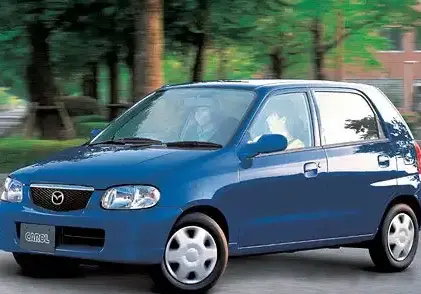
The Mazda Carol II 0.7 12V (54 hp) represents a significant iteration in Mazda’s long-running “Kei car” lineage, produced between 1998 and 2001. Positioned as an entry-level offering within the Carol II range, this variant catered to the Japanese domestic market (JDM) with its focus on affordability, fuel efficiency, and compact dimensions. The Carol II, as a whole, occupied the supercompact or “Kei car” class, designed to navigate Japan’s congested urban environments and benefit from favorable tax and insurance regulations. This specific 0.7-liter engine and transmission combination was aimed at buyers prioritizing economy over outright performance.
Technical Specifications
| Brand | Mazda |
| Model | Carol |
| Generation | Carol II |
| Type (Engine) | 0.7 12V (54 Hp) |
| Start of production | 1998 |
| End of production | 2001 |
| Powertrain Architecture | Internal Combustion engine |
| Body type | Hatchback |
| Seats | 4 |
| Doors | 3/5 |
| Fuel consumption (urban) | 8 l/100 km (29.4 US mpg) |
| Fuel consumption (extra urban) | 4 l/100 km (58.8 US mpg) |
| Fuel Type | Petrol (Gasoline) |
| Maximum speed | 140 km/h (86.99 mph) |
| Weight-to-power ratio | 11.7 kg/Hp |
| Weight-to-torque ratio | 10.3 kg/Nm |
| Power | 54 Hp @ 6500 rpm |
| Power per litre | 82.1 Hp/l |
| Torque | 61 Nm @ 4000 rpm (44.99 lb.-ft. @ 4000 rpm) |
| Engine layout | Front, Transverse |
| Engine displacement | 658 cm3 (40.15 cu. in.) |
| Number of cylinders | 3 |
| Engine configuration | Inline |
| Cylinder Bore | 68 mm (2.68 in.) |
| Piston Stroke | 60.4 mm (2.38 in.) |
| Compression ratio | 10.5:1 |
| Number of valves per cylinder | 4 |
| Fuel injection system | Multi-port manifold injection |
| Engine aspiration | Naturally aspirated engine |
| Valvetrain | DOHC |
| Kerb Weight | 630 kg (1388.91 lbs.) |
| Fuel tank capacity | 30 l (7.93 US gal) |
| Length | 3395 mm (133.66 in.) |
| Width | 1475 mm (58.07 in.) |
| Height | 1450 mm (57.09 in.) |
| Wheelbase | 2360 mm (92.91 in.) |
| Front track | 1295 mm (50.98 in.) |
| Rear track | 1290 mm (50.79 in.) |
| Minimum turning circle | 8.4 m (27.56 ft.) |
| Drivetrain Architecture | Front wheel drive |
| Drive wheel | Front wheel drive |
| Number of gears | 5 |
| Gearbox type | Manual transmission |
| Front suspension | Spring Strut |
| Rear suspension | Coil spring |
| Front brakes | Ventilated discs |
| Rear brakes | Disc |
| Assisting systems | ABS (Anti-lock braking system) |
| Steering type | Steering rack and pinion |
| Power steering | Hydraulic Steering |
| Tires size | 155/65 R13 75 S |
| Wheel rims size | 4J x 13 ET 45 |
Powertrain & Engine Architecture
The heart of the Carol II 0.7 was the F6A engine, a 658cc inline-three cylinder unit. This engine utilized a double overhead camshaft (DOHC) valvetrain with four valves per cylinder, a relatively sophisticated setup for a Kei car engine of the time. Multi-port fuel injection was employed to optimize fuel delivery and improve efficiency. The engine’s 10.5:1 compression ratio contributed to its modest power output. The 54 horsepower peak arrived at 6500 rpm, while the 61 Nm (45 lb-ft) of torque was available at 4000 rpm. This engine was known for its relatively smooth operation for a three-cylinder design, though it wasn’t particularly powerful. The standard transmission was a five-speed manual, providing adequate control for the engine’s powerband. An optional three-speed automatic transmission was also available, though it further reduced performance and increased fuel consumption.
Driving Characteristics
The 0.7-liter engine, paired with the five-speed manual transmission, provided adequate, though not exhilarating, performance. Acceleration was modest, particularly when fully loaded. The car felt most comfortable in urban environments, where its compact size and nimble handling were advantageous. The gear ratios were tuned for economy, meaning the engine needed to be revved to maintain speed on inclines or during overtaking maneuvers. Compared to the slightly more powerful Carol II variants, this 0.7L version felt noticeably slower. The automatic transmission option further dulled performance, with noticeable lag and less responsive shifts. However, it provided a more relaxed driving experience for those prioritizing convenience.
Equipment & Trim Levels
The Carol II 0.7 12V was typically offered in a fairly basic trim level, reflecting its position as the entry point to the range. Standard features generally included power steering, air conditioning (often optional), and a basic audio system. Interior upholstery was typically cloth, with a simple dashboard layout. Optional extras could include upgraded audio systems, alloy wheels, and power windows. The 3-door version was often more spartan than the 5-door, with fewer convenience features. The focus was on providing functional transportation at an affordable price point.
Chassis & Braking
The Carol II utilized a front-engine, front-wheel-drive layout. Suspension consisted of a MacPherson strut setup at the front and a coil spring arrangement at the rear. The lightweight nature of the vehicle (630 kg or 1389 lbs) helped to compensate for the modest power output. Braking was provided by ventilated discs at the front and discs at the rear, with ABS (Anti-lock Braking System) becoming increasingly common as standard equipment towards the end of the production run. The relatively small tires (155/65 R13) provided adequate grip for normal driving conditions.
Market Reception & Comparison
The Mazda Carol II 0.7 12V was well-received in the Japanese market as a practical and economical Kei car. Critics praised its fuel efficiency and maneuverability, but noted its lack of outright performance. Compared to other Kei cars of the time, such as the Suzuki Alto or the Daihatsu Mira, the Carol II offered a slightly more refined driving experience, but at a slightly higher price point. The automatic transmission version was often criticized for its sluggishness and reduced fuel economy. The manual transmission version was generally preferred by those seeking a more engaging driving experience.
Legacy
The Mazda Carol II 0.7 12V, while not a performance icon, represents a significant example of Japanese automotive engineering focused on efficiency and practicality. The F6A engine proved to be relatively reliable, and well-maintained examples continue to be found on the used car market in Japan. The Carol II’s legacy lies in its contribution to the evolution of the Kei car segment, demonstrating how a small, affordable vehicle could provide functional transportation for millions of Japanese commuters. Today, these cars are often sought after by enthusiasts of JDM (Japanese Domestic Market) vehicles and are appreciated for their simplicity and charm.