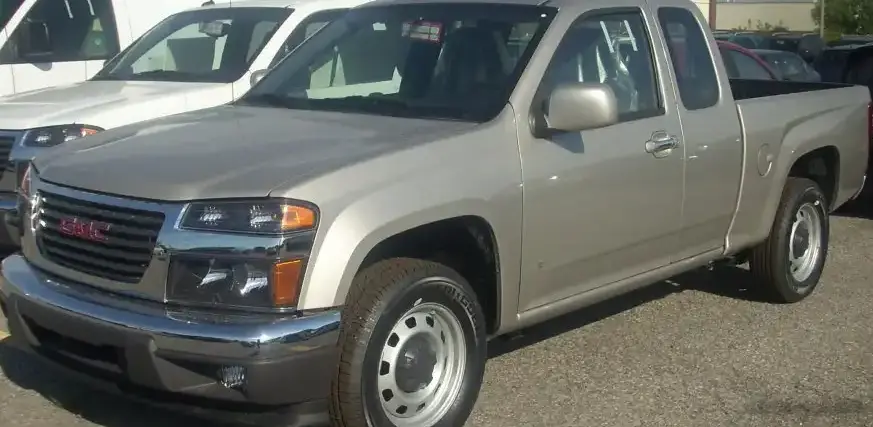
The GMC Canyon I Extended Cab, produced from 2007 to 2012, represented GMC’s entry into the mid-size pickup truck market in North America. Positioned below the full-size Sierra, the Canyon aimed to provide a more manageable and fuel-efficient option for buyers who didn’t require the larger truck’s capabilities. The 2.9-liter inline-four cylinder engine paired with a four-speed automatic transmission was a key configuration during this generation, serving as the base engine option and appealing to buyers prioritizing affordability and basic functionality. It was built on the GMT900 platform, shared with the Chevrolet Colorado.
Technical Specifications
| Brand | GMC |
| Model | Canyon |
| Generation | Canyon I Extended Cab |
| Type (Engine) | 2.9 (185 Hp) Automatic |
| Start of production | 2007 |
| End of production | 2012 |
| Powertrain Architecture | Internal Combustion engine |
| Body type | Pick-up |
| Seats | 4-5 |
| Doors | 4 |
| Fuel consumption (urban) | 11.7 l/100 km (20.1 US mpg) |
| Fuel consumption (extra urban) | 9 l/100 km (26.1 US mpg) |
| Fuel Type | Petrol (Gasoline) |
| Weight-to-power ratio | 8.9 kg/Hp |
| Weight-to-torque ratio | 6.4 kg/Nm |
| Power | 185 Hp @ 5600 rpm |
| Power per litre | 63.3 Hp/l |
| Torque | 258 Nm @ 2800 rpm (190.29 lb.-ft. @ 2800 rpm) |
| Maximum engine speed | 6300 rpm |
| Engine layout | Front, Longitudinal |
| Engine Model/Code | LLV |
| Engine displacement | 2921 cm3 (178.25 cu. in.) |
| Number of cylinders | 4 |
| Engine configuration | Inline |
| Cylinder Bore | 95.5 mm (3.76 in.) |
| Piston Stroke | 102 mm (4.02 in.) |
| Compression ratio | 10:1 |
| Number of valves per cylinder | 4 |
| Fuel injection system | Multi-port manifold injection |
| Engine aspiration | Naturally aspirated engine |
| Valvetrain | DOHC, CVVT |
| Engine oil capacity | 4.7 l (4.97 US qt | 4.14 UK qt) |
| Coolant | 9.8 l (10.36 US qt | 8.62 UK qt) |
| Kerb Weight | 1650 kg (3637.63 lbs.) |
| Max. weight | 2268 kg (5000.08 lbs.) |
| Max load | 618 kg (1362.46 lbs.) |
| Trunk (boot) space – minimum | 1245 l (43.97 cu. ft.) |
| Fuel tank capacity | 74.2 l (19.6 US gal | 16.32 UK gal) |
| Length | 5260 mm (207.09 in.) |
| Width | 1717 mm (67.6 in.) |
| Height | 1649 mm (64.92 in.) |
| Wheelbase | 3200 mm (125.98 in.) |
| Front track | 1460 mm (57.48 in.) |
| Rear (Back) track | 1460 mm (57.48 in.) |
| Ride height (ground clearance) | 185.7 mm (7.31 in.) |
| Minimum turning circle (turning diameter) | 13.5 m (44.29 ft.) |
| Drivetrain Architecture | Rear wheel drive |
| Drive wheel | Rear wheel drive |
| Number of gears and type of gearbox | 4 gears, automatic transmission Hydra-Matic |
| Front suspension | Independent coil spring |
| Rear suspension | Leaf spring |
| Front brakes | Ventilated discs |
| Rear brakes | Drum |
| Assisting systems | ABS (Anti-lock braking system) |
| Steering type | Steering rack and pinion |
| Power steering | Hydraulic Steering |
| Tires size | 205/75 R15; 225/70 R15 |
| Wheel rims size | 6J x 15; 6.5J x 15 |
INTRODUCTION
The 2007-2012 GMC Canyon I Extended Cab, equipped with the 2.9-liter inline-four engine and four-speed automatic transmission, was designed to be the entry point into the Canyon lineup. It offered a more affordable alternative to the more powerful V6 options, targeting buyers who needed a pickup for light-duty tasks and prioritized fuel economy. The Extended Cab configuration added a small rear seat, increasing passenger capacity compared to the regular cab models. This variant played a significant role in establishing the Canyon as a viable competitor in the burgeoning mid-size truck segment.
Powertrain & Engine Architecture
The heart of this Canyon variant is the LLV 2.9-liter inline-four cylinder engine. This engine utilized a cast iron block and an aluminum cylinder head, incorporating dual overhead camshafts (DOHC) and Continuously Variable Valve Timing (CVVT) on both intake and exhaust valves. The multi-port fuel injection system delivered fuel directly to each cylinder, optimizing combustion. The engine produced 185 horsepower at 5600 rpm and 258 lb-ft of torque at 2800 rpm. The four-speed Hydra-Matic automatic transmission was chosen for its simplicity and reliability. While not offering the refinement of more modern transmissions, it provided adequate performance for the engine’s output and was known for its durability. The transmission featured standard overdrive for improved highway fuel efficiency.
Driving Characteristics
The 2.9-liter engine and four-speed automatic combination in the Canyon delivered adequate, but not exhilarating, performance. Acceleration was modest, and passing maneuvers required planning. The transmission’s gear ratios were optimized for fuel economy rather than outright speed. Compared to the available 4.3L V6 or the 5.3L V8 options, this configuration felt noticeably less powerful, especially when towing or hauling significant loads. However, the lower engine weight contributed to better handling and a more comfortable ride. The automatic transmission offered smooth shifts, but lacked the responsiveness of a manual transmission. In real-world driving, the 2.9L Canyon was best suited for commuting, light hauling, and occasional weekend projects.
Equipment & Trim Levels
The 2.9-liter automatic Canyon typically came standard with basic features such as air conditioning, power windows and locks, and an AM/FM stereo. The Extended Cab configuration added a small rear seat, though legroom was limited. Higher trim levels, such as the SLE and SLT, offered additional features like alloy wheels, upgraded audio systems, cruise control, and power mirrors. Optional extras included a towing package, off-road suspension, and a sunroof. Interior upholstery was typically cloth, with higher trims offering leather options. The dashboard layout was functional and straightforward, prioritizing usability over luxury.
Chassis & Braking
The Canyon I utilized a body-on-frame construction, providing a robust and durable platform. The front suspension consisted of independent coil springs, while the rear suspension employed leaf springs. This setup provided a comfortable ride, but could feel somewhat bouncy when unloaded. Braking duties were handled by ventilated discs in the front and drum brakes in the rear. Anti-lock Braking System (ABS) was standard. The rear drum brakes were a cost-saving measure on the base models, and were a point of criticism compared to the available four-wheel disc brake setup on higher trims. Steering was rack-and-pinion with hydraulic power assist, providing responsive and predictable handling.
Market Reception & Comparison
Critics generally viewed the 2.9-liter Canyon as a competent, but unremarkable, pickup truck. The engine was praised for its fuel efficiency, achieving around 20 mpg in the city and 26 mpg on the highway. However, its lack of power was a common complaint. Compared to the V6 models, the 2.9-liter Canyon offered significantly lower performance, but at a lower price point. Reliability was generally good, with the 2.9-liter engine proving to be durable and relatively maintenance-free. The four-speed automatic transmission also had a reputation for longevity. Competitors like the Toyota Tacoma and Nissan Frontier offered more refined driving experiences and stronger resale values, but the Canyon provided a compelling value proposition for budget-conscious buyers.
Legacy
The 2.9-liter engine and four-speed automatic transmission combination in the GMC Canyon I proved to be a reliable and durable powertrain. While not known for its performance, it provided years of dependable service for many owners. In the used car market today, these Canyons are often found with high mileage, but remain relatively affordable. Maintenance is generally straightforward and parts are readily available. The 2.9-liter engine is known for its simplicity, making it a good choice for DIY mechanics. However, potential buyers should be aware of the engine’s limited power and the transmission’s lack of modern features. Overall, the 2.9L Canyon represents a solid, if unspectacular, entry into the mid-size truck segment.