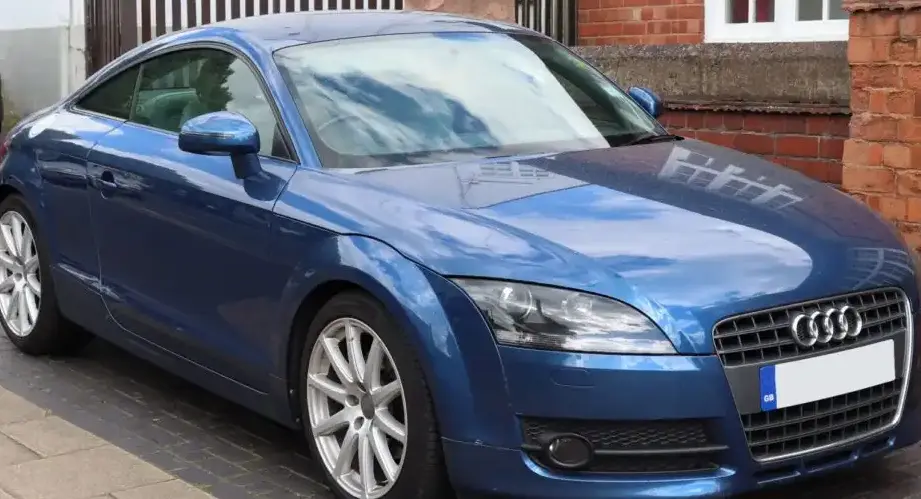
The Audi TT Coupe (8J) 3.2i V6 24V quattro, produced between 2006 and 2010, represented the performance pinnacle of the first-generation TT Coupe (8J) lineup. Positioned as the flagship model, it offered a significant step up in power and handling compared to the 1.8T and 2.0T variants. This model was a key component of Audi’s strategy to offer a sporty, yet refined, coupe experience, appealing to enthusiasts seeking a blend of performance and everyday usability. The 8J TT, launched in 2006, addressed criticisms of the original TT’s practicality and driving dynamics, offering a more mature and capable package.
Technical Specifications
| Brand | Audi |
| Model | TT |
| Generation | TT Coupe (8J) |
| Type (Engine) | 3.2i V6 24V (250 Hp) quattro |
| Start of production | 2006 |
| End of production | 2010 |
| Powertrain Architecture | Internal Combustion engine |
| Body type | Coupe |
| Seats | 4 |
| Doors | 3 |
| Fuel consumption (urban) | 14.7 l/100 km (16 US mpg, 19.2 UK mpg, 6.8 km/l) |
| Fuel consumption (extra urban) | 7.8 l/100 km (30.2 US mpg, 36.2 UK mpg, 12.8 km/l) |
| Fuel consumption (combined) | 10.3 l/100 km (22.8 US mpg, 27.4 UK mpg, 9.7 km/l) |
| CO2 emissions | 247 g/km |
| Fuel Type | Petrol (Gasoline) |
| Acceleration 0 – 100 km/h | 5.9 sec |
| Acceleration 0 – 62 mph | 5.9 sec |
| Acceleration 0 – 60 mph | 5.6 sec |
| Maximum speed | 250 km/h (155.34 mph) |
| Emission standard | Euro 4 |
| Weight-to-power ratio | 5.6 kg/Hp, 177.3 Hp/tonne |
| Weight-to-torque ratio | 4.4 kg/Nm, 227 Nm/tonne |
| Power | 250 Hp @ 6300 rpm |
| Power per litre | 78.4 Hp/l |
| Torque | 320 Nm @ 2500-3000 rpm (236.02 lb.-ft. @ 2500-3000 rpm) |
| Engine layout | Front, Transverse |
| Engine Model/Code | BUB |
| Engine displacement | 3189 cm3 (194.6 cu. in.) |
| Number of cylinders | 6 |
| Engine configuration | V-engine |
| Cylinder Bore | 84 mm (3.31 in.) |
| Piston Stroke | 95.9 mm (3.78 in.) |
| Compression ratio | 11.3:1 |
| Number of valves per cylinder | 4 |
| Fuel injection system | Multi-port manifold injection |
| Engine aspiration | Naturally aspirated engine |
| Valvetrain | DOHC |
| Engine oil capacity | 5.5 l (5.81 US qt, 4.84 UK qt) |
| Coolant | 12.7 l (13.42 US qt, 11.17 UK qt) |
| Kerb Weight | 1410 kg (3108.52 lbs.) |
| Max. weight | 1810 kg (3990.37 lbs.) |
| Max load | 400 kg (881.85 lbs.) |
| Trunk (boot) space – minimum | 290 l (10.24 cu. ft.) |
| Trunk (boot) space – maximum | 700 l (24.72 cu. ft.) |
| Fuel tank capacity | 60 l (15.85 US gal, 13.2 UK gal) |
| Length | 4178 mm (164.49 in.) |
| Width | 1842 mm (72.52 in.) |
| Height | 1352 mm (53.23 in.) |
| Wheelbase | 2468 mm (97.17 in.) |
| Front track | 1572 mm (61.89 in.) |
| Rear (Back) track | 1558 mm (61.34 in.) |
| Drag coefficient (Cd) | 0.31 |
| Minimum turning circle | 10.96 m (35.96 ft.) |
| Drive wheel | All wheel drive (4×4) |
| Number of gears | 6 |
| Gearbox type | Manual transmission |
| Front suspension | Independent, type McPherson with coil spring and anti-roll bar |
| Rear suspension | Independent multi-link suspension |
| Front brakes | Ventilated discs |
| Rear brakes | Ventilated discs |
| Assisting systems | ABS (Anti-lock braking system) |
| Steering type | Steering rack and pinion |
| Tires size | 245/45 R17 |
| Wheel rims size | 8.5J x 17 |
Powertrain & Engine Architecture
The heart of the 3.2i quattro is the BUB engine, a 3.2-liter naturally aspirated V6. This engine, part of Audi’s long-running V6 family, features an aluminum alloy block and cylinder heads, contributing to a relatively lightweight construction. It utilizes a multi-port fuel injection system and a double overhead camshaft (DOHC) valvetrain with four valves per cylinder. The engine’s 60-degree V-angle provides a good balance between smoothness and compactness. The 3.2L V6 produced 250 horsepower at 6,300 rpm and 236 lb-ft of torque between 2,500 and 3,000 rpm. This power was delivered through a standard six-speed manual transmission, although a DSG (Direct-Shift Gearbox) automatic was also available as an option. The DSG offered quicker shifts and improved fuel efficiency compared to a traditional automatic.
Driving Characteristics
The 3.2i quattro offered a noticeably more engaging driving experience than the lower-powered TT variants. The V6 engine provided strong, linear acceleration, with ample torque available throughout the rev range. The all-wheel-drive system, Audi’s renowned quattro, provided excellent traction and stability, particularly in adverse weather conditions. The six-speed manual transmission allowed for precise control, while the optional DSG offered seamless gear changes. While not a track-focused machine, the 3.2i quattro was capable of delivering spirited performance on winding roads. Compared to the 1.8T, the V6 offered a more refined and powerful experience, but at the cost of some fuel economy. The 2.0T offered a middle ground, providing a good balance of performance and efficiency.
Equipment & Trim Levels
The 3.2i quattro typically came well-equipped, reflecting its position as the range-topping model. Standard features included leather upholstery, automatic climate control, a premium audio system, and 17-inch alloy wheels. Optional extras included navigation system, sunroof, and upgraded interior trim. The interior design was characterized by Audi’s signature minimalist aesthetic, with a focus on high-quality materials and a driver-focused layout. The instrument cluster featured distinctive aluminum-look gauges, and the steering wheel was often wrapped in leather with aluminum accents.
Chassis & Braking
The 8J TT Coupe featured a MacPherson strut front suspension and a multi-link rear suspension, providing a comfortable yet controlled ride. The 3.2i quattro benefited from slightly stiffer suspension tuning compared to the lower-powered models, enhancing handling and reducing body roll. Braking duties were handled by ventilated discs on all four wheels, providing ample stopping power. The ABS (Anti-lock Braking System) was standard, enhancing safety and stability during hard braking. The quattro all-wheel-drive system distributed power between the front and rear axles as needed, optimizing traction and stability.
Market Reception & Comparison
The Audi TT Coupe (8J) 3.2i V6 quattro was generally well-received by automotive critics. It was praised for its stylish design, engaging driving dynamics, and high-quality interior. However, some critics noted its relatively high price compared to competitors. Fuel economy was also a point of concern, as the V6 engine consumed more fuel than the turbocharged four-cylinder options. Compared to the 1.8T and 2.0T models, the 3.2i quattro offered a more premium and performance-oriented experience, but at a higher cost of ownership. The BMW Z4 and Porsche Cayman were often cited as competitors, offering similar levels of performance and handling.
Legacy
The 3.2i V6 quattro remains a desirable variant of the 8J TT Coupe. The BUB engine is known for its reliability, although regular maintenance is essential. The quattro all-wheel-drive system continues to be highly regarded for its performance and safety benefits. On the used car market, the 3.2i quattro commands a premium price compared to the lower-powered models, reflecting its performance and exclusivity. Finding well-maintained examples is becoming increasingly important, as age and mileage can impact the condition of components such as the timing chain and fuel injectors. Overall, the 3.2i V6 quattro represents a compelling blend of style, performance, and refinement, making it a sought-after choice for Audi enthusiasts.